
1,193 Total Views
Lepakshi Temple doesn’t just sit in Andhra Pradesh’s Anantapur district — it argues with you. A pillar that shouldn’t hang, does. A bull carved from a single boulder looks ready to walk off its plinth. A wedding hall was abandoned mid-construction, and the reason why is carved, quite literally, into the story of the men who built it. Most 16th-century temples ask you to admire their age. Lepakshi asks you to solve it.
This guide walks through the real history of the Veerabhadra Swamy Temple at Lepakshi — the Vijayanagara-era construction, the tragic legend of Virupanna, the still-debated mechanics of its famous hanging pillar, and the ceiling murals art historians rank among the finest surviving examples of Vijayanagara painting anywhere in India. If you’re planning the trip, save it to your Explurger Bucket List now — there’s enough packed into this one temple complex that you’ll want to plan a full half-day around it, not a quick stop.
About Lepakshi Temple: The Legend Behind Its Name
Ask three people about Lepakshi Temple and you’ll likely hear two different origin stories for the name itself — and both are worth knowing, because neither has been definitively proven over the other.
The gentler version ties Lepakshi to the Ramayana. According to local tradition, this is where Jatayu — the mythical eagle who battled Ravana in a doomed attempt to stop Sita’s abduction — fell, mortally wounded. When Rama arrived and found the dying bird, he is said to have spoken the Telugu words “Le Pakshi” — “rise, O bird” — and the place took its name from that moment of compassion.
The darker version traces “Lepakshi” to “Lepa-akshi,” referencing a blinded or mutilated eye — a direct nod to the temple’s own founding tragedy, which you’ll read about below. Rather than pick a winner between the two, it’s worth holding both: one gives Lepakshi a mythological pedigree stretching back to the Ramayana, the other roots it in a very real, very human act of devotion and disaster from the 1500s. Both are part of how the temple is talked about locally, and a serious retelling of Lepakshi’s story includes them side by side rather than flattening one into a footnote.
The Lepakshi Mandir and the Brothers Who Built It
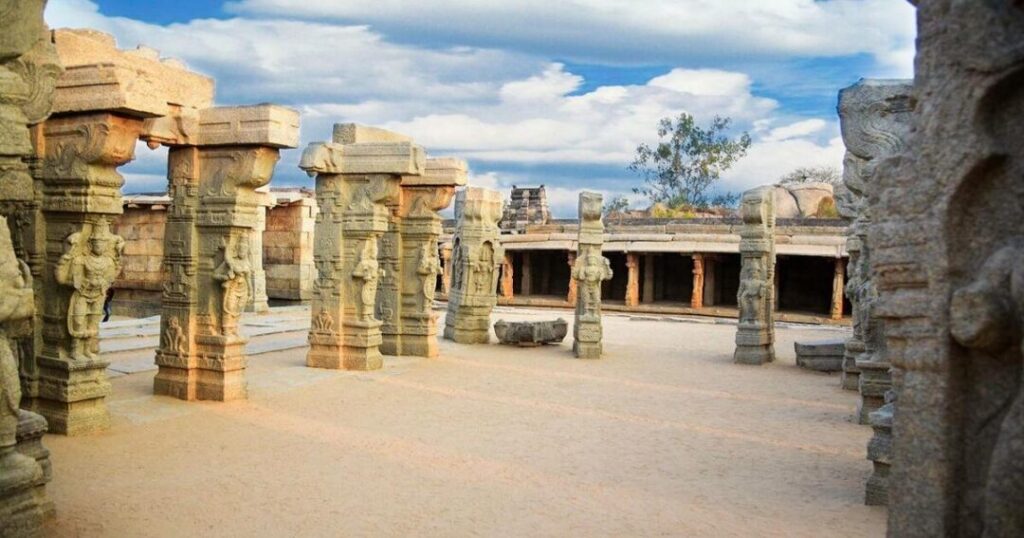
The Lepakshi mandir — formally the Veerabhadra Swamy Temple — was constructed during the reign of the Vijayanagara emperor Achyuta Deva Raya, with most accounts dating its main construction to somewhere between 1530 and 1542 CE. [STAT: The temple was built over roughly a decade during the reign of Vijayanagara emperor Achyuta Deva Raya, in the early-to-mid 1500s CE.]
It wasn’t commissioned by a king, but by two brothers: Virupanna Nayaka and Viranna Nayaka, local governors serving under the Vijayanagara administration. That detail matters, because it shapes everything that happens next. This was a temple built by ambitious regional officials, not royal decree — and ambition without royal sign-off, in the Vijayanagara bureaucracy, came with real risk attached.
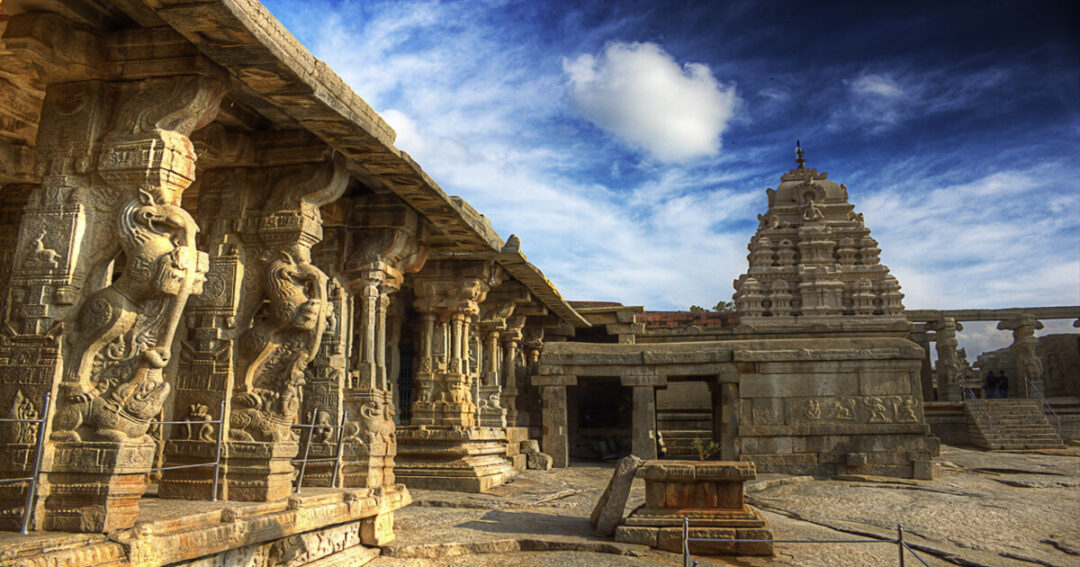
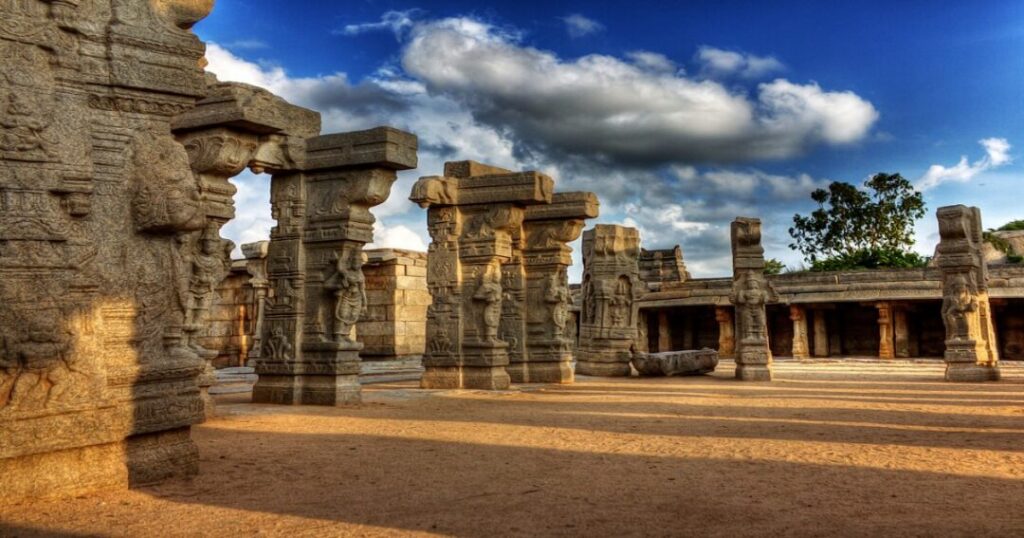
Architecturally, the temple sits low, spread horizontally rather than soaring vertically the way many South Indian temples do — built directly onto a rocky hillock shaped, according to local belief, like a tortoise. Roughly 70 carved pillars support its mandapas, each one worked with a density of detail that makes it clear the Vijayanagara sculptors treated stone the way other traditions treated palm-leaf manuscripts: as something meant to be read, not just admired.
Also Read: Top 10 Things to Do in Bhubaneswar: Temples, Caves & Day Trips
The Tragic Legend of Virupanna and the Unfinished Kalyana Mandapam
This is the part of Lepakshi’s story that people remember longest, and for good reason.
As the temple neared completion, the emperor reportedly returned from a military campaign to find the royal treasury depleted. The suspicion fell on Virupanna and Viranna — the belief being that treasury funds had been diverted, without sanction, to finish the temple. When the emperor learned of this, he ordered that Virupanna be blinded as punishment.
Rather than wait for that sentence to be carried out, Virupanna is said to have gouged out his own eyes and hurled them at the temple’s outer wall — an act of preemptive, defiant devotion rather than passive punishment. Locals still point to reddish-brown streaks on the temple’s exterior wall as the bloodstains from that moment. Whether those marks are mineral staining or something more deliberately preserved as folklore is impossible to say with certainty, but the story is told at Lepakshi with the same weight as scripture, not as a footnote.
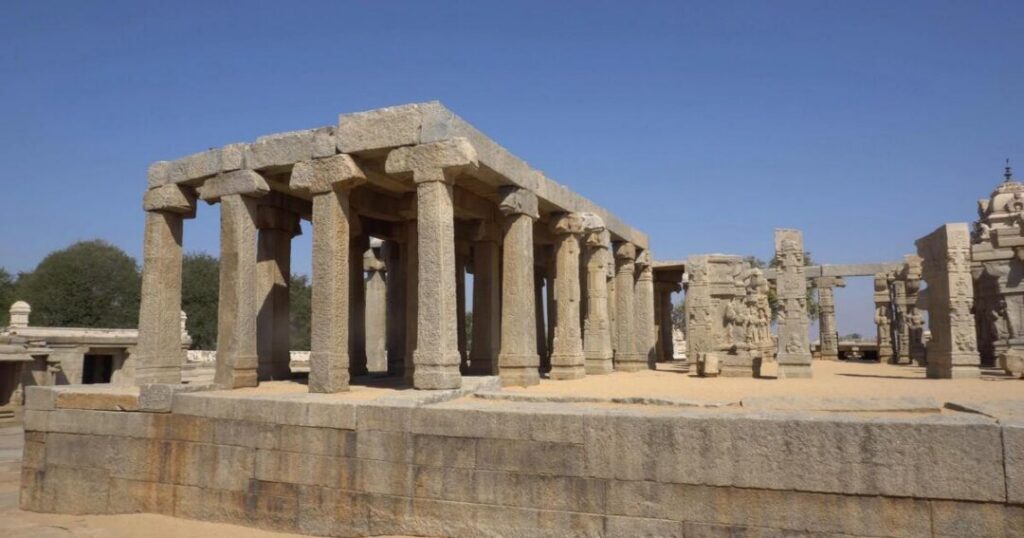
Construction stopped almost immediately after. The temple’s Kalyana Mandapam — a grand pavilion begun to commemorate the celestial marriage of Shiva and Parvati — was left unfinished, its pillars and carvings frozen mid-sentence. It remains that way today: a hall you can walk through and watch Vijayanagara ambition simply stop, pillar by pillar, exactly where the story says it stopped.
The Lepakshi Nandi: India’s Largest Monolithic Bull
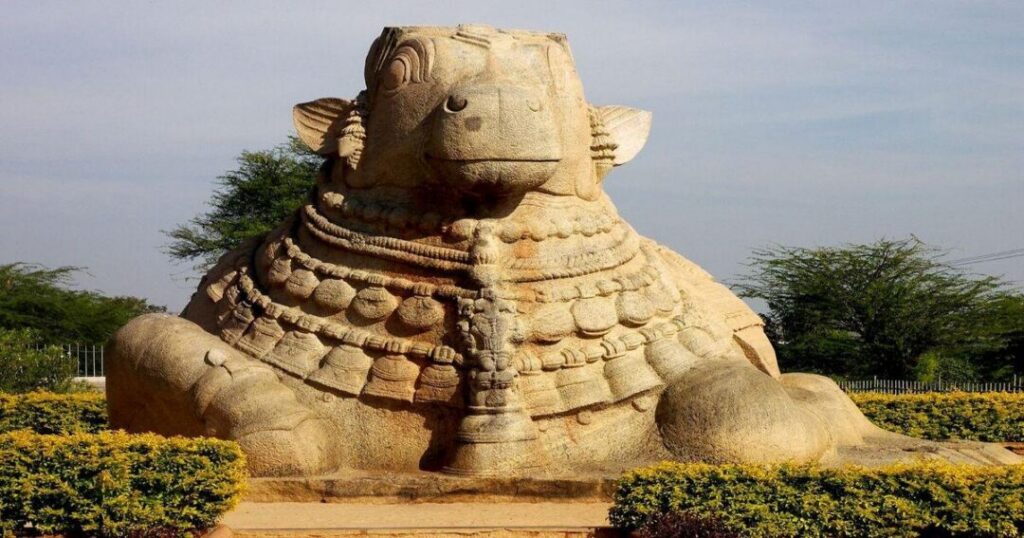
Walk a short distance from the main shrine and you’ll meet the Lepakshi Nandi — a single, uncut block of granite carved into a seated bull, and widely cited as the largest monolithic Nandi statue in India. [STAT: The Lepakshi Nandi is commonly described as India’s largest monolithic Nandi and the second-largest monolithic sculpture in the country overall, after the Gomateshwara statue at Shravanabelagola.]
Estimates on its exact dimensions vary slightly by source — figures of roughly 4.5 metres in height and just over 8 metres in length are commonly cited — but the scale is unmistakable in person in a way no measurement fully captures. There’s no plinth trick here, no forced perspective: it’s one stone, shaped entirely by hand and chisel, sitting in open air exposed to five centuries of monsoons.
Practically, this is one of the easiest highlights to fit into a short visit since it sits along the main walking route rather than tucked away — most visitors reach it within the first 15–20 minutes of entering the complex, and it photographs best in the softer light of early morning or late afternoon, avoiding the flat glare of midday.
Also Read: Places to Visit in Shirdi: 10 Best Attractions In and Around the Temple Town
The Hanging Pillar of Lepakshi Temple: A 500-Year-Old Engineering Mystery
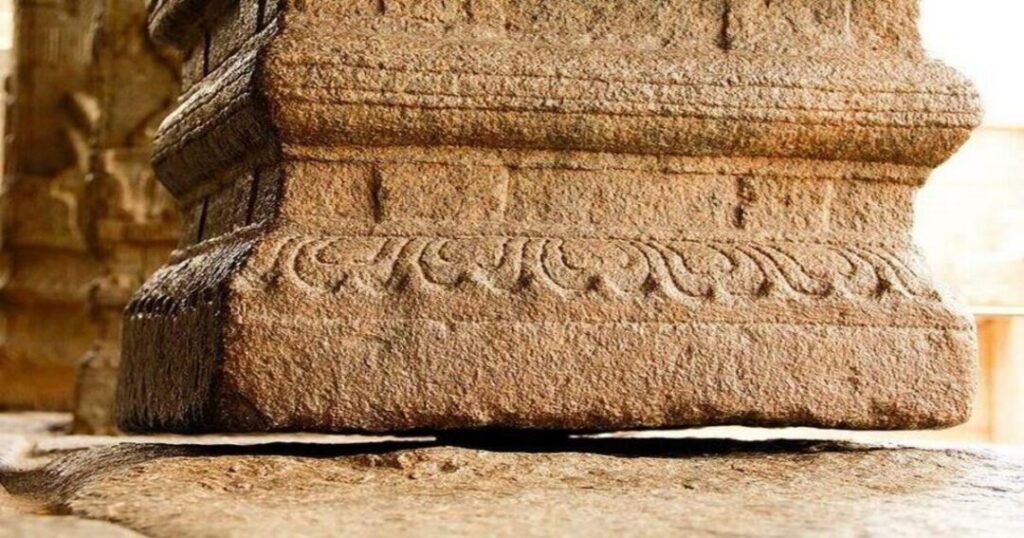
No feature has generated more curiosity — or more legend — than the hanging pillar at Lepakshi. Among the temple’s roughly 70 carved pillars, one appears to hover just above the floor, its base barely making contact with the ground beneath it. For generations, visitors have tested it themselves — sliding a piece of cloth or a sheet of paper underneath to prove the gap is real, not an optical illusion.
The most repeated story behind this Lepakshi hanging pillar involves a British engineer during the colonial period, who reportedly tried to determine what was holding the pillar up by attempting to shift it with a lever. The attempt didn’t reveal the pillar’s secret — but it’s said to have nudged the pillar slightly out of its original alignment, and possibly disturbed neighboring beams in the process. Whether that account is verified history or an add-on to the legend over time, it’s the version told at the site today, and it’s part of why some structural purists argue the pillar sits at a very slight angle now rather than perfectly level.
What’s not folklore is the underlying engineering achievement: Vijayanagara builders working without modern load calculations managed to construct a Lepakshi temple hanging pillar that has held its position, largely undisturbed, for roughly five centuries — a genuine testament to craftsmanship that still hasn’t been fully explained by structural historians.
Also Read: Tourist Places In Odisha: Temples, Beaches, Wildlife, And Hidden Gems
Lepakshi Painting: Inside the Ceiling Murals of the Natya Mandapa
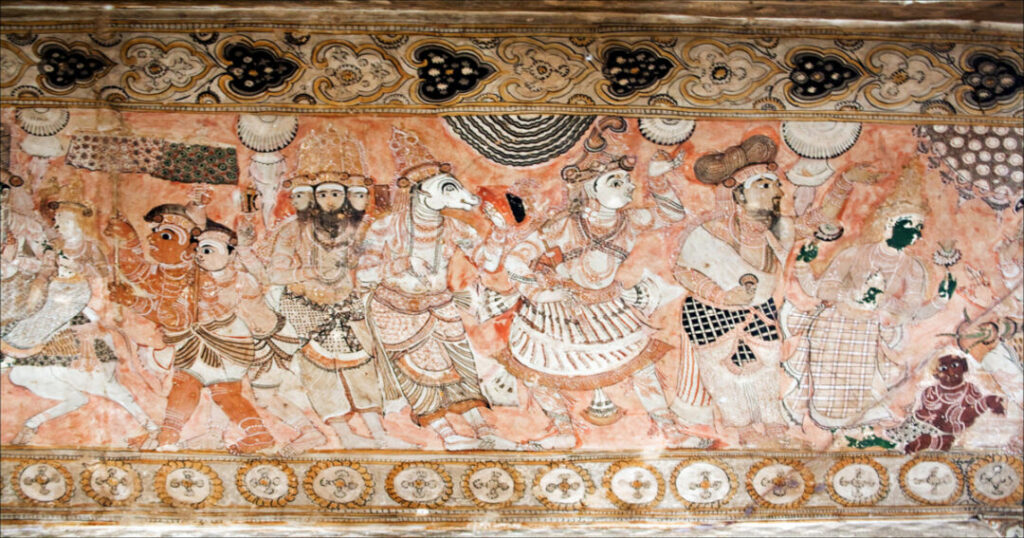
If the hanging pillar is Lepakshi’s engineering puzzle, its Lepakshi painting is its artistic crown. The ceiling of the Natya Mandapa carries what art historians widely regard as one of the largest and best-preserved ensembles of Vijayanagara-period mural painting anywhere in South India.
The centerpiece — a panel depicting a colossal figure of Veerabhadra flanked by the temple’s donor, Virupanna, and his wife — is frequently cited as measuring roughly 24 by 18 feet, sometimes described as among the largest single mural compositions surviving from the period. [STAT: The central Veerabhadra panel on the Natya Mandapa ceiling is commonly measured at approximately 24 x 18 feet, making it one of the largest surviving Vijayanagara-era mural compositions in South India.]
What makes these murals remarkable isn’t just scale — it’s material. The pigments were made entirely from natural sources: vegetable extracts, limestone, clay, mud, and dyes drawn from leaves and fruit. No synthetic binders, no imported minerals. That these colors have survived roughly 500 years of humidity, temple smoke, and monsoon air is itself a small miracle of historical material science, and it’s a large part of why conservationists treat the Natya Mandapa ceiling with the same seriousness given to far more famous cave-painting sites elsewhere in India.
The Three-Headed Nagalinga and the Temple’s Other Carved Wonders
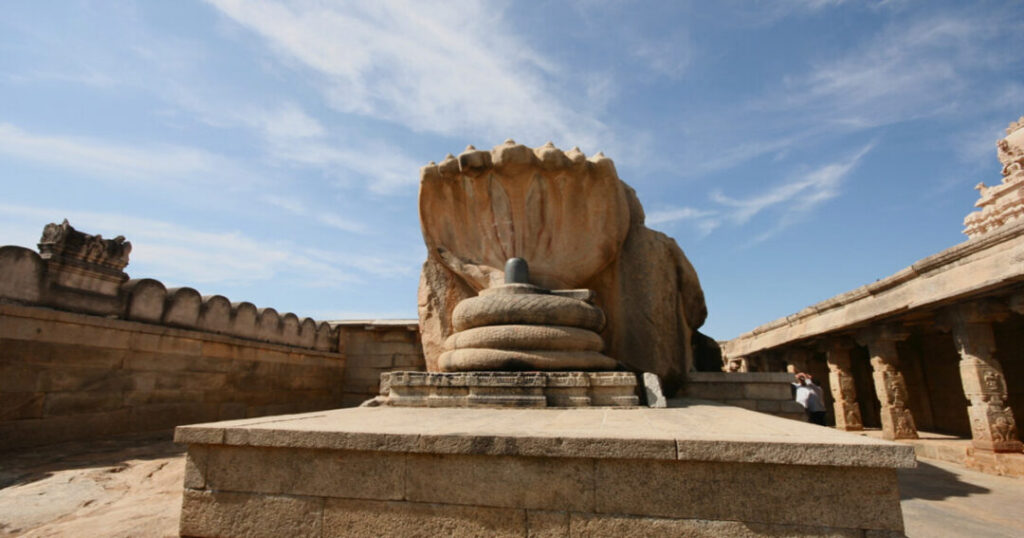
Tucked within the temple grounds is another single-stone achievement that tends to get overshadowed by the Nandi and the hanging pillar: a massive Nagalinga, carved from one uninterrupted block of granite, showing a serpent with three coils and seven raised hoods sheltering a Shivalinga beneath them. Estimates put its height at close to 27 feet.
The temple’s own oral tradition tells a far more human story behind it: that the sculptors carved the Nagalinga simply to pass the time while waiting for a meal to be prepared — a detail that, true or not, says something about the sheer surplus of skill on site during Lepakshi’s construction. When idle hands produce a 27-foot single-stone serpent as a way of killing time, it tells you how deep the talent pool working on this temple really was.
The Lepakshi Eagle Statue: Where Ancient Legend Meets a Modern Landmark
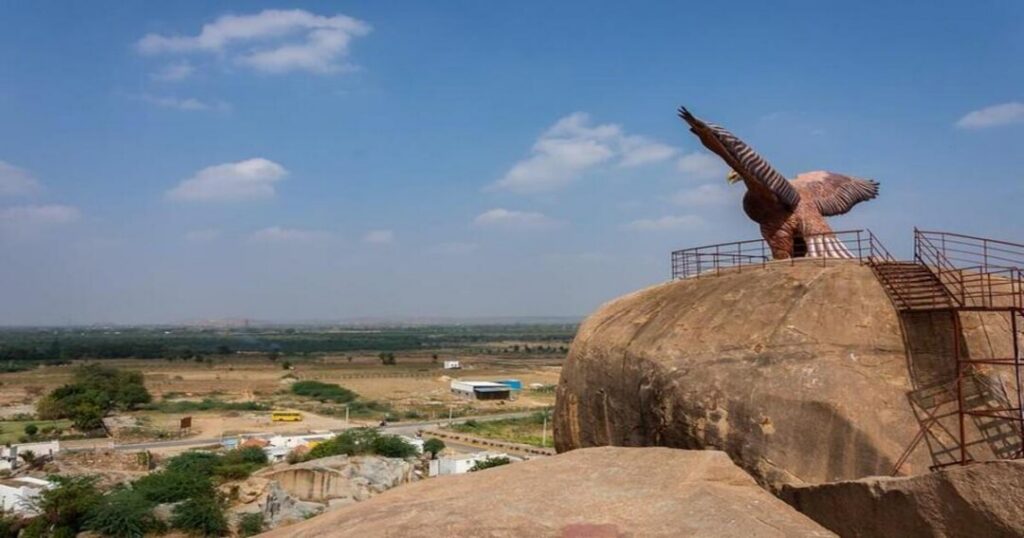
It’s worth drawing a clear line here, because it’s easy to conflate two different things: the Lepakshi eagle statue most visitors photograph today is not a 500-year-old temple carving — it’s a modern addition, inaugurated in 2020 as part of a dedicated Jatayu-themed park near the temple complex. The sculpture depicts Jatayu mid-battle, wings fully spread, carved from a single block of stone reportedly weighing around 320 tonnes before carving brought it down to roughly 140 tonnes.
What connects it to the temple’s ancient story is the legend itself, not its age — this modern statue gives physical form to the same Jatayu-Rama moment believed to have given Lepakshi its name in the first place. It’s a good stop if you have the extra time, but it’s a separate, contemporary attraction rather than part of the original Vijayanagara temple structure, and it’s worth knowing that distinction before you go in expecting a 16th-century carving.
Also Read: 10 Most Famous Temples in Bhutan
What is the Best Time to Visit Lepakshi Temple?
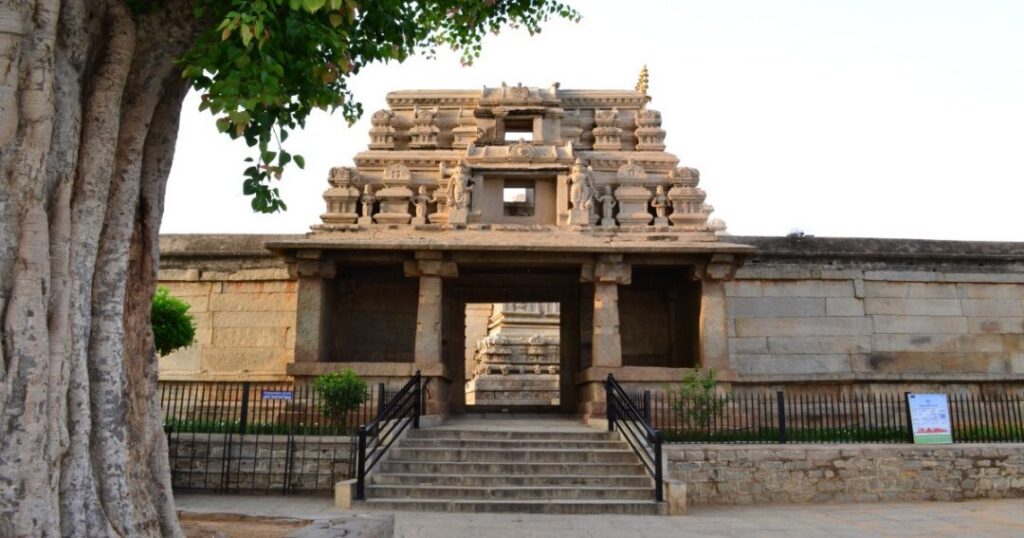
Lepakshi is a stone temple with almost no shaded walking stretches between its main features, so timing your visit around Andhra Pradesh’s heat matters more than it might elsewhere. The most comfortable window is October through February, when daytime temperatures are markedly cooler and the stonework — especially the open courtyard around the Nandi — doesn’t turn into a heat trap by midday.
If you’re set on visiting during the hotter months, an early-morning arrival right at opening is the better trade-off than a late-afternoon one. Not sure how to fit Lepakshi into a wider Andhra Pradesh or South India itinerary alongside your travel dates? NIVU AI, Explurger’s in-app planning assistant, can weigh this against the rest of your trip and give you a more personalized answer than a generic “best time to visit” list would.
How to Reach Lepakshi Temple?
Lepakshi sits close enough to Bengaluru to work well as a day trip, and far enough from Hyderabad that it’s better folded into a longer Andhra Pradesh itinerary than treated as a quick detour.
- From Bengaluru: Approximately 120 km, largely along the Bengaluru–Hyderabad highway with a short detour of around 15–16 km off the main road.
- From Hyderabad: Approximately 480 km by road — a long haul best combined with other stops rather than attempted alone.
- By rail: Hindupur is the nearest railway station, roughly 14 km from the temple, well connected to both Bengaluru and Hyderabad.
- By air: Sri Sathya Sai Airport in Puttaparthi is the nearest airport, around 58 km away.
Temple hours run from 6 AM to 6 PM daily, with no entry fee, though timings can shift around major festivals like Shivaratri. Most visitors budget 2.5 to 3 hours to see the Nandi, the hanging pillar, the murals, and the Kalyana Mandapam without rushing.
Conclusion About Lepakshi Temple
Few temples pack this much unresolved history into one complex — a name with two competing origin stories, a pillar that still puzzles engineers, and a founding legend that ends in genuine tragedy rather than tidy triumph. That’s what makes Lepakshi Temple worth the detour, whether you’re coming from Bengaluru for the day or building it into a longer Andhra Pradesh route. Add it to your Explurger Bucket List while you’re planning, and once you’ve walked its 500-year-old courtyards yourself, log it as an Explurge-in — your Automatic Travelogue will keep it mapped alongside every other heritage stop you’ve made. Let Explurger help you plan the trip and remember it afterwards.
FAQs About Lepakshi Temple
2. Why is it called Lepakshi Temple?
There are two competing traditions behind the name. One ties it to the Ramayana, where Rama is said to have told the dying eagle Jatayu to "rise" — "Le Pakshi" in Telugu — after finding him wounded at this spot following his battle with Ravana. The other traces the name to "Lepa-akshi," referencing a blinded eye, connected to the later legend of Virupanna's self-inflicted blinding. Both explanations are told locally, and neither has been established as definitively correct over the other.
3. What is the story of the hanging pillar at Lepakshi Temple?
Among the temple's roughly 70 carved pillars, one has a base that barely touches the ground, allowing a sheet of paper or cloth to be slid underneath it — a test generations of visitors have tried themselves. Local legend holds that a British engineer, during the colonial era, attempted to discover what supported the pillar by shifting it with a lever, and in doing so nudged it slightly out of its original position without ever solving the mystery. The pillar has remained standing in its near-suspended state for roughly five centuries regardless.
4. What happened to Virupanna, the man who built Lepakshi Temple?
Virupanna, along with his brother Viranna, commissioned the temple's construction as local governors under the Vijayanagara Empire. When the emperor discovered the royal treasury depleted after returning from a campaign, suspicion fell on the brothers for allegedly using those funds without sanction. Rather than face the ordered punishment of blinding, Virupanna reportedly gouged out his own eyes and threw them at the temple's outer wall — an act still referenced today through reddish stains visible on the exterior. Construction on the temple's Kalyana Mandapam stopped almost immediately afterward and was never completed.
5. How big is the Lepakshi Nandi statue?
The Lepakshi Nandi is carved from a single block of granite and is commonly cited at roughly 4.5 metres in height and just over 8 metres in length, though exact figures vary slightly across sources. It's widely described as the largest monolithic Nandi statue in India and is often ranked as the second-largest monolithic sculpture in the country overall, after the Gomateshwara statue at Shravanabelagola.
6. Is the Lepakshi eagle statue part of the original temple?
No — the large eagle statue most visitors photograph today, depicting Jatayu with wings spread, is a modern addition inaugurated in 2020 as part of a dedicated theme park near the temple complex. It represents the same Jatayu-Rama legend tied to the temple's name, but it isn't part of the 16th-century Vijayanagara structure itself, so it's worth treating it as a separate, contemporary stop rather than an ancient carving.