
1,384 Total Views
Applying for a Schengen visa for Indians means dealing with one application that covers 29 different countries—which is exactly what makes it more confusing than a single-country tourist visa. Indian applicants face a fairly standardized process (a €90 fee, a document checklist heavier on financial proof than most other visas, and a 15-20 working day turnaround through VFS Global), but the details that trip people up are usually the same: which country’s embassy to actually apply through, what counts as acceptable financial proof, and which of the 29 member states are even covered by a single visa. This guide walks through all of it.
Complete Schengen Visa Requirements for Indians
A Schengen visa application from India comes down to four things: confirming you actually need one, assembling the document checklist, paying the right fees, and avoiding the mistakes that most commonly trigger a rejection.
Who Needs a Schengen Visa?
Indian passport holders need a Schengen visa for any short trip to the Schengen Area for tourism, business, or family visits—India does not hold visa-free or visa-on-arrival status with the Schengen zone. The standard short-stay visa (Type C) permits stays of up to 90 days within any 180-day period across all 29 member countries on a single visa.
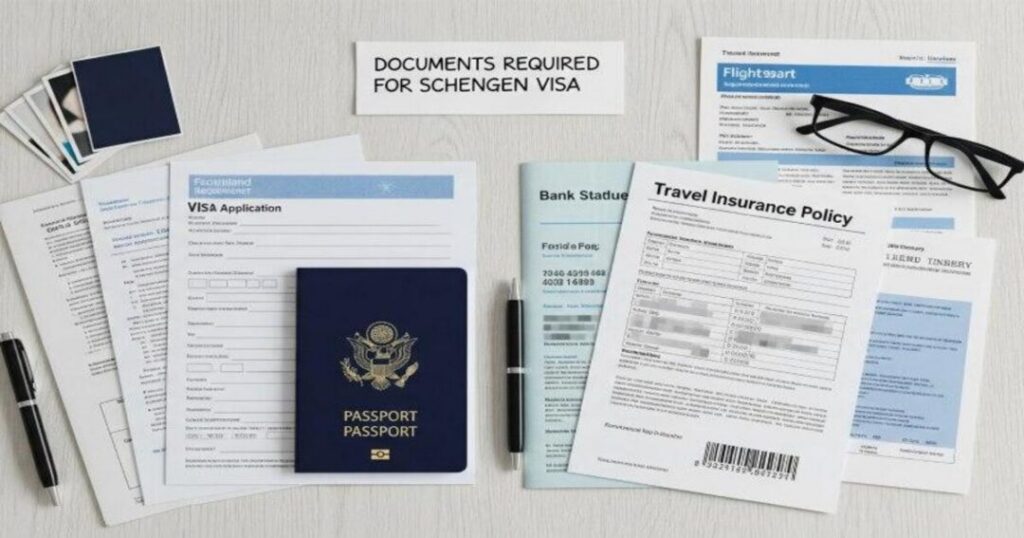
Document Checklist
[STAT: a complete Schengen visa application from India requires a passport valid 3+ months beyond the return date with 2+ blank pages, two ICAO-standard biometric photos (35x45mm), 3-6 months of stamped bank statements, 2-3 years of ITR-V or Form 16, a salary/employment NOC and payslips (or GST and business documents for the self-employed), refundable flight and hotel bookings, a day-by-day itinerary, mandatory travel insurance with at least €30,000 medical coverage, and a one-page cover]
- Bank statements need to be on letterhead with a stamp on every page—unstamped or informally exported statements are one of the most common reasons applications get sent back for resubmission.
- Employment documentation must show a consistent salary figure across payslips, bank credits, and the NOC letter; mismatched numbers across these documents raise red flags with visa officers.
- Travel insurance is non-negotiable—it must cover at least €30,000 in medical expenses, including repatriation, and be valid across the entire Schengen Area for the full length of the trip, not just the primary destination country.
Fees and Processing Time
[STAT: the Schengen visa fee is a uniform €90 for adults (12+) and €45 for children aged 6-11, roughly INR 9,100-10,100 and INR 4,600-5,100, respectively, with children under 6 exempt; on top of this, VFS Global service charges add INR 1,933-3,111 depending on the destination country, plus biometric enrollment fees of INR 600-1,000—bringing a typical adult applicant’s total cost to roughly INR 11,000-15,000]
- Standard processing takes 15-20 working days from the appointment date, though this can extend during peak travel seasons (summer, December)—most guidance recommends applying at least a month before intended travel.
- All fees paid at the VFS appointment, including the embassy fee itself, are non-refundable regardless of whether the visa is approved or rejected.
Common Reasons for Rejection
Beyond unstamped bank statements and mismatched salary figures, generic or templated cover letters and an ITR filed without a valid acknowledgement number are among the most frequently cited rejection triggers for Indian applicants. Since Indian applications tend to draw more financial scrutiny than applications from several other nationalities, treating the document checklist as a minimum rather than a target is generally the safer approach.
Schengen Countries Visa from India: Which Embassy to Apply To?

A Schengen countries visa from India application has to go through one specific country’s embassy or consulate, even though the resulting visa works across all 29 states—and choosing the wrong one isn’t just a formality issue; it can result in an automatic rejection.
- Main destination rule: if your trip has one clear primary country—measured by the most nights spent there or the main purpose of travel (a business conference, for instance, can override a longer leisure stay elsewhere)—you apply through that country’s embassy or consulate.
- First entry point rule: if there’s no single main destination (say, an equal number of nights split across three countries for pure sightseeing), you apply through the embassy of the country you’ll physically enter the Schengen Area through first.
- “Visa shopping”—deliberately applying through a country with faster processing or perceived easier approval rather than your actual main destination or entry point—is explicitly flagged by Schengen authorities and results in automatic denial with no fee refund.
- Once issued, the visa itself isn’t restricted to the country that issued it—a French-issued Schengen visa lets you enter through any member state’s border—but land border officers can and do question inconsistencies between your stated itinerary and actual entry point.
Also Read: Visa-Free Countries for Indians in 2026 | Budget International Travel Guide for Young Explorers
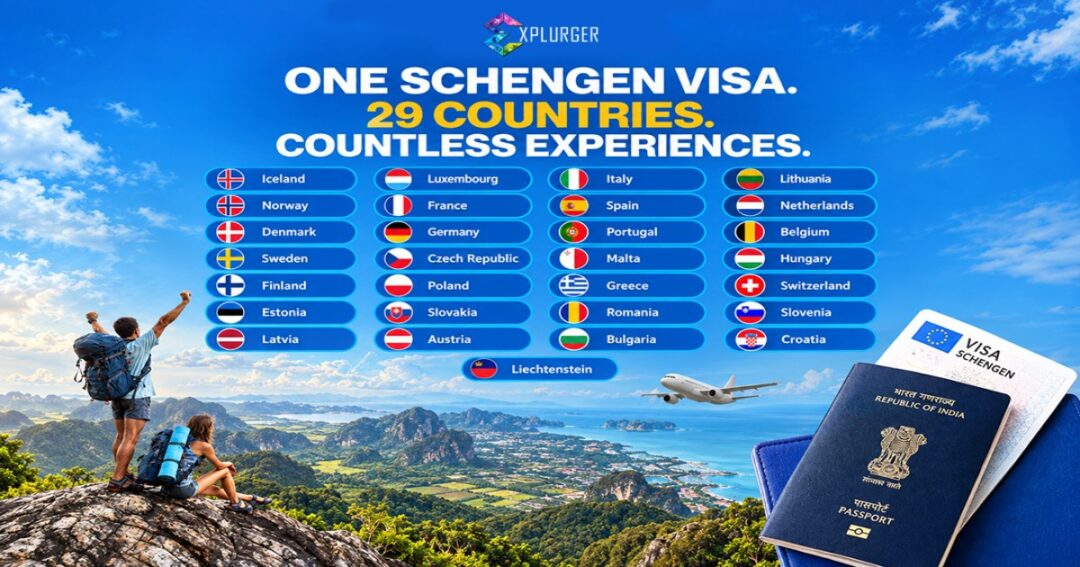
Schengen Area Countries: The Full List of 29 Members

[STAT: as of 2026, the Schengen Area comprises 29 countries—25 EU member states (Austria, Belgium, Bulgaria, Croatia, Czechia, Denmark, Estonia, Finland, France, Germany, Greece, Hungary, Italy, Latvia, Lithuania, Luxembourg, Malta, the Netherlands, Poland, Portugal, Romania, Slovakia, Slovenia, and Spain) plus 4 non-EU members (Iceland, Norway, Liechtenstein, and Switzerland); Bulgaria and Romania completed full integration, including lifting internal land border controls, on 1 January 2025]
A single visa application covers every one of these Schengen countries, which is the entire point of the Schengen Area countries system—no need for 29 separate visas to see the whole zone on one trip. Two notable EU members sit outside this list: Cyprus, which remains in the final phase of Schengen accession and isn’t a full member as of 2026, and Ireland, which maintains a permanent opt-out as part of the UK-Ireland Common Travel Area—a standard Schengen visa does not cover either of these.
Types of Schengen Travel Visas
[STAT: a Schengen travel visa comes in three main categories—Type A (airport transit, valid 24 hours, needed only when changing planes within a Schengen airport without officially entering the country), Type C (the standard short-stay visa for up to 90 days within any 180-day period, issued as single-entry, double-entry, or multiple-entry), and Type D (a national long-stay visa for stays over three months, tied to one issuing country and typically requiring a residence permit on arrival)]
- Most Indian tourists and business travelers apply for a Type C multiple-entry visa, since it allows unlimited entries during its validity as long as total days across all visits stay within the 90/180-day limit.
- A single-entry visa is more restrictive than it sounds—once you exit the Schengen Area, re-entry is not permitted even if unused days remain on the original visa duration.
- The 90/180-day rule applies cumulatively across all Schengen countries combined, not per country—spending 45 days in France and 45 in Italy within the same 180-day window still uses up the full 90-day allowance.
Also Read: e-Visa for Indians: Your Complete Guide to Visa-Free, Visa on Arrival & e-Visa Travel
Conclusion: Applying for Your Schengen Visa
Most of what makes a Schengen visa for Indian applications straightforward or stressful comes down to preparation rather than luck: stamped bank statements, consistent numbers across every financial document, insurance that actually meets the €30,000 minimum, and applying through the correct embassy based on your real itinerary rather than whichever consulate seems fastest. Get those right, submit at least a month ahead of travel, and one visa opens the door to all 29 member states.
Ready to plan your Europe trip? Download the Explurger app and start building your Schengen itinerary today.
FAQs About Schengen Visa for Indians
2. How long does it take to get a Schengen visa from India?
Standard processing takes 15-20 working days from your VFS appointment date, though this can run longer during peak travel seasons like summer and December — most guidance recommends applying at least a month before your intended travel date.
3. Which Schengen country should I apply through if I'm visiting several?
Apply through the embassy of your main destination — the country where you'll spend the most nights, or your primary purpose of travel. If there's no clear main destination, apply through the embassy of whichever country you'll physically enter the Schengen Area through first.
4. How many countries are in the Schengen Area?
29 countries as of 2026 — 25 EU member states plus Iceland, Norway, Liechtenstein, and Switzerland. Cyprus is in the final phase of accession but isn't a full member yet, and Ireland maintains a permanent opt-out.
5. What documents are required for a Schengen visa from India?
Core requirements include a passport valid 3+ months beyond your return date with 2+ blank pages, biometric photos, 3-6 months of stamped bank statements, 2-3 years of ITR, employment proof (NOC and payslips, or business documents for the self-employed), refundable flight and hotel bookings, a day-by-day itinerary, and travel insurance with at least €30,000 medical coverage.
6. What is the difference between a single-entry and multiple-entry Schengen visa?
A single-entry visa allows only one entry into the Schengen Area — once you exit, you cannot re-enter even with unused days remaining. A multiple-entry visa allows unlimited entries during its validity, as long as your total days across all visits stay within the 90-day limit in any 180-day period.