
892 Total Views
Most trekkers have Lohagad on their list. It’s close to Pune, it’s doable in a day, and the fort at the top has views that make every step worth it. But if you’ve started researching and hit a wall of conflicting answers — How hard is it really? Can I do it at night? How long will it take? — You’re in the right place.
The Lohagad trek is one of the most popular fort treks in the Sahyadri ranges of Maharashtra, sitting at an elevation of 1,033 metres above sea level. It’s beginner-friendly, stunning in the monsoon, and one of the few treks near Pune that works equally well for families, solo trekkers, and large groups.
This lohagad trek guide covers everything: the two starting points, the real difficulty level, fees, how long it actually takes, what you need to know about the night trek, group logistics, and the fort’s full history — with nothing glossed over.
Lohagad Trek Route — From Base Village to the Summit
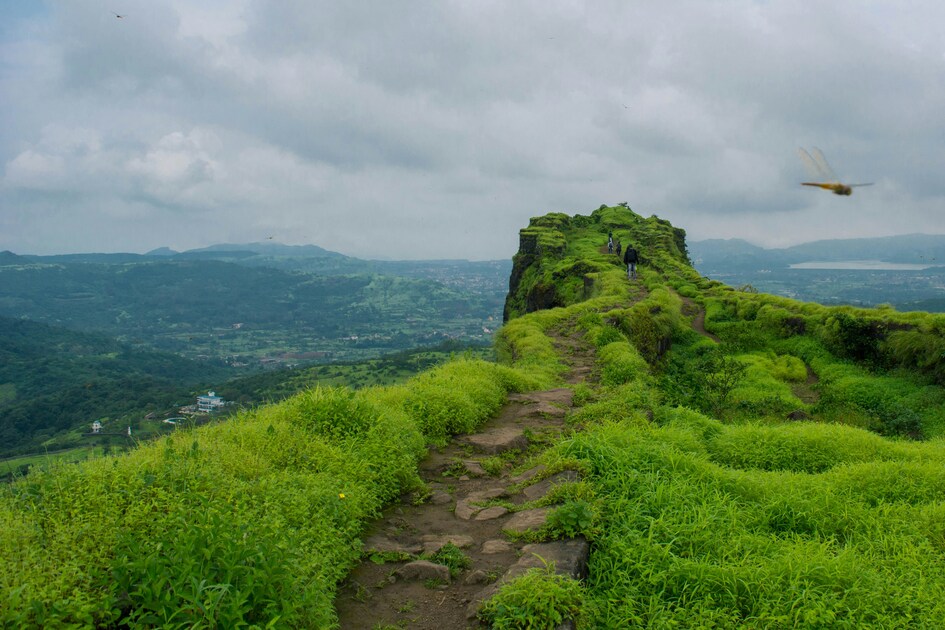
The trail is one of the most straightforward fort climbs in Maharashtra — almost entirely stone stairs, no confusing forks, no technical sections. Here’s what to expect:
Starting Point: Lohagadwadi Village
The trek begins at the Lohagadwadi village parking area, where you’ll find small food stalls, drinking water points, and local vendors. The path is clearly marked and easy to follow without a guide.
Fees: A nominal road or parking charge of around ₹25 per vehicle applies at the base — carry cash. Some sources also mention a small per-person entry fee collected partway up the trail. Either way, budget ₹25–50 per person and carry cash to avoid any hassle. Confirm the current fee structure locally, as this has changed in recent years.
The Trail Breakdown
The climb from Lohagadwadi parking to the fort summit is approximately 1.5–2 km of stone stairs — not steep mountain trekking but a steady, well-paved staircase ascent:
- Lower section: Broad, well-worn path from the village through light forest. Gentle incline. Easy walking pace.
- Middle section: Stone stairs begin. The path narrows slightly and you pass small juice and snack stalls — stock up here as there is nothing to eat or drink inside the fort itself.
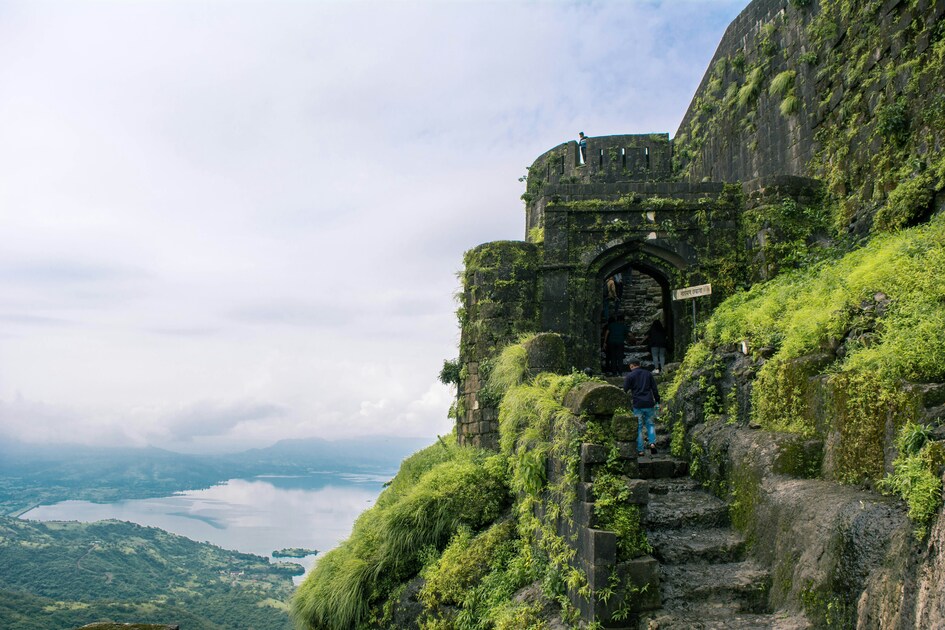
- Upper section (final push): The four successive fort gates — Ganesh Darwaza, Narayan Darwaza, Hanuman Darwaza, and Maha Darwaza — each separated by short flat stretches. The gates are deliberately small and angled to slow attackers. This is the most historically exciting section of the climb.
Key Landmarks on the Route and Fort
- Vinchu Kata (Scorpion’s Tail): A dramatic fortified spur jutting out from the fort’s northwest side, shaped like a scorpion’s tail. Walk to the edge for unobstructed 180-degree views of Pawna Lake and surrounding forts, including Tikona and Tung. Note: the descent to Vinchu Kata has a slightly rocky stretch that gets slippery in the monsoon — take care. Allow 15–20 minutes extra for the walk out and back.
- Lakshmi Kothi: A cave on the fort used by Shivaji Maharaj as a secure treasury to store the famous spoils from the sack of Surat. One of the most historically significant spots you’ll visit.
- Lomesh Rishi Cave: A spacious rock-cut cave adjacent to the main fortification — worth a quick look.
- Dargah near Maha Darwaza: An Islamic prayer area located close to the main gate — a quiet landmark that reflects the fort’s layered history under multiple dynasties.
- Bhaja Caves: Buddhist rock-cut caves (2nd century BCE) located approximately 3–4 km from Malavli station — a great add-on to your trek day.
Also read: Exploring Best Beach Destinations in India that are Hidden and Offbeat
What is the Best Time to do Lohagad Trek?
- Monsoon (June–September): The most popular window. The fort turns electric green, waterfalls appear on the hillside, and clouds sit right at fort level. Trails get slippery — grip shoes are non-negotiable.
- Post-Monsoon / Winter (October–February): Clear skies, comfortable temperatures (15–25°C), and excellent visibility from the top. The best season for photography and first-timers.
- Summer (March–May): Doable but hot. Start before 7 AM if trekking in summer. Carry at least 2 litres of water per person.
Avoid: Trekking immediately after heavy overnight rain — the stone steps become dangerously slick.
Fort Timings: Lohagad Fort is open daily from approximately 9 AM to 6 PM (some sources cite 8 AM — confirm locally before your visit as timings can vary by season). The gates close by evening — plan your ascent accordingly.
How to Reach Lohagad?
Two Starting Points — Know the Difference
This is something most lohagad trek guides skip over, and it causes the most confusion:
- Lohagadwadi Village — the base village right at the foot of the fort stairs. If you drive, this is where you park and start your climb.
- Malavli Railway Station — the nearest train station, about 5–6 km from Lohagadwadi. Many trekkers walk this stretch or take shared autos/jeeps from the station to the base.
By Road from Pune: ~52 km via the Mumbai–Pune Expressway; take the Talegaon exit, then follow signs toward Malavli / Lohagadwadi. Drive time: approximately 1.5 hours.
By Road from Mumbai: ~95–100 km via NH48; take the Khopoli or Talegaon exit. Drive time: approximately 2–2.5 hours.
From Lonavala: Lohagad is approximately 11–16 km from Lonavala. Many trekkers base themselves in Lonavala and hire a cab or take a shared vehicle to the base. It’s a 20–30 minute drive.
By Train: Take any local train from Pune toward Lonavala and get off at Malavli Station (Central Line, Pune–Mumbai route). On weekends, shared autos and jeeps are available from the station to Lohagadwadi — roughly ₹40–60 per person. On weekdays, you may need to walk the 5–6 km or pre-arrange transport.
Nearest Airport: Pune International Airport — approximately 55–60 km by road. Private cab is the most practical option.
By ST Bus: State transport buses run from Pune’s Shivajinagar and Swargate stands to Kamshet or Malavli. From there, local transport connects to Lohagadwadi.
Lohagad Fort Trek Difficulty — What to Realistically Expect?
Overall Difficulty Rating
Easy. The Lohagad fort trek is rated as one of the easiest in Maharashtra — and that rating is accurate. The entire ascent from Lohagadwadi is essentially a staircase climb of around 300 steps. Once inside the fort, the plateau is flat and easy to walk around.
There are no steep switchbacks, no scrambling, and no route-finding required. If you can climb 300 stairs comfortably, you can do this Lohagad fort trek without any training or preparation.
Terrain Profile
- Majority of trail: Stone-paved steps and packed dirt path — stable in dry conditions
- One slightly rocky section: The descent toward Vinchu Kata — manageable with care, slippery in the monsoon
- Monsoon caveat: Wet stone steps become slippery across the entire trail. Grip shoes are essential from June to September.
Who Should Attempt It
| Trekker Type | Can Do It? | Notes |
| First-time trekker | ✅ Yes | No experience needed whatsoever |
| Kids (6+ years) | ✅ Yes | Families do this regularly |
| Senior adults (60+) | ✅ With care | Take your time on the steps |
| Fitness enthusiasts | ✅ Easy | Combine with Visapur Fort for a full day |
Also read: Hidden Weekend Getaways from Mumbai for Explorers Who Hate the Obvious
Lohagad Trek Time — How Long Does It Take?
The Lohagad trek time depends entirely on which starting point you use — this is where most guides mislead people by giving a single number without context.
Starting from Lohagadwadi Village (if you drive)
- Parking at Fort Summit: 15–45 minutes, depending on your pace
- Time exploring the fort + Vinchu Kata: 1.5–2 hours
- Descent: 20–30 minutes
- Total time at the site: 2.5–3.5 hours
Starting from Malavli Railway Station (if you take the train)
- Station to Lohagadwadi: ~5–6 km uphill walk, approximately 1.5–2 hours (or 15 minutes by shared auto)
- Lohagadwadi to fort summit: 15–45 minutes
- Exploring the fort: 1.5–2 hours
- Return to station: 1.5–2 hours walk (or auto)
- Total on foot: 5–7 hours
Total Trip Duration Summary
| Trek Type | Starting Point | Total Time |
| Quick day trek | Drive to Lohagadwadi | 3–4 hours at the site |
| Full day trek | Walk from Malavli station | 5–7 hours |
| Day trek + Bhaja Caves | Drive to Lohagadwadi | 5–6 hours |
| Night departure (dawn arrival) | Full-day trek | Drive/group bus |
Lohagad Night Trek — What You Need to Know Before You Go?
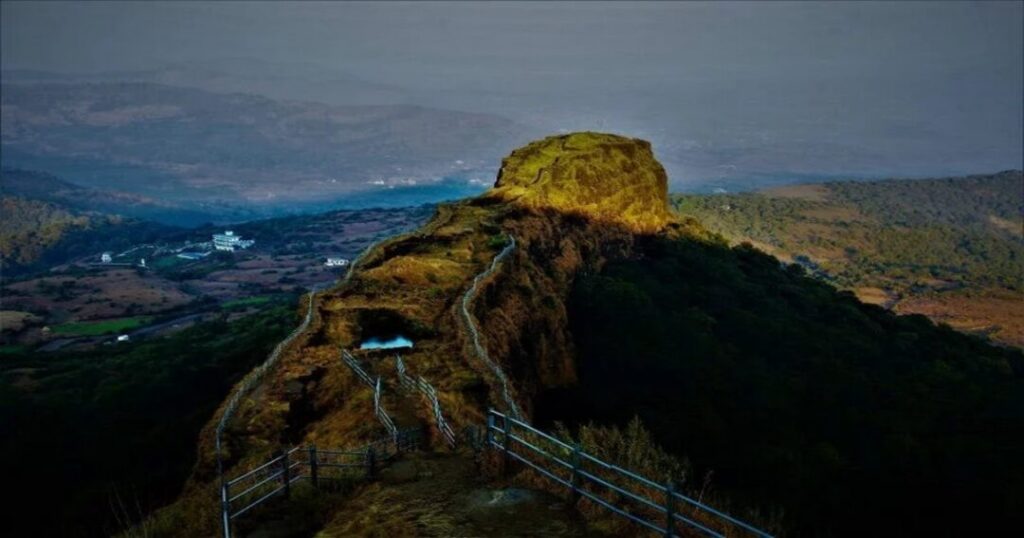
The Lohagad night trek has a strong following among Pune and Mumbai trekkers — and for good reason. Arriving at the fort walls as dawn breaks over the Sahyadri is genuinely one of the most memorable things you can do near Pune.
How Night Trekking at Lohagad Actually Works?
Here’s what most blogs don’t explain clearly: the fort closes by evening, and overnight stays in the fort are banned by the ASI and Forest Department. Camping on the fort is not permitted — fines apply.
What trekking groups actually do is depart from Pune or Mumbai late at night (typically 11 PM–12 AM by bus), reach the Lohagadwadi base by 2–3 AM, begin the climb, and arrive at the fort near dawn when the gates open. You experience the sunrise at the summit, spend time at Vinchu Kata in the early morning light, and descend by mid-morning.
It’s a night-travel-to-dawn-summit experience — not an overnight stay on-fort. This is still one of the most rewarding ways to do the Lohagad fort trek. Just go in with the right expectations, and you won’t be disappointed.
Why the Night Trek Is Worth It?
- Sunrise at Vinchu Kata with mist rolling through the valleys below
- Significantly cooler temperatures than daytime — especially in summer
- Far fewer crowds than weekend afternoons
- The fort walls and gates in early morning light are completely different to midday
Safety Tips for the Lohagad Night Trek
- Always go with a group — solo night arrivals at the base are not safe
- Full moon nights are ideal (October to February) — natural light reduces dependence on torches
- Avoid monsoon night treks — wet stone steps in darkness is a genuine hazard
- Inform someone of your plan and expected return time before you leave
- Download offline maps — there is weak to no mobile signal at the base and on the trail
Night Trek Gear Checklist
- Headlamp + spare batteries
- Windproof jacket (the Fort Plateau gets very cold before dawn in winter)
- Grip trekking shoes
- Minimum 1.5 litres of water per person
- Dry snacks (energy bars, dry fruits)
- Fully charged phone + power bank
- Shared first-aid kit
Lohagad Trek Group — Planning a Group Trip
Lohagad is one of the most group-friendly treks in Maharashtra. The wide staircase trail, easy lohagad trek difficulty, short duration, and proximity to both Pune and Mumbai make it the default pick for college groups, corporate outings, and family day trips.
Best Group Size
The trail handles large groups well. For the best experience, 8–15 people is the sweet spot — easy to manage, cohesive, and fast enough to beat weekend crowds. Groups of 20–30 are common on monsoon weekends, particularly for the night trek.
Group Trek Operators vs Self-Guided
Self-guided: No guide is needed. The route is a clearly marked staircase and locals at the base are always happy to point you in the right direction. Ideal for any group with at least one person who has been before.
Organised Lohagad trek group packages: Several Pune and Mumbai-based operators — Treks and Trails, Dark Green Adventures, Mumbai Pune Adventures, and others — run regular weekend Lohagad slots, especially night trek departures. Packages typically include AC bus transport, a certified trek leader, and basic first-aid support, priced around ₹999–₹1,499 per person.
Group Logistics
- Parking: Lohagadwadi has open parking for 20–30 vehicles. On monsoon weekends, it fills up fast — arrive early or park at Bhaja village and walk.
- Food: Multiple dhabas and stalls at the base serve vada pav, kanda bhaji, chai, and fresh lime soda. Stalls also appear partway up the trail. Nothing is available inside the fort — carry your own water and snacks once you’re past the last stall.
- Restrooms: Available at the base village. None on the trail or inside the fort — plan accordingly.
- Mobile network: Weak to no signal on the trail and on the fort. Download maps offline before departure.
- Fees: Budget around ₹25–50 per person for the road/parking charge and carry cash — no digital payments at the base collection point.
Lohagad Fort History — The Story Behind the Summit
Lohagad Fort’s history stretches back over 2,000 years, passing through the Satavahanas, Chalukyas, Rashtrakutas, Yadavas, Bahamanis, Nizams, and Mughals before its most celebrated chapter — the Maratha era.
Chhatrapati Shivaji Maharaj captured the fort in 1648 AD, but was forced to surrender it to the Mughals in 1665 AD under the Treaty of Purandar — one of the most painful political compromises of his reign, in which he surrendered 23 forts to the Mughals. He recaptured Lohagad in 1670 AD and immediately put it to use as a secure treasury, storing the famous spoils from the sack of Surat inside the Lakshmi Kothi cave — the same cave you walk past on the fort today.
Later during the Peshwa era, Nana Phadnavis lived on the fort for a period and constructed several structures, including a large water tank and a step-well, both still visible.
The fort’s name means “Iron Fort” in Marathi (Loha = iron, Gad = fort) — a name earned through its near-impregnable position on the Sahyadri plateau. The four successive gates are a masterpiece of Maratha military design: each forces attackers to change direction, break formation, and squeeze through a narrow passage — making even a small defending force devastatingly effective against a larger enemy.
Key facts:
- Elevation: 1,033 metres (3,389 ft) above sea level
- Fort area: Approximately 125 acres
- Protected monument under the Archaeological Survey of India
- Connected to neighbouring Visapur Fort by a small range, both can be combined in a single day for experienced trekkers
Also read: 2026 BUCKET LIST MUST-HAVES: TOP PLACES TO VISIT IN MUMBAI
Traveller’s Experience at Lohagad Trek
“We left Pune at midnight with a group of 14, reached the base by 2 AM, started walking by 2:30. It was cold — really cold — but completely worth it. We were at Vinchu Kata as the sun came up over the valley. By 10 AM, we were on the way back. One of the best trips I’ve done near Pune, and honestly one of the easiest to plan.” — Trekker, Maharashtra Adventure Community
“I was nervous — I hadn’t done any physical activity in months. But the Lohagad fort trek surprised me. It’s basically a very long staircase. I was at the top in under 30 minutes from the parking. Spent two hours exploring. Came down easily. No guide needed.” — First-time trekker, Pune
Final Thoughts: Why Lohagad Should Be Your Next Weekend Trek
The Lohagad trek delivers everything a great Sahyadri experience should — a 2,000-year-old fort with a gripping Maratha history, an easy staircase trail that genuinely anyone can do, spectacular monsoon scenery, and enough layered landmarks to keep you exploring long after you reach the top.
Key takeaways before you go:
- Route: Lohagadwadi parking → stone staircase → four fort gates → fort plateau + Vinchu Kata → back to base
- Difficulty: Easy — approximately 300 steps, flat plateau at the top
- Time: 15–45 mins from parking to summit; 2.5–3.5 hours total at the site
- Fees: ~₹25–50 per person at the base — carry cash
- Timings: Fort open approximately 9 AM to 6 PM — confirm locally; overnight stays not permitted
- Best season: October–February for clear skies; June–September for monsoon drama
- Night trek: A dawn-summit experience, not an overnight — depart Pune by midnight, arrive at fort near sunrise
- Group tip: Book transport early for weekend and night treks — base parking fills fast on full moon nights
Track every trail, log every summit, and find your next Sahyadri adventure with the Explurger app — download it before you go.
Whether you’re planning a solo sunrise hike or a midnight group expedition, the Lohagad fort trek gives you history, views, and a genuine piece of Maharashtra’s Maratha heritage — all within a few hours of Pune.
Pack your shoes. The Sahyadri is calling.
FAQs about Lohagad Trek
2. What is the difficulty level of the Lohagad trek?
The Lohagad trek difficulty is rated Easy. The ascent from Lohagadwadi base is almost entirely stone stairs — there are no steep switchbacks or challenging terrain. The one section that requires a little care is the rocky descent toward Vinchu Kata, which gets slippery during the monsoon. Any person of average fitness can complete the round trip comfortably. Grip shoes are essential during the June–September monsoon window.
3. How long does the Lohagad trek take?
The Lohagad trek time depends on your starting point. From the Lohagadwadi parking area, the climb to the summit takes 15–45 minutes. Including time exploring the fort and walking to Vinchu Kata, the total time at the site is 2.5–3.5 hours. If you take the train to Malavli Station and walk the 5–6 km to the base, add around 2 hours each way. For night trek groups departing Pune around midnight, the return to base is typically by mid-morning.
4. Can I do the Lohagad night trek?
Yes, but it works differently from what many blogs suggest. The fort closes by evening, and overnight stays in the fort are not permitted by the ASI. What trekking groups actually do is depart late at night from Pune or Mumbai, reach the base around 2–3 AM, begin the climb, and arrive at the fort near dawn. You experience the sunrise at the top and descend by mid-morning. Full moon nights between October and February offer the best conditions. Avoid monsoon night treks — wet stone steps in the dark are a genuine safety hazard.
5. What is the entry fee for Lohagad Fort?
A nominal road or parking charge of around ₹25 applies at the Lohagadwadi base — carry cash as no digital payments are accepted. Some sources also mention a small per-person collection at the trail. Budget ₹25–50 per person to be safe and confirm the current arrangement locally, as the fee structure has changed in recent years. Fort timings are approximately 9 AM to 6 PM daily — confirm locally before your visit.
6. What is the best time of year for the Lohagad trek?
Post-monsoon and winter (October to February) offer the best overall conditions — clear skies, cool temperatures of 15–22°C, and excellent visibility from the top and from Vinchu Kata. The monsoon season (June to September) is the most dramatic visually, with green hillsides and clouds at fort level, but the trails are slippery. Summer (March to May) is doable if you start before 7 AM to avoid the heat. The fort is worth visiting year-round — just plan for the season.