
1,614 Total Views
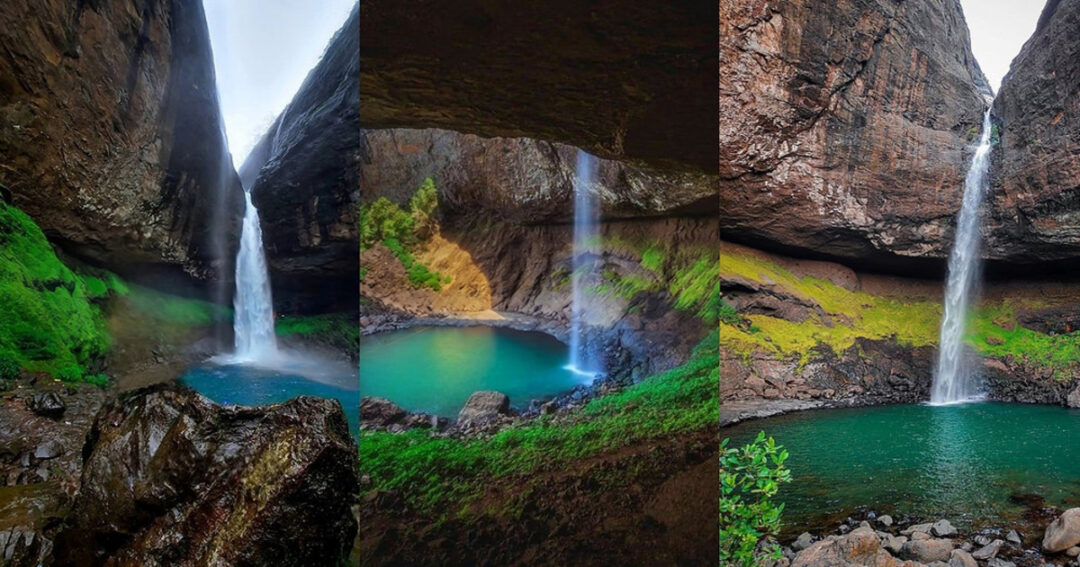
There are waterfalls you find on Google Maps, and then there are waterfalls you have to earn. The Devkund waterfall trek is firmly in the second category. Hidden inside the dense forests of the Western Ghats near Bhira village in Raigad district, Devkund — literally meaning “the bathing pond of gods” (from the Sanskrit Dev meaning god, and Kund meaning pond or bathing pool) — is a plunge waterfall that drops into one of the clearest, most impossibly blue-green natural pools you will find anywhere in Maharashtra. It flows year-round, stays off the radar of most casual day-trippers, and rewards anyone willing to do the 6.5 km forest walk to reach it.
If you are planning the Devkund trek, this guide covers everything — route, distance, difficulty, timing, the monsoon ban, Shelar camping, and what experienced trekkers wish they had known before going.
GPS coordinates before you enter Tamhini Ghat — network drops significantly inside the forest section.
Best Time for the Devkund Waterfall Trek
- October to February — the ideal window for the Devkund trek. Post-monsoon water flow is strong, the pool is crystal clear, and the forest is lush without the hazard of flash flooding. This is when the Devkund secret waterfall looks exactly like the photos you have seen
- March to May — still accessible, flow reduces, heat increases. Doable but not ideal
- June to July (early monsoon) — conditions are slippery, and water levels are high; mandatory to go with a licensed local guide only
- August onwards (monsoon ban) — ⚠️ The trek is officially banned every August by the forest department due to repeated accidents, deaths, and dangerously high water levels. As of June 2026, a Section 163 order under the Indian Civil Protection Code has restricted entry from June 17 to September 30, 2026. Always verify current restrictions with local authorities or Bhira village before planning — this order is renewed and updated annually
How to Reach Devkund
Base village: Bhira village (also called Bhira Patnus), Mangaon Taluka, Raigad district, Maharashtra
From Mumbai (~150–170 km depending on route | 4–5 hrs)
- By road: Mumbai → Panvel → Pen → Mangaon → Bhira via NH 66
- By train + local: Train to Khopoli → bus to Pali Balhareshwar → bus/jeep to Mhasewadi (Bhira)
- Nearest railway station: Mangaon on the Konkan Railway, ~30 km from the base
From Pune (~110–120 km | 3–4 hrs)
- By road: Pune → Tamhini Ghat → Mangaon → Bhira (scenic route, highly recommended)
- By bus: Swargate → Vile village (buses towards Mahad/Mangaon) → auto to Mhasewadi
Pro tip: Load the
Devkund Trek Route — Full Breakdown
The Devkund trek route starts at Bhira village and follows a well-marked but physically engaging trail through forest, backwaters, and stream crossings. Here is what each stage actually looks like on the ground.
Stage 1: Bhira Village to Dam Backwaters (0–2 km)
- The trail begins at the edge of Bhira village near the Tata Power Bhira Hydroelectric Plant, commissioned in 1927 — the third in Tata Power’s chain of hydro stations in the Western Ghats, following Khopoli (1915) and Bhivpuri (1922)
- The path runs alongside the Bhira Dam backwaters — calm, wide, and flat
- This is the easiest section of the Devkund trek route; good for warming up and taking in the surrounding Sahyadri hills
- Time: 30–40 minutes
Stage 2: Forest Entry and River Crossings (2–4.5 km)
- The trail enters dense forest — canopy closes overhead, light goes green and muted
- You will cross 3 to 4 stream crossings, depending on the season; wooden bridges handle some, but expect to wade through others
- Terrain is muddy, rooted, and uneven — this is where footwear matters most
- Route is marked with direction signs; a local devkund trek guide is strongly advisable for river crossings in the monsoon
- Time: 1 to 1.5 hours
Stage 3: Rocky Ascent to Devkund (4.5–6.5 km)
- The final stretch involves a moderate rocky ascent of approximately 300 feet — the only real climb of the entire Devkund Waterfall trek
- Terrain shifts to exposed rock — slippery when wet, grippy when dry
- You will hear the waterfall before you see it
- Time: 30–45 minutes
Total one-way distance: ~6.5 km (Wikipedia-verified).
Total one-way time: 2–3 hours, depending on pace and season. Round-trip Devkund
trek time: 5–6 hours, including time at the waterfall
Also Read: Dayara Bugyal Trek: The Complete Guide to Uttarakhand’s Most Beautiful Meadow
Devkund Trek Difficulty — What You Are Actually Getting Into
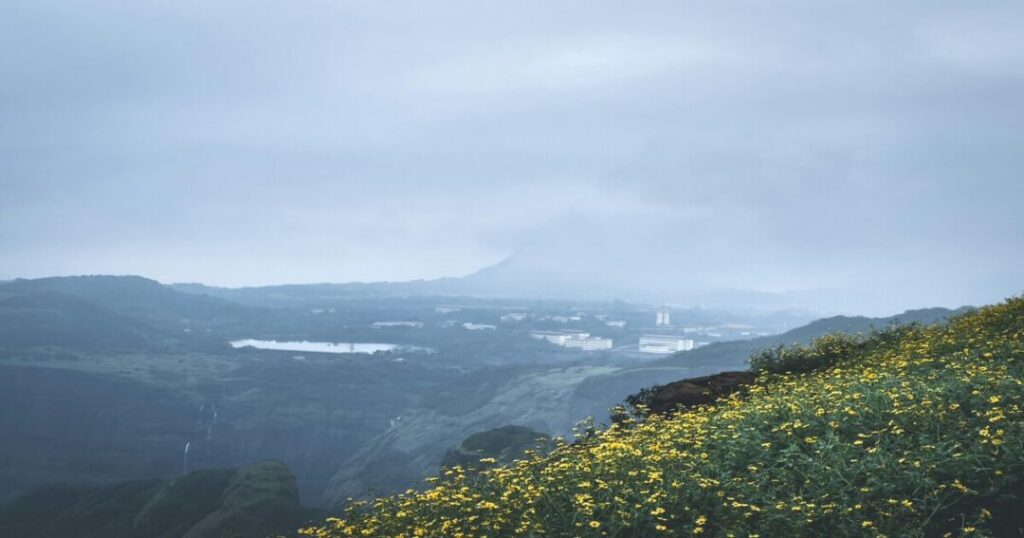
The Devkund trek difficulty is rated easy to moderate — and that rating holds, with important caveats.
What makes it manageable:
- No sustained steep climbing; most of the Devkund trek is flat or gently undulating
- Well-marked route with guides and markers at key points
- Total Devkund trek distance is approximately 13 km round trip — comfortable for anyone who can walk 10+ km
What makes it demanding:
- River crossings can be waist-deep in monsoon — route judgement matters
- Rocky ascent in the final section gets genuinely slippery in wet conditions
- Heat in summer (March–May) makes the return walk tiring
- No shade on the dam backwater section in the first 2 km
Honest assessment for experienced trekkers: You will not be challenged by the terrain, but you will be tested by the conditions — water levels, slippery rock, and forest navigation in poor visibility. The Devkund trek rewards preparation, not just fitness.
Guide requirement: A local guide is compulsory. The forest department enforces this, and for good reason — the dense forest section has caused multiple trekkers to get lost when attempting solo. Guides are available at Bhira village. This is not a formality; it is enforced.
Devkund — The Waterfall Itself
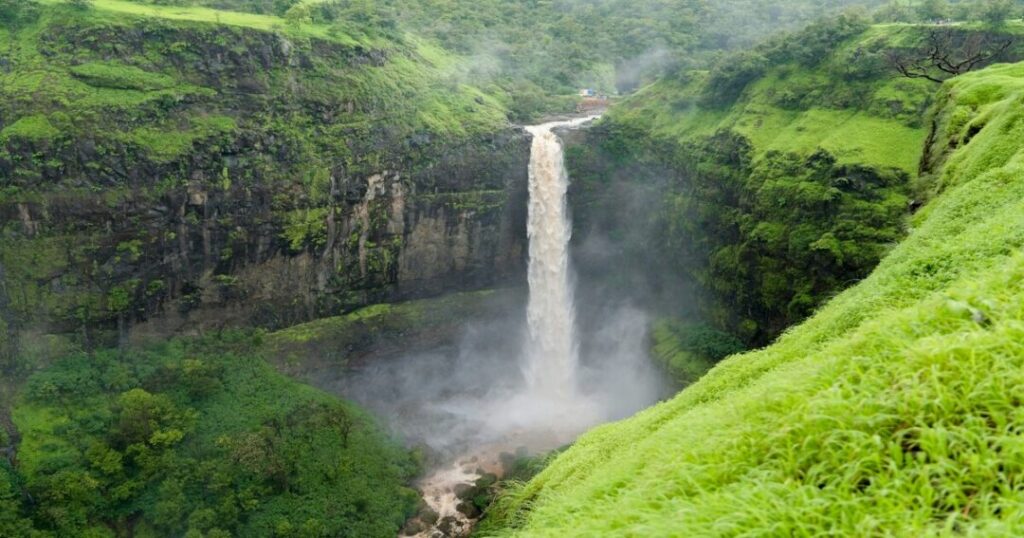
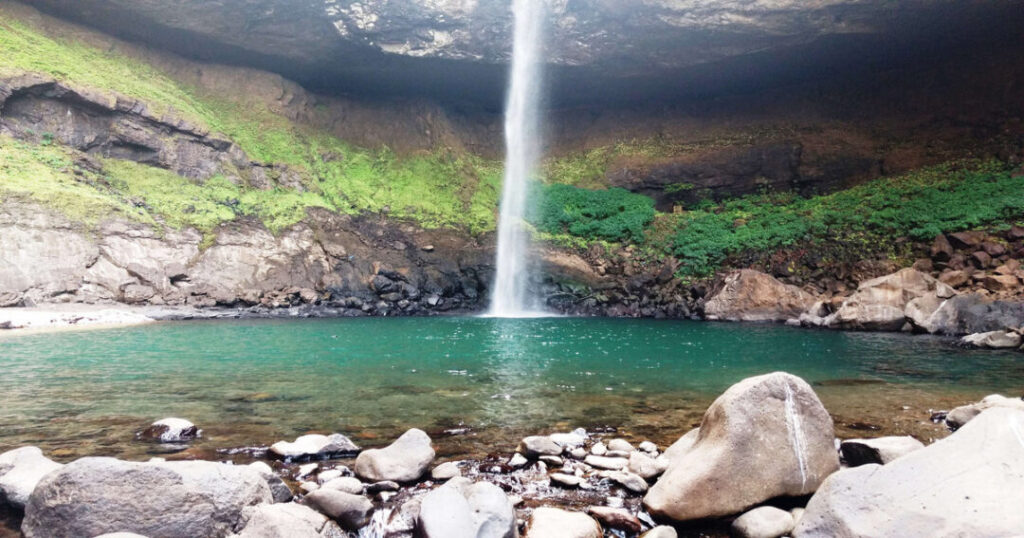
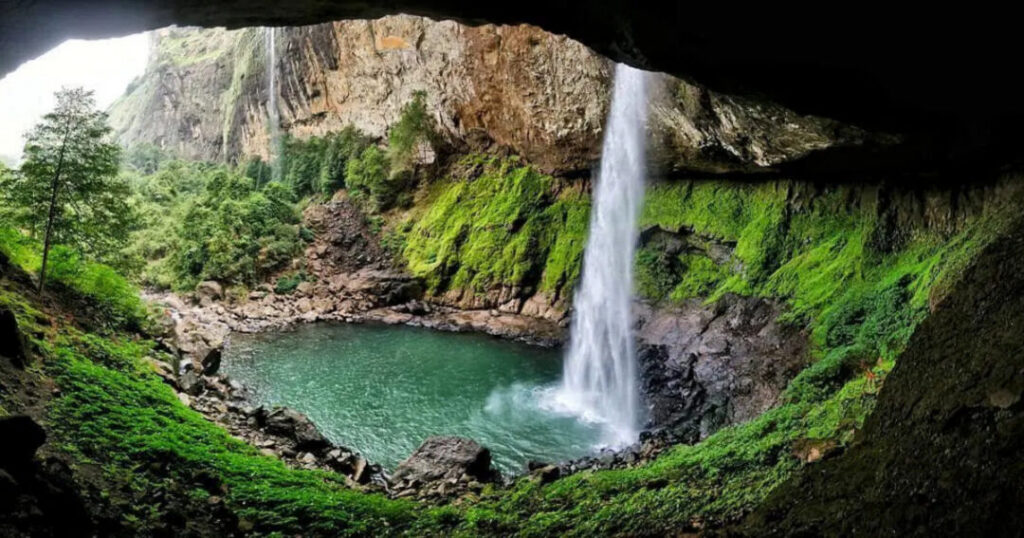
Devkund is a plunge waterfall — meaning the water drops free-fall off a cliff edge rather than cascading down rock. It is the confluence of three separate streams. Locals consider it the origin point of the Kundalika River, though hydrologically the river is primarily fed by excess water released from Tata Power’s Mulshi Dam through the Bhira hydroelectric project. The Kundalika flows downstream through Kolad, known for white-water river rafting.
- Type: Plunge waterfall
- Height: Approximately 80 feet (~24–27 metres; varies across sources)
- Pool depth: Up to 60 feet at the deepest point near the waterfall drop
- Pool diameter: Approximately 30 metres
- Name meaning: Dev (God) + Kund (pond/bathing pool) = “Bathing Pond of Gods” — considered sacred by the local community
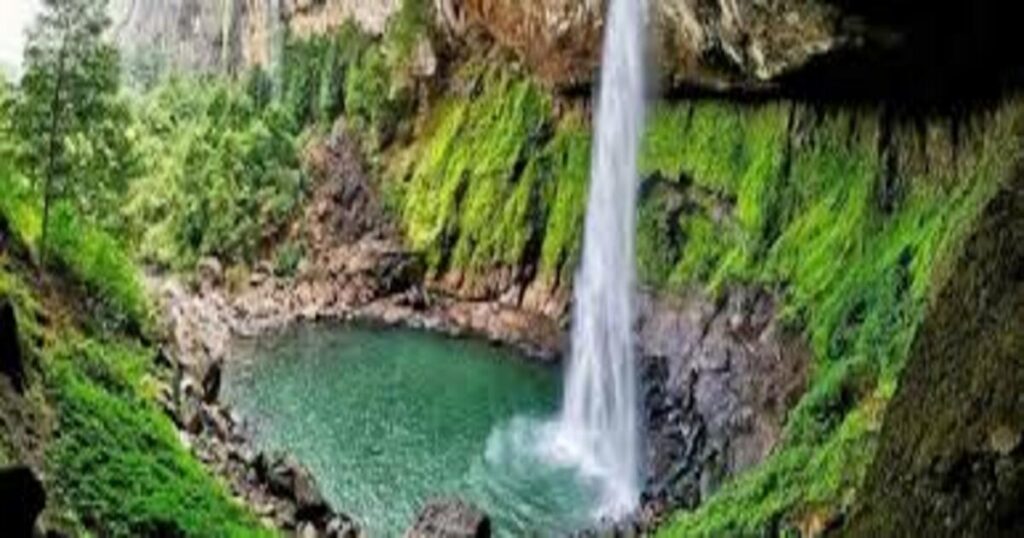
The pool is the reason people come back. The water is glacier-cold even in summer, visibly clear, and surrounded by vertical rock walls draped in moss. It is one of the most distinctive features of any secret waterfall near Devkund — there is simply nothing quite like it in the region.
⚠️ Swimming Rules — Read This Before You Go
Swimming rules at Devkund are strictly enforced by the forest department and change seasonally. As per the current forest department guidelines, swimming near the main waterfall drop is prohibited due to the extreme depth (up to 60 feet), strong undercurrents, and a documented history of drowning incidents. Multiple trekkers have lost their lives by ignoring these restrictions.
Locals have marked a line of control across the pool — swimming may be permitted only in the shallow half, away from the drop zone, and only when explicitly allowed by your guide. Do not enter the water based on advice in any blog, including this one — always follow the on-site instructions of your local guide and posted forest department notices.
Camping directly at the waterfall is also prohibited by the forest department. The pool is a drinking water source for local communities — carry out everything you carry in.
Devkund Camping — Shelar Camping at Bhira
The most established and recommended option for Devkund trek and camping is Shelar Devkund Waterfall Trek and Camping, run by Sunil Shelar and family at Mhasewadi, Patnus — about a 4 km auto ride from Vile village.
Why Shelar for devkund waterfall by shelar camping:
- The Shelar family are the original local operators at Devkund — running guided treks and Devkund camping here for years, with certified guides who also serve as a rescue force at the waterfall
- 4.6 rating on JustDial with 700+ reviews (ratings subject to change — verify before booking)
- Village-cooked home-made food — not packaged meals; a genuine differentiator
- Tents are set up near the Bhira Dam lakeside — not at the waterfall (as per forest regulations)
What a typical overnight Devkund trek and camping package includes:
- Day 1 evening: Arrive at campsite, settle in, campfire, dinner
- Day 2 morning: Breakfast, then guided Devkund waterfall trek to the waterfall, lunch at base on return
- Accommodation: Tent stay near Bhira Dam backwaters
Approximate costs (verify directly before booking — prices change seasonally):
- Trek + homestay package: ₹1,399–₹1,500 per person
- Camping near Bhira Dam: ₹1,000–₹1,500 per night
- Trek-only packages from operators: ₹799–₹1,499 per person, depending on inclusions
- Entry fee at forest: ₹100–₹150 per person
- Guide fee: ₹100–₹300 per person (mandatory in monsoon)
- Jeep from Khopoli (up to 10 people): ~₹1,800 one-way
How to reach Shelar Camping:
- From Mumbai: Train to Khopoli → bus to Pali → bus/jeep to Mhasewadi
- From Pune: Bus from Swargate to Vile → auto to Mhasewadi
- Contact: Sunil Shelar & Navlesh Shelar | +91 86527 62191
[INTERNAL LINK: Maharashtra camping guide → best camping spots near Mumbai and Pune]
Quick Tips Before You Go
- Footwear is non-negotiable: Waterproof trekking shoes with a strong grip. This Devkund trek route will destroy flat sneakers
- Start early: Leave base village by 7–8 AM — gives you buffer for the waterfall, return, and drive home before dark
- Water: Carry at least 2 litres. There is no reliable water source en route
- Check restrictions before booking: The monsoon ban is annual; broader Section 163 orders may apply. Call Bhira village or check with your operator before committing to dates
- Follow swimming rules on-site: Do not base any decision about entering the water on what any blog says — only follow live instructions from your guide and forest department notices
- Leave no trace: Devkund’s pool is a local drinking water source. What you carry in, carry out
Nearby Treks Worth Combining
If you are already making the drive to Bhira, these are worth knowing about:
- Andharban Trek — the “dark forest” trail (~13 km) that descends from Pimpri village near Tamhini Ghat through dense jungle and ends at Bhira Dam backwaters — the exact starting point of the Devkund waterfall trek. Combining both as a two-day itinerary (Andharban Day 1, Devkund Day 2) is one of the best weekend trek combinations in Maharashtra
- Tamhini Ghat — the mountain pass you drive through from Pune is itself a destination during monsoon — roadside waterfalls, mist-covered valleys, and far fewer crowds than Lonavala
- Kundalika River Rafting (Kolad) — approximately 30 km from Bhira; Grade 2–3 rapids on the river fed by Bhira Dam releases
Also Read: Andharban Trek: The Complete Beginner’s Guide to Maharashtra’s Dark Forest
Conclusion
The Devkund waterfall trek is exactly what it sounds like — a route to one of Maharashtra’s best-kept secrets. Six and a half kilometres of forest, river crossings, and rocky trail leading to a Devkund secret waterfall that drops into water so clear it looks edited. Book the overnight Devkund camping with Shelar for the full experience: a lakeside tent, home-cooked food, and a sunrise start for the trek. Go post-monsoon, go with a guide, respect the swimming rules, and go before the crowds catch up.
Before you head out, download the Explurger app to log your Devkund experience, discover what other trekkers are saying about the secret waterfall near Devkund, and find your next trail in Maharashtra.
The forest is waiting. Start early.
FAQs About the Devkund Waterfall Trek
2. What is the Devkund trek difficulty level?
The Devkund trek difficulty is rated easy to moderate. The terrain is manageable for anyone with basic fitness who can walk 10–12 km — there are no sustained steep climbs. The challenge comes from river crossings (which can be waist-deep in monsoon), slippery rocky patches near the waterfall, and the dense forest section, which requires a local guide. Not a technical trek, but not a casual walk either.
3. When is the Devkund waterfall trek banned?
The Devkund waterfall trek is officially banned every August by the forest department due to dangerously high water levels and a history of accidents and fatalities. In 2026, a broader Section 163 order restricted entry from June 17 to September 30. Always verify current restrictions with Bhira village or your operator before booking — orders are renewed and updated annually.
4. What is Shelar camping at Devkund?
Devkund waterfall by Shelar camping is run by Sunil Shelar and family at Mhasewadi, Patnus, near Bhira — the most established local operator for Devkund camping. They offer guided treks with certified guides who double as a rescue team, village-cooked home-made meals, and lakeside tent camping near Bhira Dam backwaters.
5. Is Devkund waterfall open throughout the year?
Devkund waterfall is one of the few perennial waterfalls in Maharashtra — it flows year-round as it is fed by three streams. However, access is not year-round. The monsoon ban (August and broader Section 163 orders in some years) restricts entry. Post-monsoon, from October to February, is the safest and most visually rewarding period. March to May is accessible, but water flow decreases and the heat increases.
6. Is a guide compulsory for the Devkund trek?
Yes. A local devkund trek guide is compulsory and is enforced by the forest department. This is not optional — the dense forest section has caused multiple trekkers to get lost when attempting solo, and river crossings require local knowledge of safe crossing points, especially in the monsoon. Guides are available through Bhira village or by booking with operators like Shelar Camping.