
365 Total Views
Ask ten Indians for the best street food in India and you will get ten different answers, usually delivered with some heat. There is no official ranking and no single dish that wins, because the answer changes with the city, the season and the hour. What can be said is that a handful of dishes show up again and again: the crisp, tangy shells of pani puri, the spiced potato fritter in a bun that is Mumbai’s vada pav, the fried pastries of Rajasthan and Delhi, the rolls of Kolkata and the momos of the hills. This guide covers five dishes to start with, a region-by-region tour, the cities where stalls cluster, sweets, meat and egg dishes, safety advice and a sample eating route. Where food historians disagree about where a dish began, the post says so instead of picking a side.
Best Street Food in India: Five Dishes to Start With
These five are chosen for reach and variety. They are an editorial pick and not a ranking, and each has a regional twist worth seeking out.
1. Pani Puri, Golgappa and Phuchka
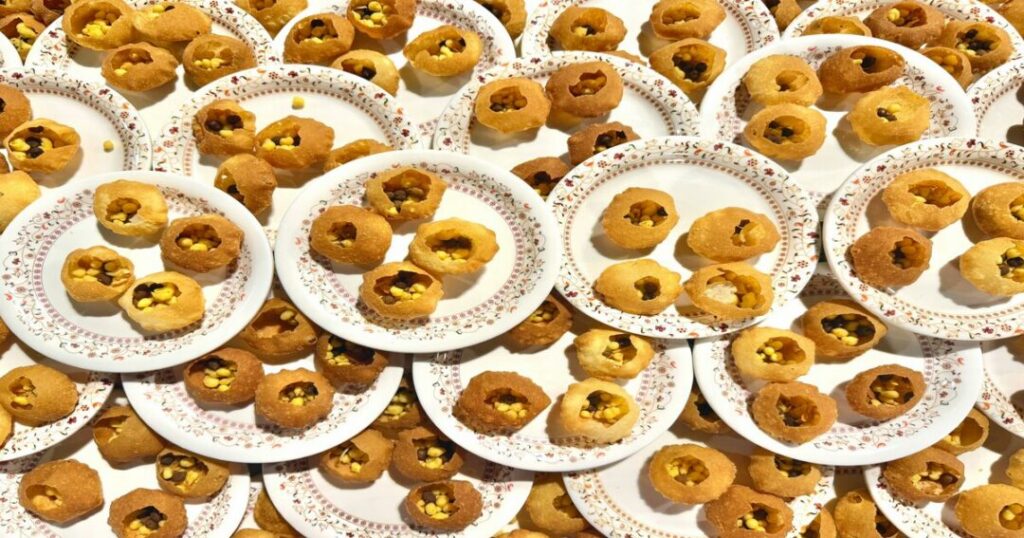
A hollow, crisp shell is filled with potato or chickpeas, then dunked in spiced water and eaten in one bite. Where the dish came from is unknown: the food historian Pushpesh Pant calls the search for its true origin futile. One 1955 theory traces the small crunchy puri to Varanasi, while the culinary anthropologist Kurush Dalal ties it to the chaat of what is now Uttar Pradesh under Shah Jahan. Potatoes, now common in the filling, only arrived after the Columbian Exchange, so the earliest versions must have been different.
The name changes as you travel. It is panipuri in much of India, including Mumbai, Gujarat, Karnataka and Tamil Nadu, and golgappa in Delhi and across Punjab and Haryana. Kolkata and parts of eastern India say phuchka, Rajasthan says pani ke batashe, and Chhattisgarh and Telangana say gup chup. Delhi golgappe come with potatoes, black chickpeas and a mint-and-coriander water. Kolkata’s phuchka is filled with mashed potato and green chilli, with a sour tamarind water and sometimes gondhoraj lime. Mumbai’s version uses ragda, a white-pea gravy, with tamarind and mint waters.
2. Vada Pav and Pav Bhaji
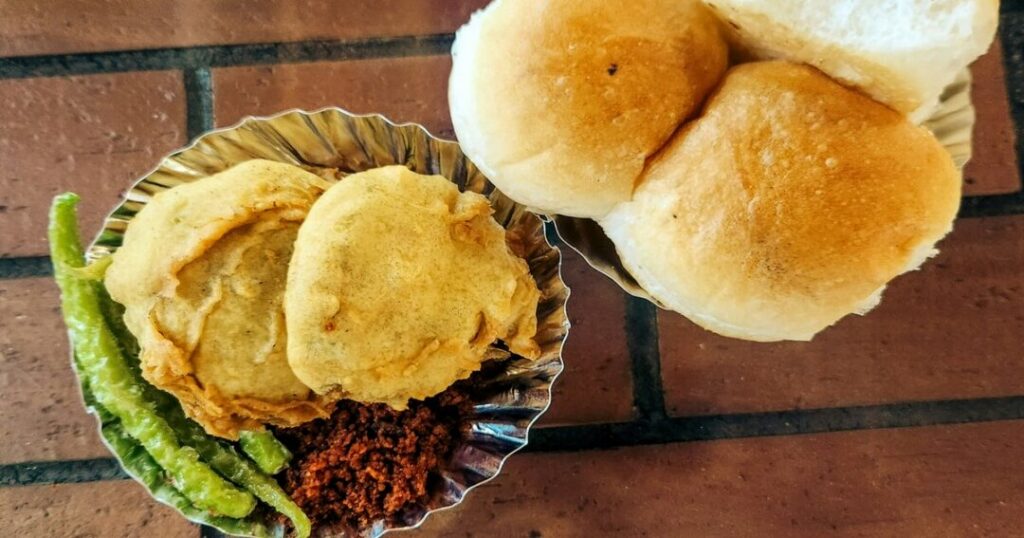
Vada pav is a batata vada, a fritter of mashed potato and spices, served in a pav bun with green chilli and chutneys. Wikipedia lists it as first made in 1966 and credits Ashok Vaidya and Sudhakar Mhatre, though without details or sources, so treat the date and the names as unconfirmed. It is a Mumbai original, yet a Mysuru variant called vada pavu, served with tea, shows how far it has travelled.
Pav bhaji is the other Mumbai staple: a thick, spicy vegetable curry cooked on a flat griddle with plenty of butter and served with a buttered pav. It began, according to the usual account, as a quick lunch for textile mill workers in Mumbai, and it later moved into restaurants. No date is given for that origin, and variations now include cheese, paneer and a Jain version made without onion and garlic.
3. Chaat: Bhel Puri, Aloo Tikki and Raj Kachori
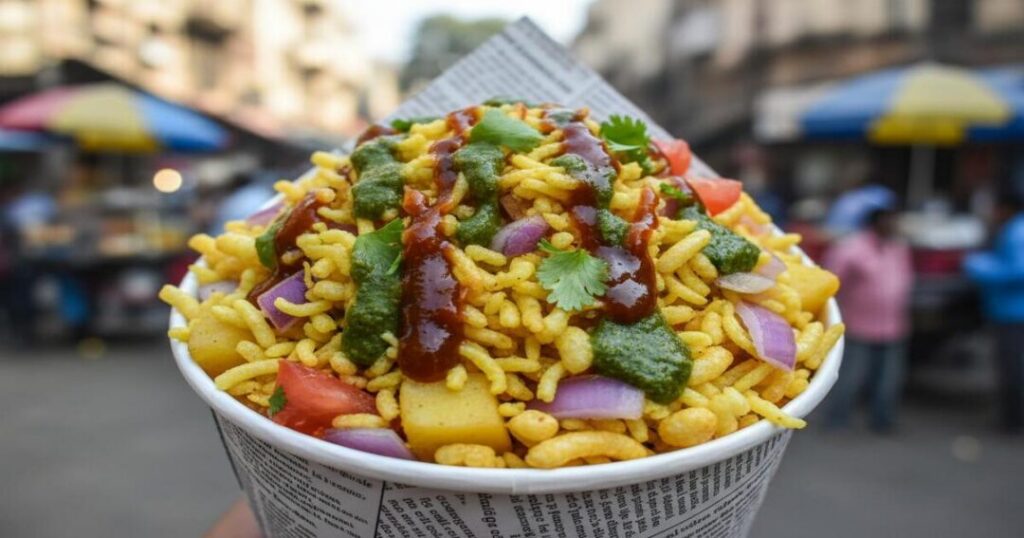
Chaat is a family of snacks usually based on fried dough, with yogurt, onion, coriander, sev and a spice mix called chaat masala. The name comes from a Hindi word for tasting. Dalal places the rise of chaat as a distinct group in late 17th-century northern India, with a story that royal doctors told Delhi residents to eat spicy fried snacks and yogurt to counter the alkaline water of the Yamuna. That story is a reported claim, not a documented fact, and Wikipedia flags its chaat article as needing more citations.
Bhel puri, built on puffed rice, crisp papri and sev with tamarind and mint chutneys, is the Mumbai beach classic and can use as many as fifteen components. The food writer Vir Sanghvi notes that it is the only chaat not originating in North India, and the Vithal restaurant’s claim to have invented it in the 19th century is called apocryphal by one food writer. Aloo tikki, a patty of boiled potatoes, peas and spices, is served with tamarind and mint sauces, and in Maharashtra it appears as ragda pattice. Raj kachori is a hollow wheat ball filled with sprouts, chickpeas, potatoes, bhalla and chutneys.
4. Samosa and Kachori
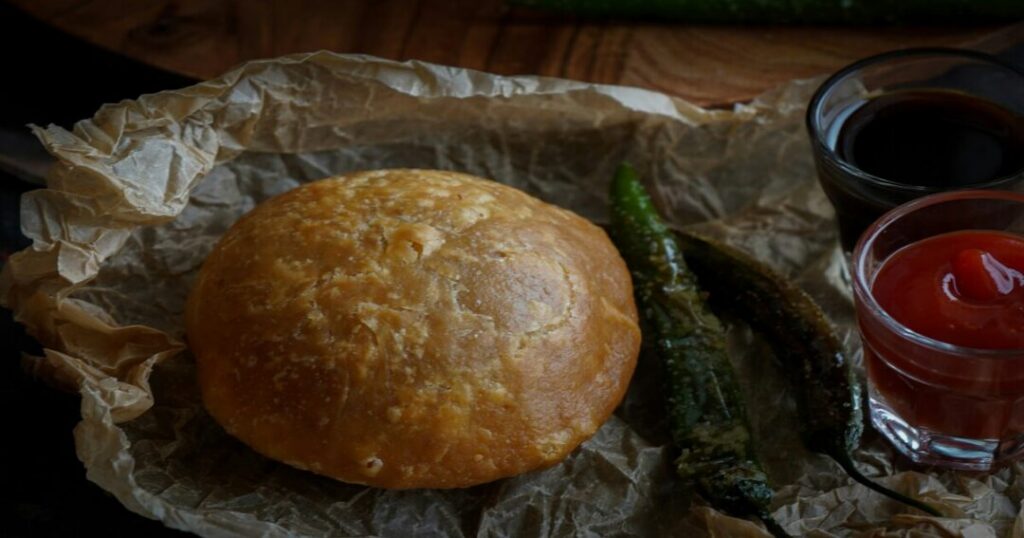
The samosa’s name comes from the Middle Persian sambosag, meaning triangular pastry. Its ancestor was a baked pastry of the medieval Middle East, and the poet Amir Khusrau wrote around 1300 of a samosa filled with meat, ghee and onion. The now-standard Indian version is fried and filled with spiced potato, onion and peas. Regional cousins include the smaller singara of Bengal, Odisha, Assam, Bihar and Jharkhand, the lukhmi of Hyderabad and Goa’s chamuça.
Kachori is a fried pastry stuffed with moong dal or onion and is believed to come from Marwar in Rajasthan, though that rests on belief and not firm evidence. Jodhpur is known for pyaaz kachori and the sweet mawa kachori, and Kota for a yellow moong dal version with a hint of asafoetida. Kolkata has its own softer kochuri, and the pea-stuffed koraishuti kochuri is a winter speciality there.
5. Chole Bhature
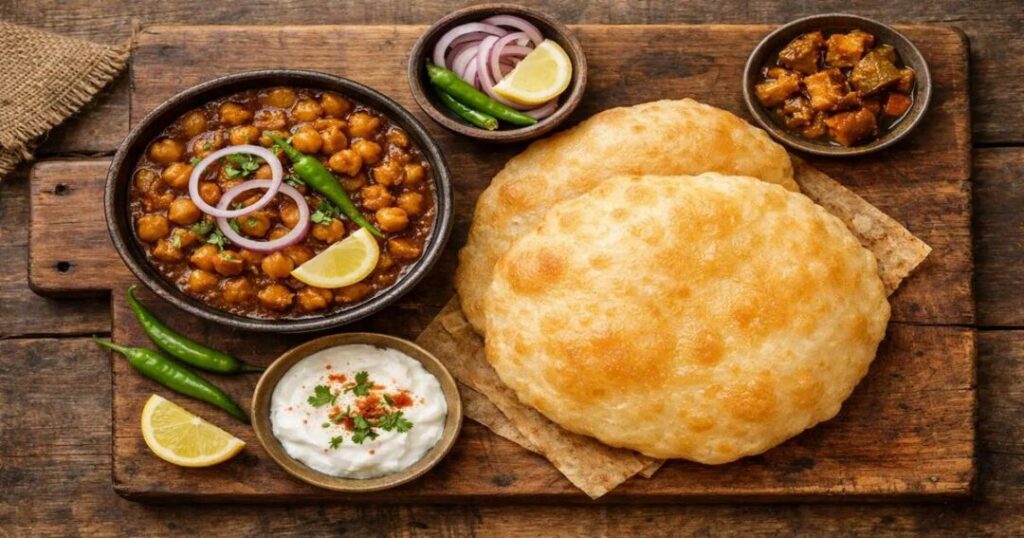
Chole bhature pairs a thick chickpea curry with bhature, a deep-fried bread made from fermented refined flour, and it is usually eaten as a hot breakfast. Its origin is contested between Punjab, pre-partition Rawalpindi through the pindi chole link, and eastern Uttar Pradesh. The usual story for its arrival in Delhi in the 1940s credits two men said to have come from Lahore after 1947: Peshori Lal Lamba of Kwality in Connaught Place, and Sita Ram, whose cart later became Sita Ram Diwan Chand in Paharganj. Sources are inconsistent about who did what and when.
Famous Indian Street Food by Region
The most famous indian street food differs sharply from one region to the next. This section follows the map instead of the menu.
East: Kolkata Rolls, Jhalmuri and Litti Chokha
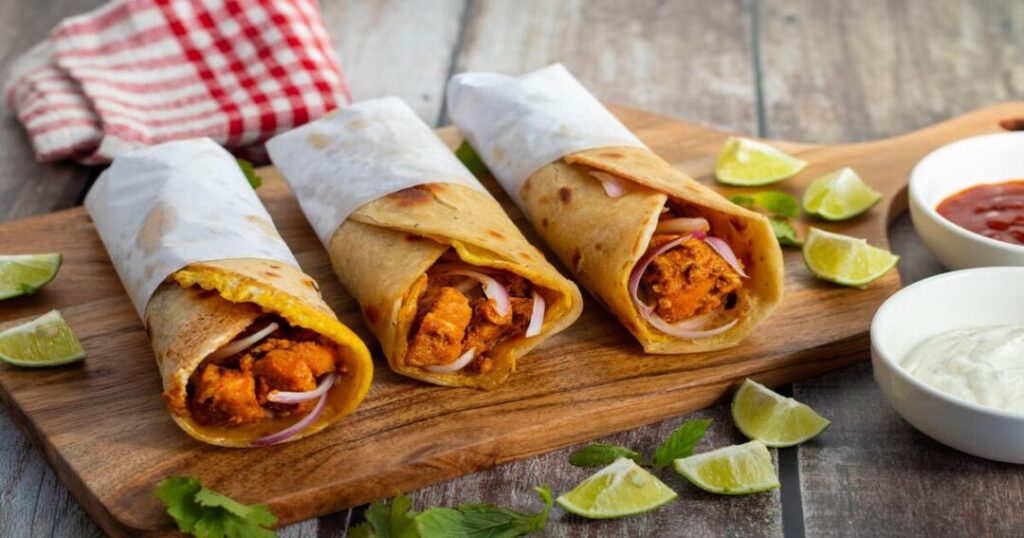
The kati roll is a skewer-roasted kebab wrapped in paratha. It is said to have started at Nizam’s, a Mughlai restaurant founded in Kolkata in 1932, and the “kati” in the name comes from the Bengali word for stick, a name that followed a switch to bamboo skewers in 1964. Several other origin stories exist and Wikipedia’s article calls the true one probably more mundane. Jhalmuri is puffed rice tossed with chanachur, cucumber, onion, chilli, lemon and mustard oil, sold in paper cones across West Bengal, Bihar and nearby states. Telebhaja (fried snacks) and ghugni are also part of Kolkata’s street scene, and in Cuttack, Odisha, a dish of fried dough in yogurt with potato and pea curry, dahi bara aludam ghugni, is a local favourite.
Further west, in the Bhojpuri region around Buxar and Varanasi, litti chokha is a whole-wheat dough ball stuffed with roasted gram flour, served with a mashed vegetable relish. It is traditionally cooked over charcoal. The claim that it was a staple for the armies of Magadh carries a citation-needed tag, so it is best treated as unconfirmed.
West: Gujarat’s Dhokla and Maharashtra’s Poha
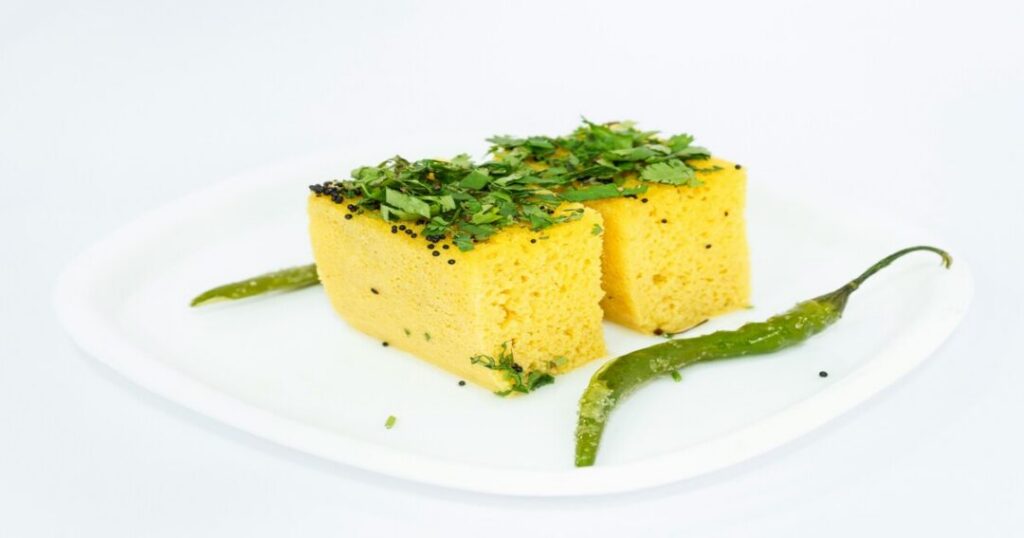
Dhokla is a steamed savoury sponge from Gujarat, made from a fermented batter of rice and split Bengal gram and served with chutney. A pulse-based precursor called dukkia appears in a Jain text dated 1066 CE, and the earliest known work using the word dhokla dates to 1520 CE. Poha, a flattened-rice breakfast dish, is eaten across Maharashtra and Madhya Pradesh, and Goa has its own ros omelette, an omelette in spiced gravy served with pav.
South: Dosa and Gadbad Ice Cream
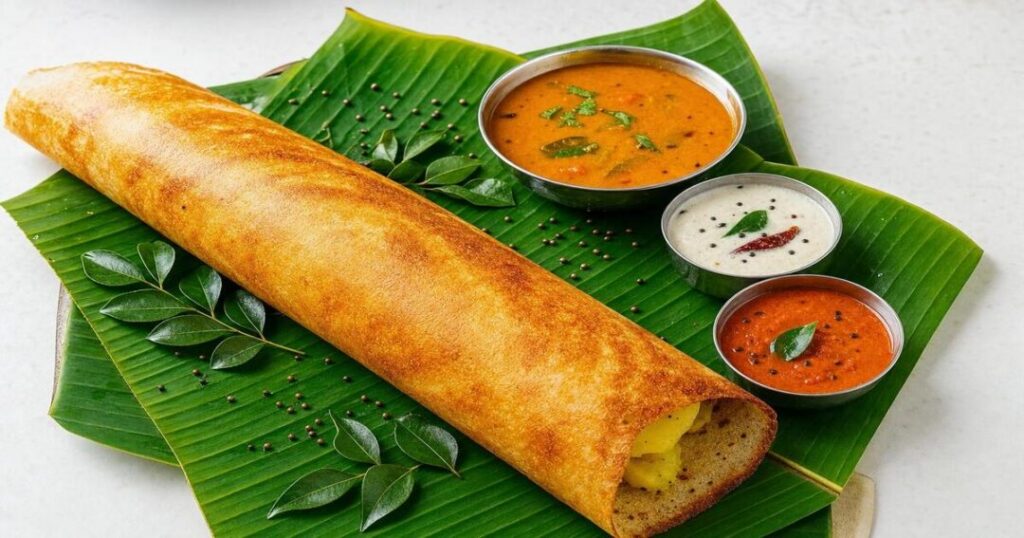
Masala dosa, a fermented rice-and-lentil crepe stuffed with spiced potato, is generally credited to K. Krishna Rao, who popularised it in 1930s Madras through his Udupi-style restaurants. A tale linking it to the cooks of King Someshvara III of Mysore in the 12th century is disputed, since potatoes reached India only in the 16th century. Elsewhere in the south, Telangana and Andhra Pradesh have punugulu, fried batter balls, Kerala has pazhampori banana fritters, and Udupi and Mangalore are known for gadbad ice cream, a layered dessert in a tall glass.
Northeast and the Himalayas: Momos and Smoked Pork
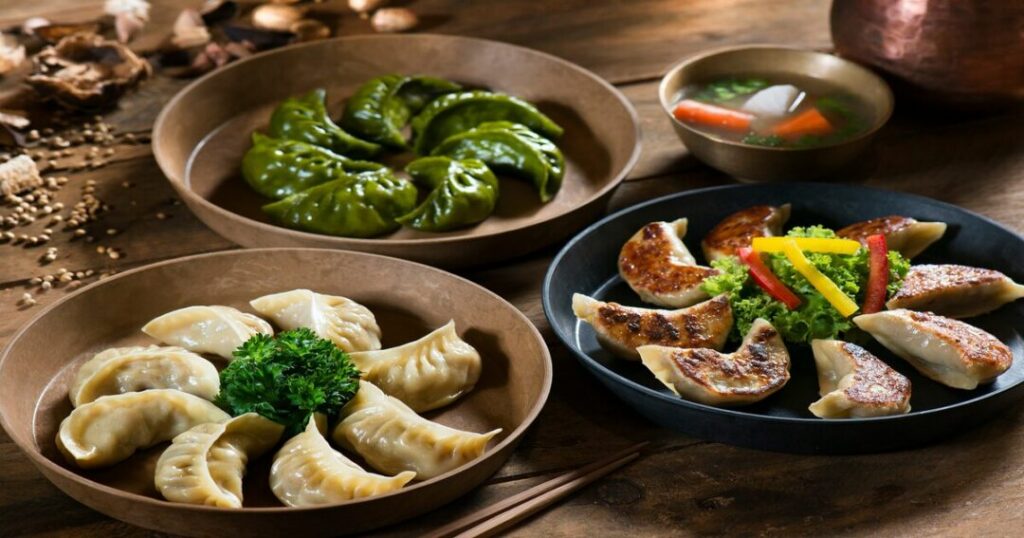
Momos came to India’s streets largely through Tibetan emigrants who arrived after the 1959 uprising. Sikkim is associated with pork, chicken, goat and water buffalo fillings, while on the plains chicken became the most common filling and vegetable momos were introduced for vegetarian Hindus. Whether momos spread from Nepal to Tibet or the other way round is still debated. In Shillong and Mon in Nagaland, charcoal-grilled smoked pork is a street favourite, Manipur serves spiced chickpeas in a lotus leaf, and Delhi’s Majnu ka Tilla is a known momo spot, although that last detail rests on a single source.
India Best Street Food Cities: Where the Stalls Cluster
Anyone searching for the India best street food will see the same few cities repeat. Each has a different strength.
Old Delhi
Delhi Tourism calls Chandni Chowk the food capital of India, which is the department’s own phrase, not an independent ranking. Wikipedia says vendors in Chandni Chowk and Chawri Bazar have sold street food for three or more generations. Paranthewali Gali became a food lane when parantha shops moved there in the 1870s, and the paranthas are fried in ghee and served with chutneys and aloo subzi. Named stops on the tourism page include Natraj for dahi bhalla, Jung Bahadur Kachori Wala for urad dal kachori, the Old and Famous Jalebiwala at Dariba Kalan and Giani di Hatti near Fatehpuri Mosque for rabdi faluda. Nihari and paya near Jama Masjid are said to sell out by 8:30 in the morning.
Indore
Sarafa Bazaar is a jewellery market by day that becomes a night food market after the shops close. Dishes named there include bhutte ka kees, made from grated corn cooked in milk and spices, Joshi Dahi Bada, malpua with rabdi and a milk-based Indore shikanji with dry fruits and saffron. Garadu, a fried purple yam, is available mainly in winter. Chappan Dukan, named for an original row of 56 shops, is known for poha with jalebi, Johnny Hot Dog (a spiced potato patty in a bun, nothing to do with the American hot dog) and sabudana khichdi. Descriptions such as “one of India’s most famous night food markets” come from trade-magazine copy without a cited ranking.
Lucknow
Lucknow is known for Awadhi kebabs, including galouti and the Tunday Kababi shop, which one travel magazine says is named after its creator Haji Murad Ali, a single-source claim. Sheermal, a saffron-and-cardamom sweet bread, and kulcha nihari are also listed. For chaat, the potato-shell basket chaat of Hazratganj is a local classic, and Shukla Chaat House is a named stop.
Kolkata and Mumbai
Wikipedia says North Kolkata has more street stalls than the south and that street food helps earn the city the nickname City of Joy, while Mumbai’s repertoire runs from vada pav, pav bhaji, sev puri and dahi puri to kheema pav and egg bhurji, with bhel puri a staple on the beaches. Both cities reward a slow walk and a short list of stalls.
Also Read: Middle Eastern Street Food: Must-Try Dishes & Flavors
Popular Indian Street Food for Sweet Tooths
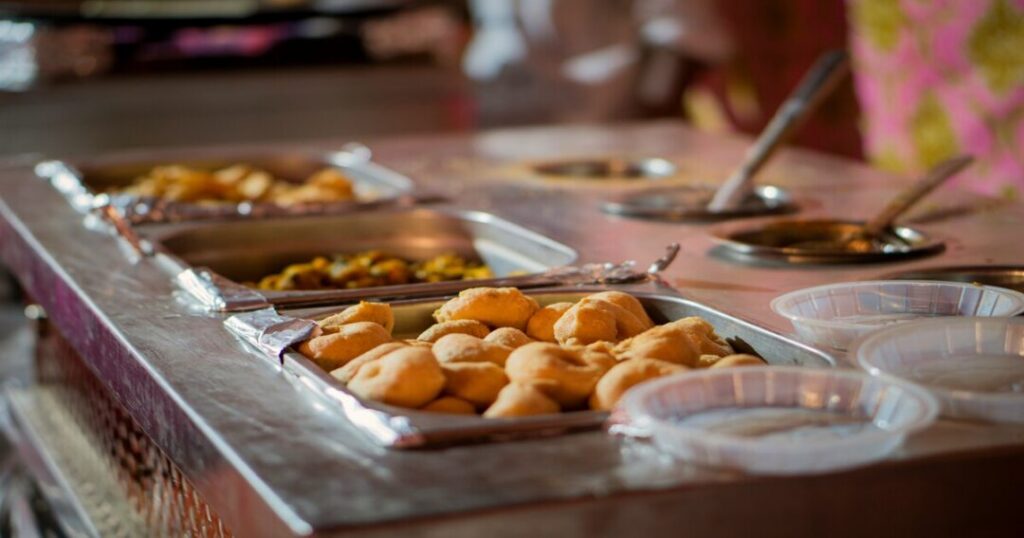
Savoury snacks are only half of the story, and the most popular indian street food desserts are easy to find. Jalebi, batter fried in coils and soaked in syrup, is recommended in Delhi, Bhopal and Indore, and Old Delhi’s tourism page also lists kulfi from Ajmeri Gate and rabdi faluda near Fatehpuri Mosque. Malpua with rabdi is a Sarafa Bazaar sweet, mawa kachori from Jodhpur is stuffed with dry fruits and dipped in syrup, and gadbad ice cream in Udupi and Mangalore builds a dessert in layers.
Best Indian Street Foods for Meat and Egg Lovers
Not all of the best indian street foods are vegetarian. Kebabs in Delhi and Lucknow, the kati roll in Kolkata, egg bhurji and kheema pav in Mumbai, momos with chicken, pork or goat in the Himalayas, charcoal-grilled smoked pork in Shillong and Mon, and Lukter, a sun-dried grilled meat served with a very hot chilli in Arunachal Pradesh, all fall into this group. Delhi’s Jama Masjid area is known for kebabs, tikkas and mutton burrah, and Lucknow’s kulcha nihari pairs mutton nihari with bread.
Also Read: Malaysian Street Food: Must-Try Dishes and Where to Find Them
Indian Best Street Food: Eating It Safely
Every question about indian best street food eventually reaches the same one: is it safe? The honest answer is that it varies by stall. The World Health Organization estimates that about 866 million people fall ill from contaminated food each year worldwide, a general figure that is not specific to street food or to India. A study of 170 vendors in one part of Pune, conducted from May to December 2025 and published in BMC Public Health, found 68.8 percent noncompliant with an FSSAI inspection checklist and 17.6 percent satisfactory, although it also found that 83.5 percent met cooking requirements. Only 32.9 percent had adequate handwashing facilities, and only 21.8 percent had any food safety training. The authors note that the study covers one area and cannot be generalised.
There are efforts under way. FSSAI piloted the Clean Street Food Hub programme in 2018, with each hub a cluster of up to 50 vendors, and a 2020 working paper reported eight certified locations. In February 2026, FSSAI also announced a FoSTaC training for about 550 street food vendors in East Delhi. Practical advice from travel writers is consistent: choose busy stalls with fast turnover and food prepared fresh in front of you. One blog also suggests avoiding raw salads and watery sauces such as pani puri water, but that is a single promotional source, and many visitors eat pani puri anyway. Studies have also found bacteria such as E. coli in street-vendor bhel puri, which is served raw, so a cautious traveller might prefer freshly fried or freshly cooked items, such as kachori, samosa or dosa. That last point is our own suggestion and not an official recommendation.
Also Read: Street Food in Haridwar: 8 Dishes You Shouldn’t Miss
Top Street Food in India: A Sample Eating Route
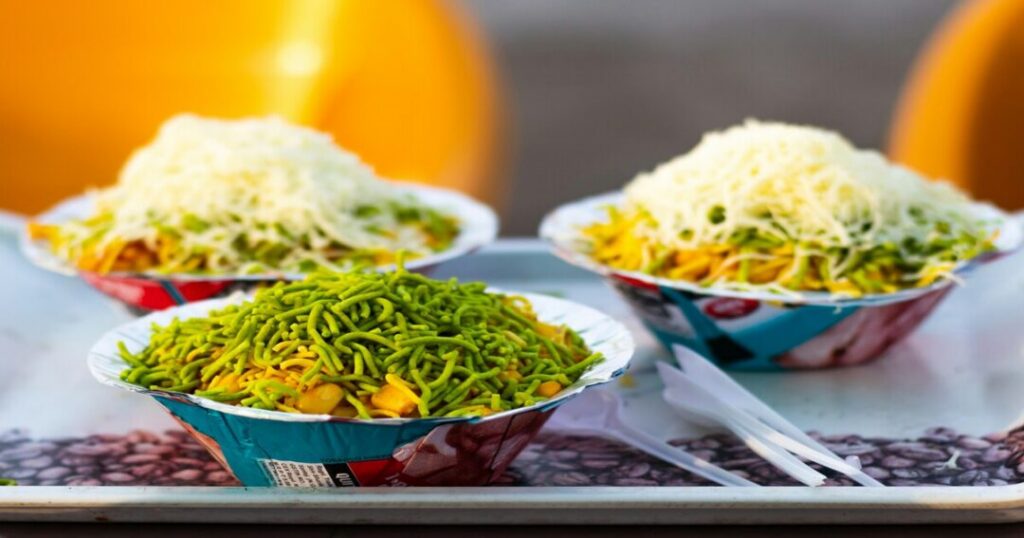
For the top street food in india in a single trip, one workable approach is to take four cities and one dish from each. This route is our own suggestion and has not been timed or costed.
- Mumbai: Vada pav and bhel puri.
- Delhi: Chole bhature for breakfast, then paranthas and chaat in the old city.
- Indore: Poha and jalebi in the morning, Sarafa Bazaar at night.
- Kolkata: Phuchka, jhalmuri and a kati roll.
Season note: The monsoon has just ended across much of central India (in Gwalior, for example, it runs from late June to early October), so mid-October is the start of the drier months, though dates vary by region. Some specialities are seasonal. Garadu in Indore is mainly a winter dish, and koraishuti kochuri is a winter speciality in Kolkata, so late autumn and winter are good times to aim for them.
Also Read: Food Festivals Around the World: The Complete Guide
Conclusion: Start With One Dish and Follow the Crowd
The best street food in India is not a single dish but a map of habits, from Mumbai’s vada pav to Kolkata’s kati roll and the momos of the Himalayas. Pick a city, choose a busy stall, and let the vendor’s pace tell you what is worth ordering.
Planning a food trip across India? Use the Explurger app to find travel companions who love eating their way through every city on the route.
FAQs About Best Street Food in India
2. Which Indian city is best for street food?
Old Delhi, Indore, Lucknow, Kolkata and Mumbai are the cities most often named. The rankings come from tourism and trade writing and not from an independent survey.
3. Is Indian street food safe to eat?
It depends on the stall. A 2025 Pune study found most sampled vendors did not meet an FSSAI checklist, while FSSAI runs vendor training and hygiene hub programmes. Choose busy stalls and freshly cooked food.
4. What is the difference between pani puri, golgappa and phuchka?
They are regional names for the same family of hollow, crisp shells filled and dunked in spiced water. Fillings and waters differ by city, for example Kolkata's tamarind water and Delhi's mint-coriander water.
5. Where did vada pav originate?
Mumbai. Wikipedia lists it as first made in 1966 and credits Ashok Vaidya and Sudhakar Mhatre, but without sources, so the details are unconfirmed.
6. What are the best vegetarian street foods in India?
Pani puri, bhel puri, vada pav, pav bhaji, dhokla, masala dosa and litti chokha are usually vegetarian, as described in the sources above, though fillings and cooking fats can vary by vendor, so ask if it matters to you.