

708 Total Views
Spain doesn’t really do “street food” the way Bangkok or Mexico City does. There are no rows of outdoor stalls or food carts lining every corner. Instead, Spanish street food lives inside—at bar counters groaning with small plates, in covered markets buzzing with vendors, and at no-sign neighborhood bodegas where the menu is chalked on a board and the wine comes by the jug.
It’s one of the most rewarding food cultures on earth. And if you know what to order, where to go, and what each region does differently, you’ll eat extraordinarily well for very little money.
This guide covers the essential dishes city by city, the cultural traditions that make Spanish eating unique, what to drink alongside the food, and everything a foodie or cultural traveller needs to eat like a local—whether you’re in Madrid, Barcelona, Seville, or San Sebastián.
🌿 = Vegetarian-friendly
The Culture Behind Spanish Street Food — Why Spain Eats Differently
Before the dishes, a bit of context—because the way Spain eats is genuinely unlike anywhere else in Europe, and understanding it makes the food taste better.
The Real History of Tapas
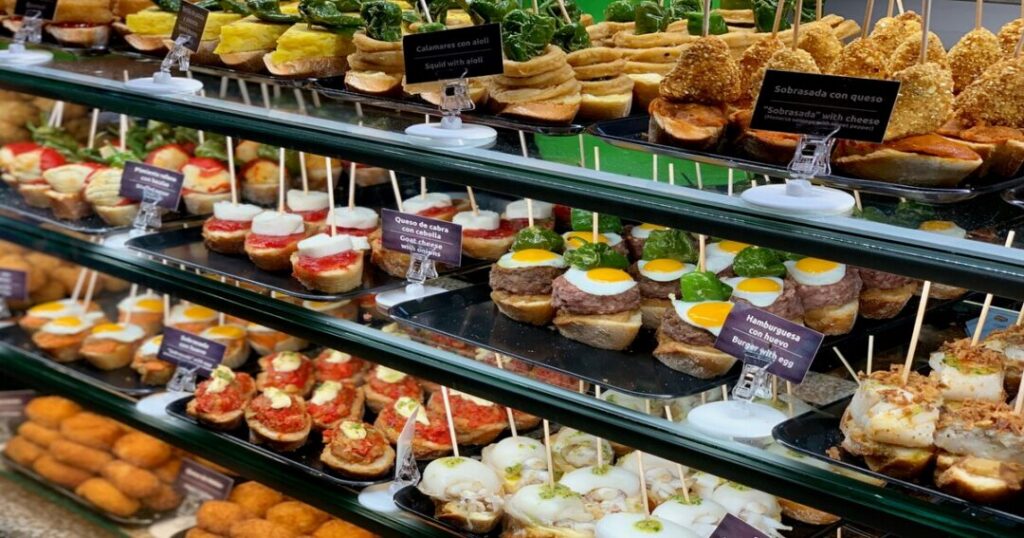
The word “tapa” comes from the Spanish verb “tapar”—”to cover.” The most popular story is that bartenders placed a slice of bread or ham over a glass of sherry to keep flies out in Andalusian taverns. But food historians are clear: the origin of tapas is genuinely contested, with at least six competing theories—including a 13th-century royal decree by King Alfonso X of Castile, a 19th-century Cádiz tavern story involving King Alfonso XIII, and a more pragmatic theory that salty food was served simply to make drinkers thirstier.
What’s certain is that the word “tapa” in a culinary sense didn’t appear in the Royal Spanish Academy dictionary until 1936, which makes any medieval legend about it impossible to verify. What matters more than the origin is the tradition it created: small plates of food eaten with drinks, moving between bars, sharing everything, staying for hours.
Bar Culture, Mercados, and Freidurías
Spanish street food operates through three main venues:
- Tapas bars and bodegas: The backbone of Spanish eating. Counter service, no reservations; you eat standing up or perched on a stool. Moving between three or four bars in an evening — a tapeo — is the authentic experience.
- Mercados (covered markets): Every major city has one—Madrid, Barcelona, Seville, and San Sebastián. These are where quality and variety collide. The best place to sample widely in a single visit.
- Freidurías: Andalusian fry shops—a defining feature of southern Spanish street eating. Paper cones of fresh fried fish, eaten standing on the pavement. Nothing quite like it anywhere else in Europe.
Also read: 10 Best Places to Visit in Spain for Indian Tourists
Regional Identity — Spain Is Not One Cuisine
| Region | Character | Signature Style |
| Madrid | Hearty, meat-forward | Fried squid, cured ham, chocolate-dipped dough |
| Barcelona / Catalonia | Fresh, market-led, Catalan-proud | Tomato bread, blistered peppers, seafood |
| Andalusia | Generous, fried, Moorish-influenced | Fried fish, cold soups, honey-drizzled aubergine |
| Basque Country | Precise, gastronomic, pintxo-led | Skewered bites, Cantabrian anchovies, txakoli wine |
| Galicia | Seafood-obsessed, Atlantic-facing | Octopus, empanadas, salt cod |
Spanish Street Food in Madrid — The Capital’s Greatest Hits
Madrid sits on a high inland plateau—no coastline, no port. And yet its most iconic street food is a fried squid sandwich. That contrast tells you something about how Madrid has always pulled the best of every region into its centre.
Bocadillo de Calamares
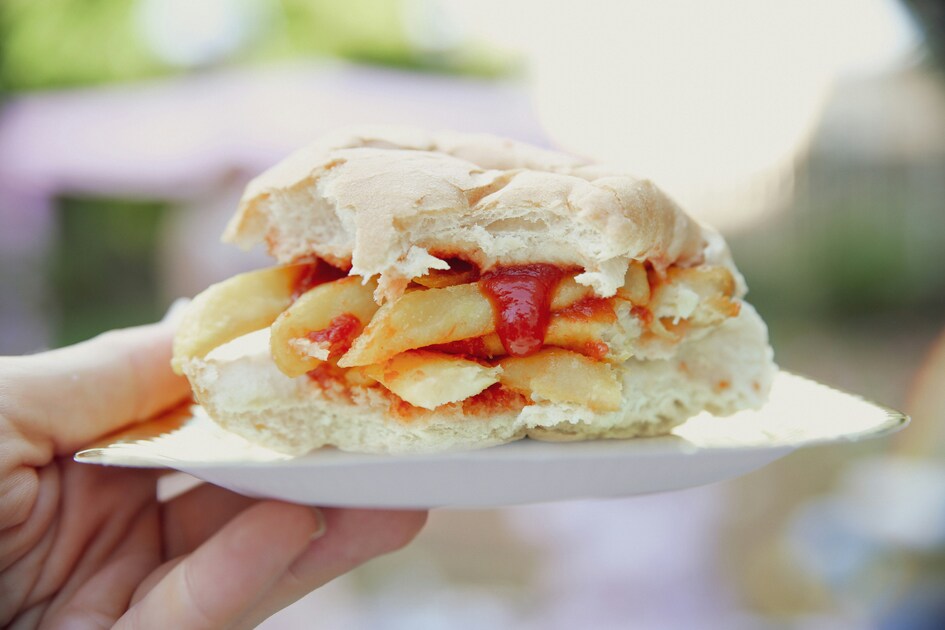
A crusty barra (baguette) packed with rings of lightly floured, deep-fried squid. No lettuce, no garnish—just squid and bread, sometimes finished with a squeeze of lemon or a streak of aioli. It sounds minimal. It tastes remarkable.
The Plaza Mayor area is the historic heartland of this dish — you’ll find it in the surrounding streets at almost every traditional bar.
- 🔴 Not vegetarian
Churros con Chocolate 🌿
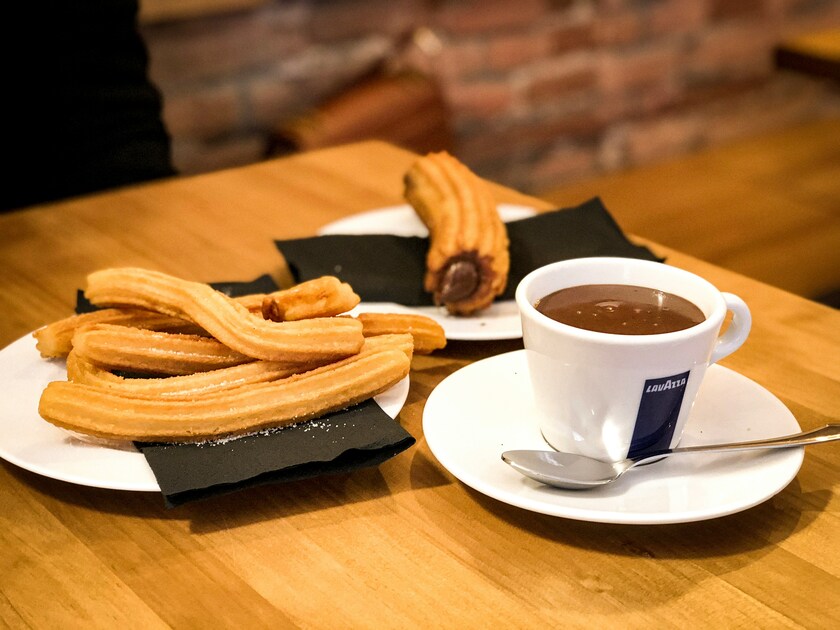
Long, ridged fried dough — crisp outside, pillowy inside — served with a cup of thick dark chocolate for dipping. In Madrid, churros are simultaneously a 7 AM breakfast and a 3 AM post-club ritual. They are made from water, flour, salt, and olive oil, piped through a star nozzle into hot oil. The chocolate is thickened with cornstarch—not cream.
- 🌿 Vegetarian
Pimientos de Padrón 🌿
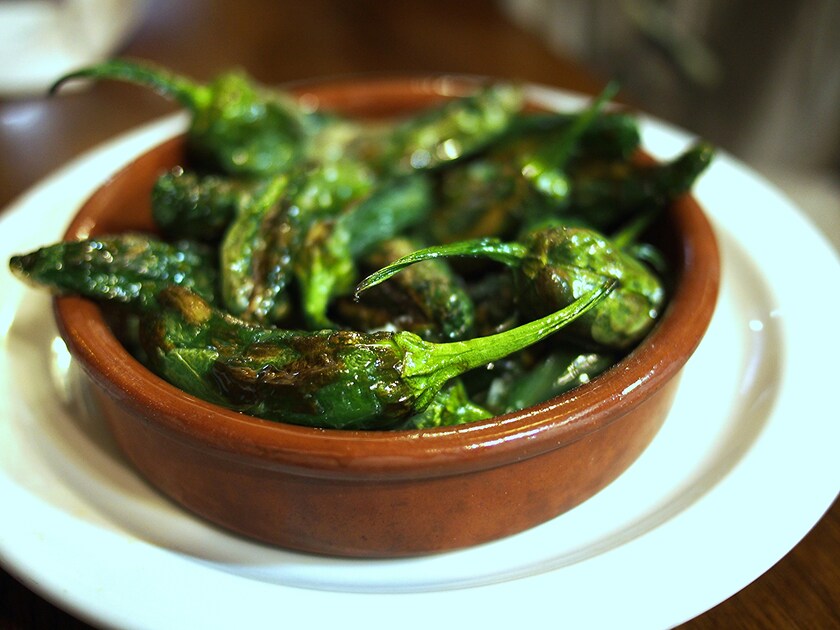
Small green peppers from Galicia, blistered in olive oil and finished with flaky sea salt. Most are mild—but roughly one in every dozen or so delivers fierce heat, and you never know which until you bite in. Ordering a plate is one of Spain’s great small pleasures.
- 🌿 Vegetarian
Tortilla Española 🌿
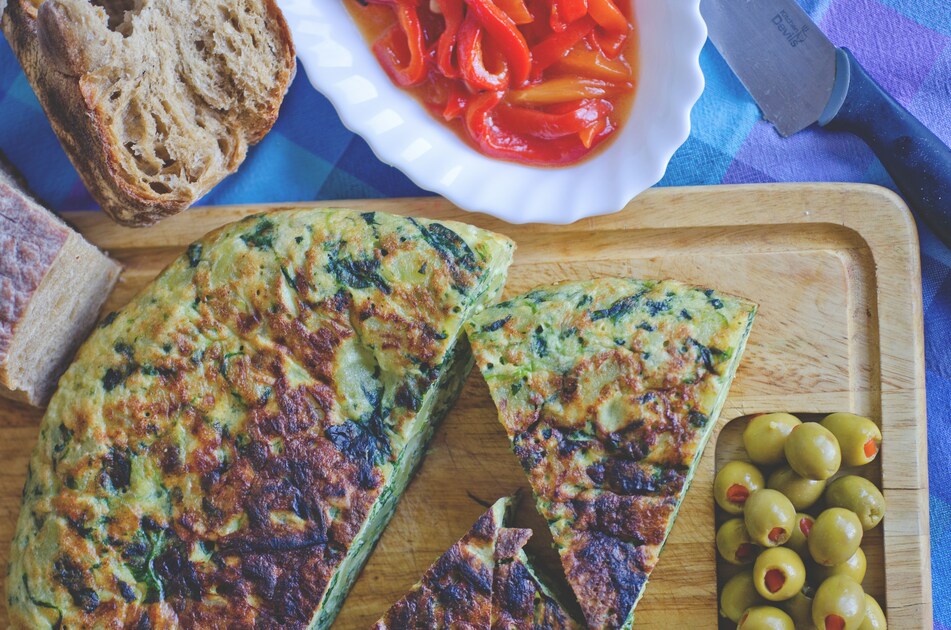
A thick omelette of potato, onion, and egg—served at room temperature in wedges—is found at every bar in the city at almost any hour. One of the genuinely great vegetarian fast bites in Spain. The great Spanish food debate is con cebolla (with onion) vs. sin cebolla (without onion). The classic version includes onion.
- 🌿 Vegetarian
Spanish Street Food Barcelona — Catalan Eating, Catalan Rules
Barcelona’s food culture is Catalan first and Spanish second — locals will remind you of the difference. The cooking here is lighter and more produce-forward than in Madrid, built around the city’s extraordinary markets and coastal access.
Pan con Tomate 🌿 (Pa amb Tomàquet)
The cornerstone of Catalan food culture. Toasted bread, rubbed with raw garlic, then rubbed hard with a very ripe halved tomato until the flesh soaks into the surface. Finished with good olive oil and sea salt. In Barcelona, bread arrives at the table with tomato and oil — not butter. It is the default.
This is also one of the most achievable Spanish street food ideas to recreate at home: ripe tomatoes, garlic, good olive oil, and toast. Five minutes, five ingredients, transformative result.
- 🌿 Vegetarian
Patatas Bravas 🌿
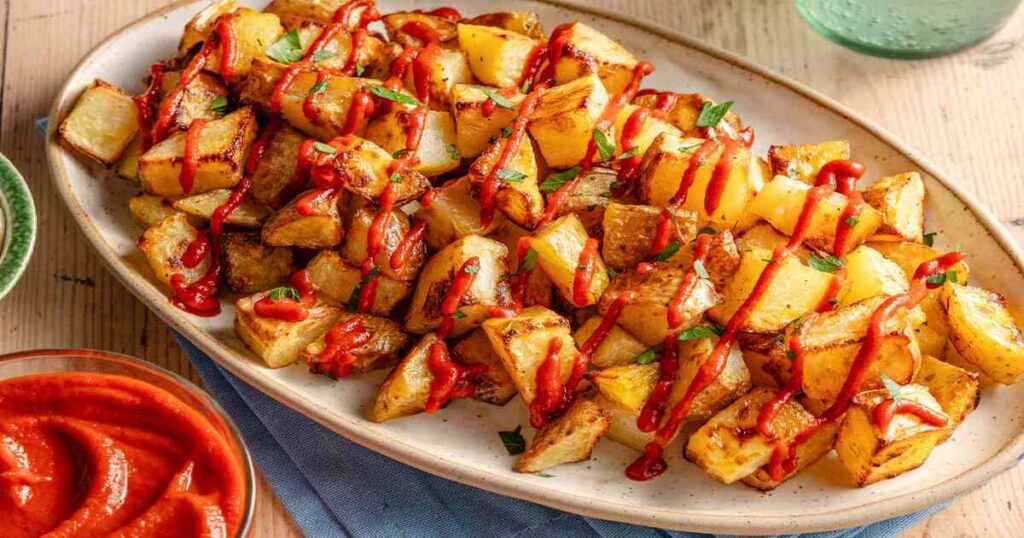
Cubed fried potatoes, crisp outside and fluffy inside, served with salsa brava—a spiced tomato sauce—and often aioli alongside. Every bar in Spain has a version. Barcelona’s tend to come with both sauces served separately, which gives you control over each bite.
- 🌿 Vegetarian
Croquetas
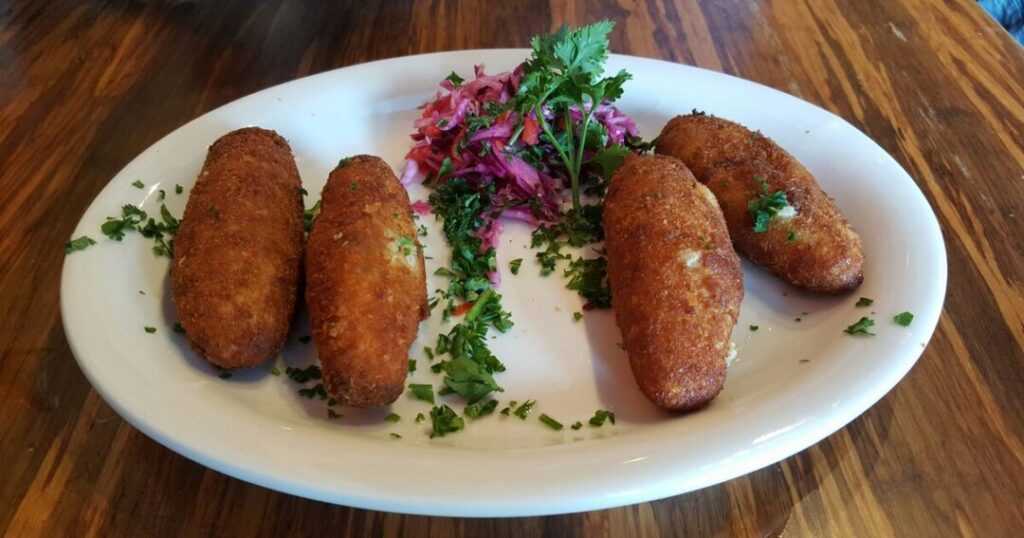
Thick béchamel—loaded with jamón ibérico, bacalao (salt cod), or mushrooms—is shaped into ovals, crumbed, and deep-fried. The shell shatters. The inside is molten and intensely savory. A well-made croquette is one of the most satisfying bites in Spanish eating.
- 🔴 Most versions not vegetarian; mushroom croquetas 🌿 are available at quality bars
In the Barceloneta neighborhood, keep an eye out for the Bomba—a dish unique to Barcelona and one of its most underrated street bites. It’s a golf ball of mashed potato, stuffed with minced meat, deep-fried, and served with aioli and a spicy sauce. Invented in the 1950s by the matriarch of a family-run bodega in the neighborhood, the Bomba has since spread to bars across the city—though Barceloneta remains its natural home.
- 🔴 Not vegetarian
Also read: e-Visa for Indians: Your Complete Guide to Visa-Free, Visa on Arrival & e-Visa Travel
Andalusia’s Spanish Street Food — Seville, Cádiz and the Deep South
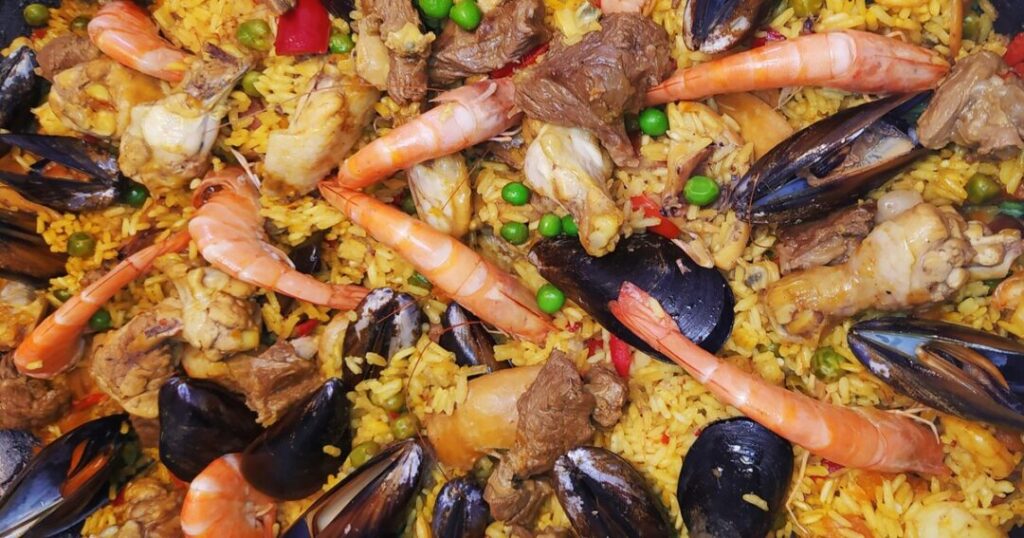
Andalusia is where Spain’s Moorish history lives most clearly in the food. Nearly 800 years of Arab presence in the region (711–1492 CE) left lasting traces: sweet-savory combinations, honey on fried vegetables, almonds in sweets, and cold tomato soups. When you eat in Seville, you are eating through layers of history that predate the Spanish nation itself.
Pescaíto Frito (Fried Fish)
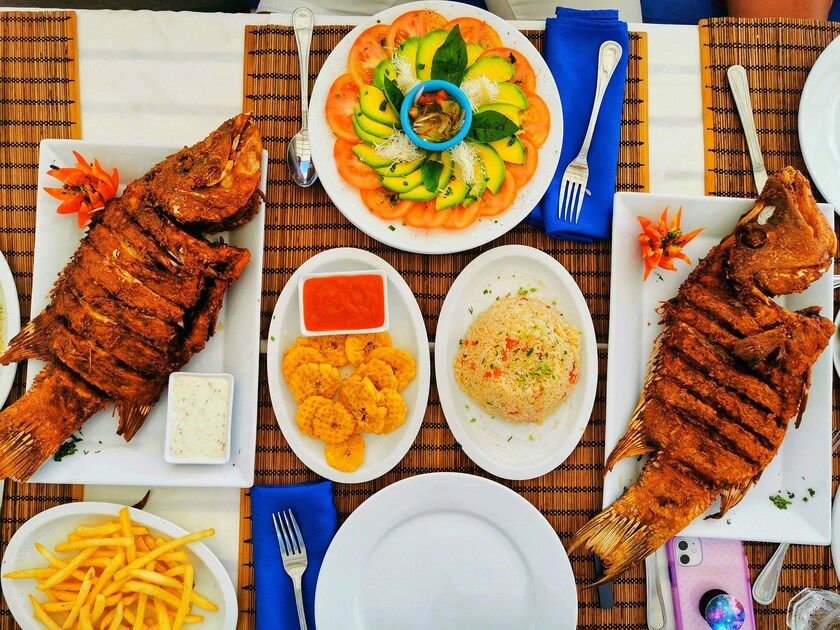
The defining Andalusian street food. Small whole fish—anchovies, whitebait, tiny sole, and baby squid—dusted in harina de fritura (a fine wheat flour specific to the region), fried whole in olive oil, and served in a paper cone. Eaten with your fingers, standing up, ideally alongside a cold beer or glass of dry sherry. Andalusia produces the majority of Spain’s olive oil—and Spain is the world’s largest olive oil producer—so the frying here is done in exceptional oil.
- 🔴 Not vegetarian
Montaditos 🌿
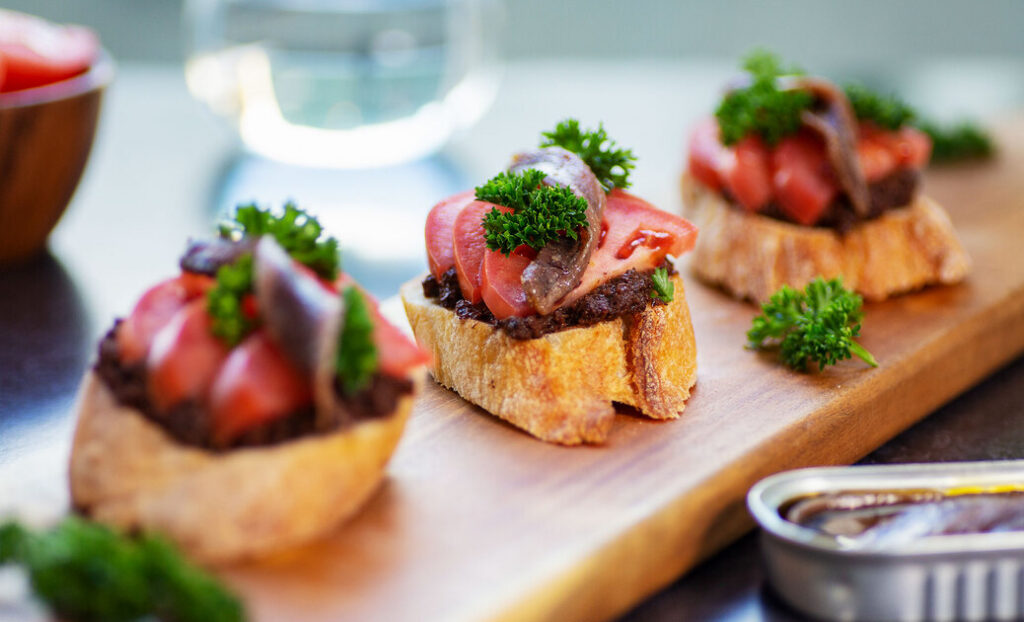
Small open bread slices, each topped with a single ingredient: jamón, Manchego cheese, roasted pepper, anchovy, or olive tapenade. Eaten in rounds of three or four as you move between bars. This format became one of the most recognizable forms of Spanish fast food across the country—informal, affordable, and infinitely adaptable.
- 🌿 Many vegetarian options — cheese, roasted pepper, olive, tomato
Berenjenas con Miel 🌿 (Aubergine with Honey)
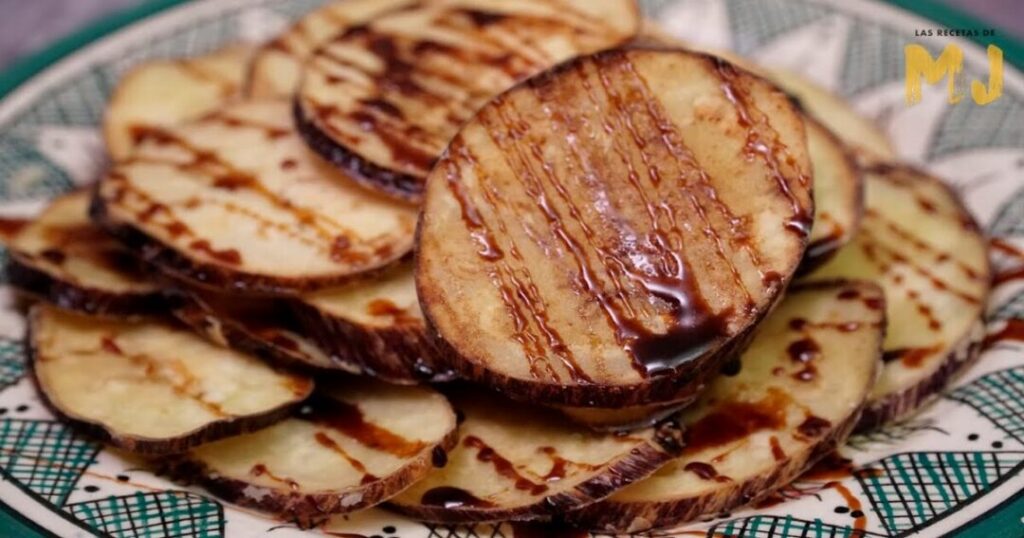
Thin aubergine slices, battered and fried light and crisp, are drizzled with dark cane honey or molasses. A dish with direct Moorish ancestry — the sweet-and-fried combination is characteristic of pre-Reconquista Andalusian cooking. One of the great vegetarian dishes in Spain and consistently underrated by food guides.
- 🌿 Vegetarian
Boquerones en Vinagre
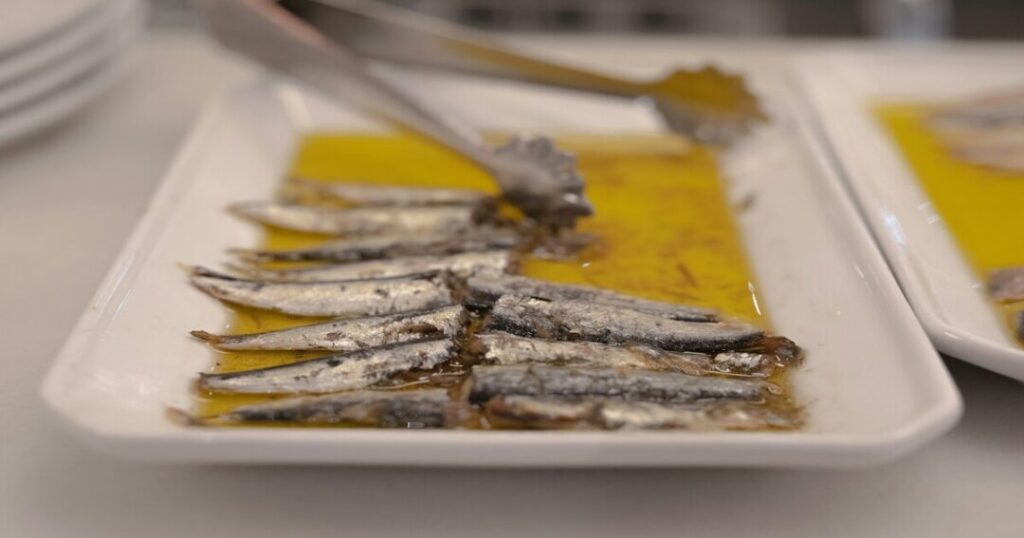
White anchovies are marinated raw in white wine vinegar until the acid “cooks” them — a technique with ancient Mediterranean roots. Served cold, dressed with olive oil, garlic, and parsley. One of the most widely eaten tapas across Andalusia and one of the best things to eat at a traditional bar in the south.
- 🔴 Not vegetarian — fish
Basque Country Bites — San Sebastián’s Pintxo Culture
San Sebastián (Donostia in Basque) has more Michelin stars per capita than almost anywhere on earth. Its street food reflects this—precise, ingredient-driven, and taken with considerable seriousness.
Pintxos — How Do They Actually Work?
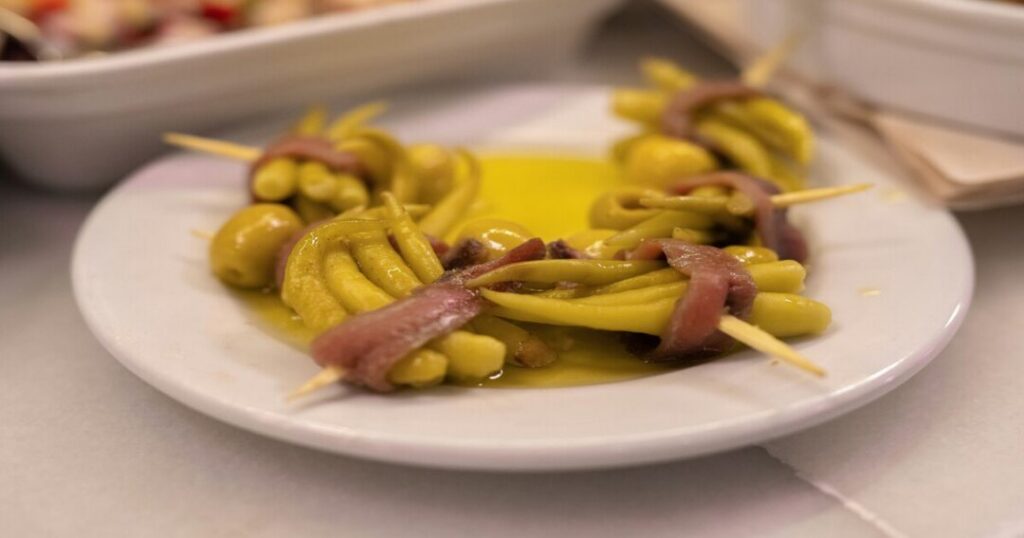
Pintxos (pronounced peen-chos, also written “pinchos” in Spanish) are small bites served on slices of bread, pinned with a toothpick. Bars display trays along the counter. You take what you want and keep your toothpicks, and the bartender counts them when you pay.
Unlike tapas, which are shared plates often brought to a table, pintxos are individual bites, each priced separately. This is not a Basque version of tapas. It is its own tradition, its own culture, and its own ritual.
- 🌿 Many vegetarian options—tortilla, cheese, roasted pepper, mushroom
The Gilda — The Original Pintxo
A skewer of one guindilla or piparra pepper (a mild pickled Basque green pepper), one salted Cantabrian anchovy, and one manzanilla olive. Three ingredients. The Gilda is widely considered the first pintxo ever created.
It was assembled in the 1940s at Bar Casa Vallés in San Sebastián—not by the bar’s owners, but by a regular customer named Joaquín Aramburu, nicknamed “Txepetxa,” who began threading together the bar’s individual snacks onto a single toothpick. The name came from the 1946 Rita Hayworth film Gilda—because the pintxo, like the character, was considered “salty, spicy, and a little dangerous.”
The bar where it was created is still open today. The Gilda has not changed.
- 🔴 Not vegetarian (anchovy)
Gambas al Ajillo
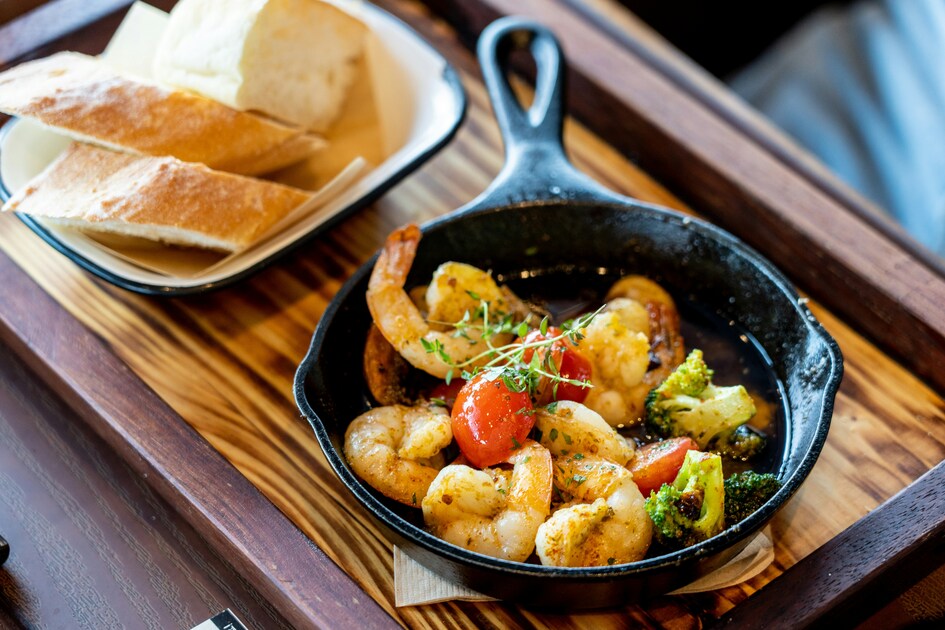
Prawns cooked fast in a small terracotta dish with sizzling olive oil, garlic, dried chili, and a splash of dry sherry. It was served still bubbling at the table. One of the most universally loved bar dishes in Spain, found everywhere from San Sebastián to Seville, always arriving dramatically.
- 🔴 Not vegetarian
Spanish Fast Food — What Locals Actually Eat Every Day?
The phrase “Spain fast food restaurants” usually refers to international chains, which exist across Spain. But Spain’s genuine fast food culture predates those chains by centuries and is far more interesting.
The Real Spanish Fast Food
- Bocadillo — a filled baguette eaten at 11 AM by workers, students, and professionals across the country. Standard fillings: jamón serrano, tortilla española, manchego. The Spanish meal deal. Available at every bakery and bar.
- Tortilla Española 🌿— Its role as an all-day bar snack sold by the wedge makes it one of the most practical forms of fast food in Madrid, Spain, and across the country.
- Empanada Gallega — Galicia’s flaky pastry parcel, filled with tuna and tomato, chicken, or spinach and cheese. Sold by the slice in bakeries and markets all over Spain.
- Pimientos de Padrón 🌿 — blistered peppers with sea salt; ordered and eaten at a bar counter in under five minutes.
Spain Fast Food Restaurants Worth Knowing
Beyond international chains, a few Spanish formats have scaled nationally:
- Montadito bars — the montadito chain format; quick, affordable, and genuinely Spanish in feel
- Mid-market tapas chains—operate across major cities with consistent quality
- Mercados—covered food markets in every major city function as Spain’s best fast food courts: fresh, local, varied, and often cheaper than restaurants
Also read: 25 Best Countries to Visit in March 2026 from India
Spanish Street Food and Culture—What the Food Tells You?
For the culturally curious traveler, Spanish street food is a living history lesson.
The Moorish Thread
Andalusia was under Moorish presence for nearly 800 years (711–1492 CE), and that influence is visible on every plate in the south. Berenjenas con miel—fried aubergine with honey—is a direct descendant of Andalusian Arab cooking. Almonds in sweets, saffron in rice, the sweet-sour-salty combinations running through southern Spanish cuisine: all trace back to Al-Andalus. The food of Seville carries a historical depth that most visitors don’t fully appreciate until someone points it out.
The Jamón Culture
Jamón ibérico—the cured leg of an acorn-fed Iberian black pig—is not a garnish in Spain. It is a subject of serious national conversation, with four official quality grades, its own regulatory body (Denominación de Origen), and the cultural gravity that wine has in France. At a bar, it is carved thin by hand, served at room temperature, and eaten slowly. It deserves your full attention.
In San Sebastián, the evening pintxo crawl — called a txikiteo — is the primary social ritual of the city. Groups move from bar to bar in the old town, drinking a small glass of txakoli (the local Basque sparkling white wine) and eating two or three pintxos at each stop. It is one of the most civilized ways of spending an evening on earth—and understanding it as social architecture, not just a food experience, changes how you engage with it.
The Mercado as Community
Spain’s covered food markets are not tourist attractions in origin—they are the infrastructure of daily life. The vendors in Madrid’s, Barcelona’s, and Seville’s great markets have supplied their neighbourhoods for generations. Going to a market is not just about eating — it is participating in how a city sustains itself. Buy something you don’t recognize. Ask the vendor what it is and how to eat it.
Also read: The Most Beautiful Villages in the World You Should Add to Your Bucket List
What to Drink Alongside Spanish Street Food?
No food guide to Spain is complete without the drinks:
- Txakoli—Basque sparkling white wine, very dry, traditionally poured from a height to aerate it. The correct pairing for pintxos in San Sebastián.
- Manzanilla / Fino Sherry — dry, cold, and nutty. The classic accompaniment to pescaíto frito and jamón in Andalusia. Deeply underrated outside of Spain.
- Vermut (Vermouth) — Spain has a thriving vermut culture entirely its own, separate from the Italian tradition. Served cold over ice with an olive, usually as a pre-lunch aperitif. The hora del vermut (12–2 PM) is taken seriously across the country.
- Canas—small glasses of draft lager. The default accompaniment to almost anything. The correct size for drinking across multiple bars in an evening.
- Agua con gas — sparkling water, for non-drinkers. Spanish bars are not pushy about alcohol, and sparkling water with a plate of patatas bravas is a completely normal order.
Spanish Eating Times — The Cultural Key Most Visitors Miss
Understanding when Spain eats is as important as understanding what it eats.
- Breakfast (desayuno): 8–10 AM — a coffee and a pastry or toast. Brief and functional.
- Vermouth hour: 12–2 PM — aperitifs and small bites before lunch. One of the most enjoyable rituals in Spanish food culture.
- Lunch (comida): 2–4 PM — the main meal of the day.
- Tapas/pintxos hour: 7–10 PM — the pre-dinner ritual. This is when the bars fill with locals.
- Dinner (cena): 9–11 PM — later than almost anywhere else in Europe.
Arriving at a bar at 6 PM, looking for food often means finding the kitchen not running. Eating at Spanish times dramatically improves both the food and the experience around it.
Traveller’s Notes
“The mistake I made my first time in Spain was eating at restaurants with translated menus near the big sights. On my second trip, I walked into whichever bar had the most locals at the counter. The food was better and half the price. Pan con tomate near the Barceloneta market at 11 AM is still the best thing I’ve eaten in Europe.—Food traveller, Spain travel community
“San Sebastián’s old town on a Friday evening — going bar to bar in the Parte Vieja eating gildas and drinking txakoli — is genuinely one of the best experiences of my life. The whole evening cost less than a restaurant main course in London.” — Solo traveller, Basque Country
FAQs about Spanish Street Food
2. What is the most popular street food in Spain?
Tapas, as a category, represent the most popular form of Spanish street food. Among individual dishes, patatas bravas and croquetas appear on virtually every bar menu across the country. In Madrid, the bocadillo de calamares (fried squid sandwich) is the local icon. In Barcelona, pan con tomate is the foundational Catalan dish. In Seville, pescaíto frito from a friduría. In San Sebastián, the gilda pintxo. Spain's street food culture is intensely regional — the most popular dish changes completely depending on where you are.
3. What is the difference between tapas and pintxos?
Tapas are small shared plates served at bars across Spain — hot or cold, sometimes free with a drink in parts of Andalusia and the Basque Country. Pintxos are the Basque Country's distinct tradition — individual bites on small pieces of bread, each pinned with a toothpick (pintxo means "spike" in Basque). Pintxos are individually priced; you take from the bar counter and pay per piece by counting your toothpicks at the end. Both are central to Spanish street food culture but belong to entirely separate regional traditions with their own rules and rituals.
4. Is Spanish street food vegetarian-friendly?
More than most people expect, yes. Several of Spain's most iconic dishes are naturally vegetarian: pan con tomate, patatas bravas, churros con chocolate, pimientos de Padrón, tortilla española, berenjenas con miel, and many pintxo varieties. The challenge is that jamón (cured pork) and anchovies appear widely — always ask if you are strict. Andalusia and Barcelona tend to offer the widest vegetarian variety. San Sebastián's pintxo bars also carry a strong selection of vegetarian bites across tortilla, cheese, and roasted vegetable options.
5. What are the most famous Spanish street foods in Barcelona?
The most essential Spanish street food Barcelona dishes are: pan con tomate (pa amb tomàquet) — toasted bread rubbed with tomato, garlic, and olive oil, which is Catalan in origin and served at virtually every bar in the city; patatas bravas — fried potato cubes with spiced tomato sauce and alioli; croquetas — fried béchamel parcels filled with jamón or bacalao; and the Bomba — a Barceloneta-born deep-fried potato ball stuffed with minced meat invented in the 1950s. Barcelona also has a strong pintxo scene of its own, influenced by the Basque tradition.
6. What is the street food culture like in Madrid?
Madrid's street food culture is built around the tapeo — moving between bars, eating standing at the counter, ordering two or three things per stop. The city's most iconic items include the bocadillo de calamares (fried squid sandwich), churros con chocolate, pimientos de Padrón, and tortilla española. Fast food in Madrid, Spain, in the local sense means bocadillos from bakeries, tortilla wedges from bar counters, and tapas eaten on your feet — not sit-down meals. Madrid's covered food markets in the central districts are excellent places to sample a wide variety quickly.