
1,271 Total Views
You have been on the shikara. You have watched the sunset turn the Zabarwan range pink from the houseboat deck. You have visited Shalimar Bagh and stood under the chinar trees. You know what Srinagar is when it is performing for visitors. This guide is for the version underneath that: the city that existed before the houseboats were tourist accommodation, the shrines that have been receiving pilgrims for six centuries, the market where the city’s vegetables arrive on boats before dawn, the garden on the ridge that most visitors drive past without stopping, and the food tradition that the Mughals brought to Kashmir and that Kashmir has since made entirely its own.
Srinagar—the summer capital of Jammu & Kashmir, situated at approximately 1,585 meters in the Kashmir Valley on the banks of the Jhelum River—is one of the oldest continuously inhabited cities in India. It has been the center of Kashmiri culture, art, Sufi spirituality, Mughal pleasure, and mountain commerce for over a millennium. The places to visit in Srinagar that reveal this depth are not always the most photographed.
Best Places to Visit in Srinagar for a Memorable Kashmir Trip
The Mughal Gardens—Reading the Terraces
Shalimar Bagh — The High Point of Mughal Horticulture
Shalimar Bagh — built in 1619 by Emperor Jahangir for his wife Noor Jahan — covers 12.4 hectares (31 acres) on the northeast shore of Dal Lake and is considered the high point of Mughal horticulture in the subcontinent. Three terraces ascend from the lakeshore: the Diwan-e-Aam (public audience hall) with a black marble throne installed over a waterfall, the Diwan-e-Khas (private audience), and the zenana (women’s quarters). The garden was linked to Dal Lake through a canal approximately 1.6 km long and 11 meters wide—visitors originally arrived by boat through willow groves and rice terraces.
What most visitors miss: the garden has been read too quickly for too long. Shalimar rewards an unhurried half-day—the chinar avenues in October when the leaves turn, the sound of water moving through the stone channels between terraces, and the black marble throne that Jahangir sat on while watching the fountain below.
Shah Jahan later extended Shalimar with the Fayz Bakhsh (“Bounty-Bestowing”) zenana section in 1630—the black marble pavilion added at that time is one of the finest examples of Mughal decorative stonework in Kashmir.
- Best time: October (chinar in full colour) or early morning in spring before the tour groups arrive
- The Shahnahar (feeder canal) running through the garden is one of the finest pieces of Mughal water engineering in the valley
Nishat Bagh: The Garden of Joy Built on Jealousy
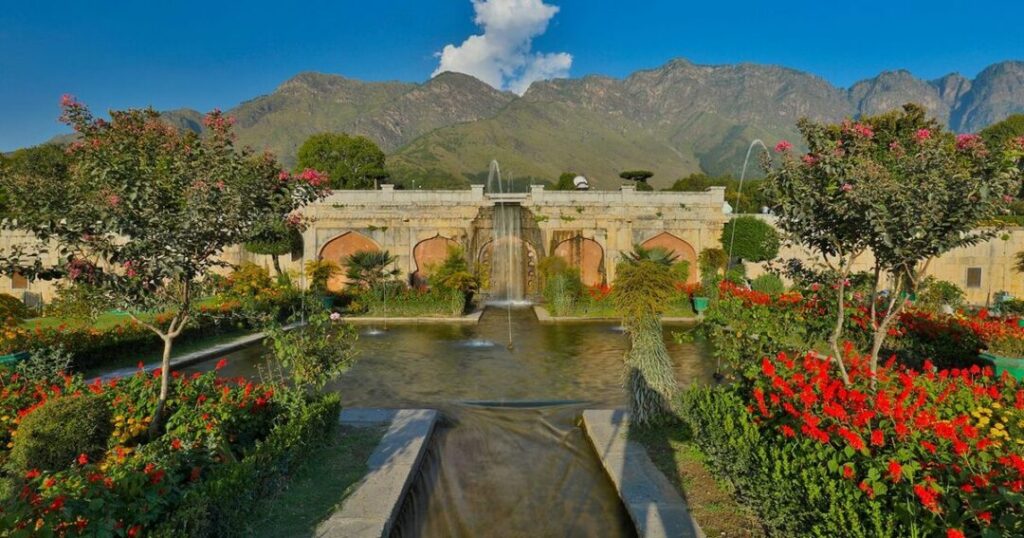
Nishat Bagh (Garden of Joy) — the second-largest Mughal garden in the Kashmir Valley at 19 hectares — was built in 1633 by Asif Khan, elder brother of Nur Jahan. It has 12 terraces representing the 12 zodiacal signs, rising from the lakeshore to the Zabarwan Mountains behind—the widest single axis of any Mughal garden in Kashmir.
The garden’s most famous story involves jealousy: Shah Jahan, visiting the garden after Asif Khan’s death, was so struck by its beauty that he reportedly demanded ownership. When Asif Khan’s son refused, Shah Jahan ordered the garden’s fountains stopped. They remained dry until a courtier reportedly lost control of his emotions at the sight of the dried garden and wept openly—Shah Jahan, moved, restored the water. The story may be apocryphal; the garden is real.
- 12 terraces are walkable; each has a different character and view—do not stop at the first terrace and photograph
- The view from the upper terraces—Dal Lake below, Zabarwan above, and the garden’s chinar-lined axis descending to the water—is one of the finest composed landscape views in India
Pari Mahal—The Angel’s Palace Nobody Visits
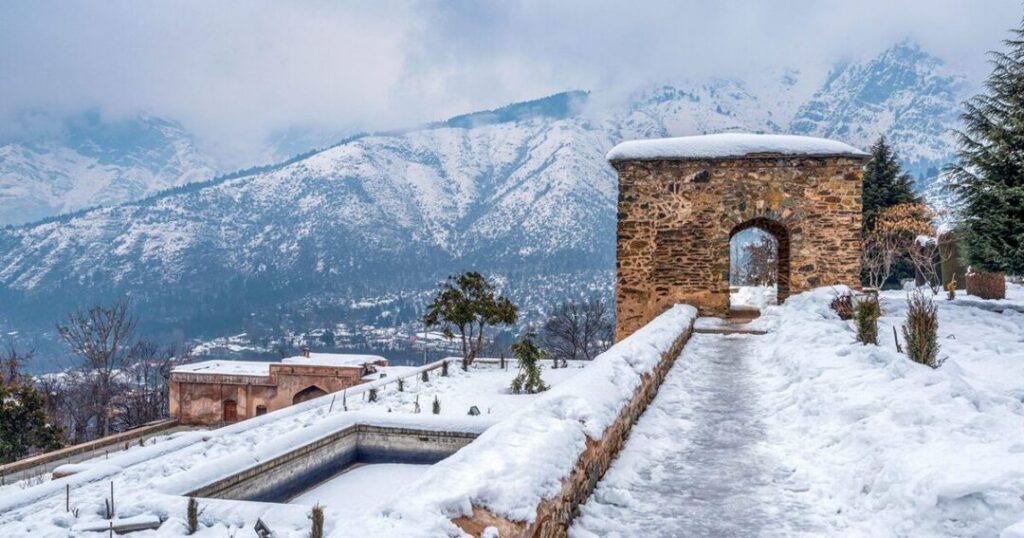
Pari Mahal (“Palace of Fairies”) — a seven-terraced Mughal garden built in 1650 by Shah Jahan at 5,200 feet (1,600 m) on the Zabarwan ridge above Srinagar — is the most dramatically sited and most undervisited of all the Srinagar Mughal gardens. It perches directly above the city on the ridge that separates Srinagar from the forests above, with the full expanse of Dal Lake visible below and the Zabarwan peaks immediately behind.
The garden was originally built as an observatory and residence for Shah Jahan’s son Dara Shikoh — a philosopher-prince who translated the Upanishads into Persian and studied both Sufi and Hindu mystical traditions before being executed by his brother Aurangzeb in 1659. Pari Mahal carries his intellectual legacy: it was a place of study, contemplation, and the specific Kashmir tradition of finding God in landscape.
- Access requires driving up a switchback road above Chashme Shahi; most visitors see it from the road and continue; it deserves at least an hour
- The sunset view of Dal Lake from Pari Mahal’s upper terrace is one of the finest viewpoints accessible by road in Srinagar
- Entry is nominal; the ruins are largely unrestored, but the setting is extraordinary
Also Read: Kashmir Food: 12 Must-Try Dishes Every Traveller Needs to Eat
Old City & Sufi Shrines — The Soul of Srinagar
Shah-i-Hamdan Mosque—The Oldest and the Finest
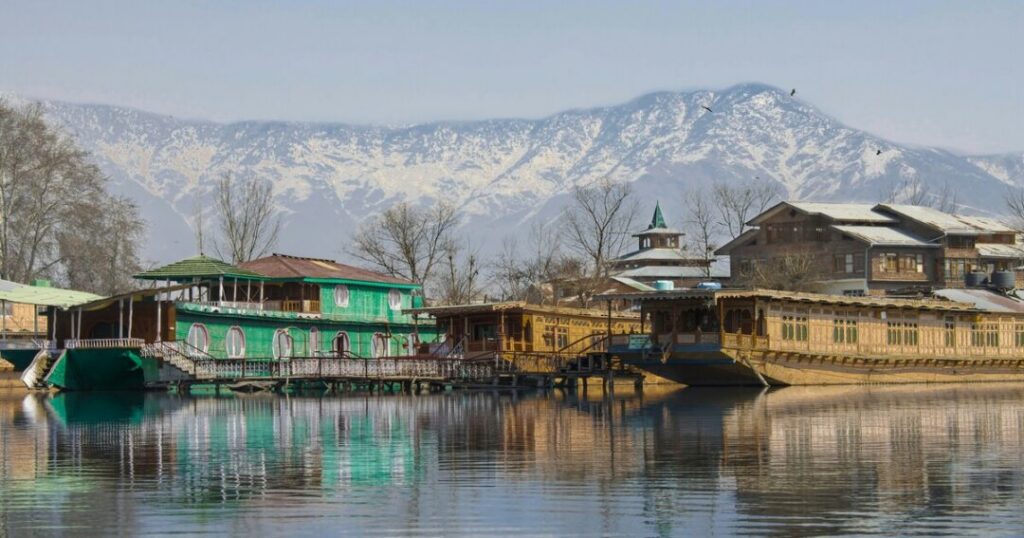
The Khanqah-i-Moula (Shah-i-Hamdan Mosque) on the banks of the Jhelum River is one of the most beautiful religious buildings in Central Asia — a wooden mosque built in 1395 CE on the instructions of Mir Syed Ali Hamadani, the great Sufi scholar from Hamadan (in present-day Iran) who is credited with bringing Islam to the Kashmir Valley. The mosque has been rebuilt multiple times after fires—the current structure dates primarily from the 17th century—but the original papier-mâché interior decorative technique (intricate geometric patterns painted on the walls and ceiling in deep red, blue, and gold) has been maintained continuously.
Shah-i-Hamdan’s arrival in Kashmir in the 14th century transformed the region’s religious culture — his emphasis on Sufi devotional practice, music, and the integration of Islamic mysticism with the valley’s existing spiritual traditions created the specific Kashmiri Islam that remains distinct from both the Arabian Peninsula and South Asian mainland traditions.
- Non-Muslim visitors are welcome in the outer courtyard; the interior of the prayer hall is not open to non-Muslims
- The riverside setting—with the old wooden bridge and the Jhelum visible behind—is one of the finest urban scenes in Srinagar
- Best experienced on a Friday morning when the community gathers
Makhdoom Sahib Shrine — The Climb Above the City
Makhdoom Sahib (Hazratbal area, Hari Parbat hill)—the shrine of Sheikh Hamza Makhdoom, a 16th-century Kashmiri Sufi poet revered as the “Sultan of Kashmiri Saints”—sits on the slope of Hari Parbat hill above Srinagar, reached by a steep flight of stone stairs from the old city below. The climb is the preparation; the shrine at the top commands a panoramic view of the city, the lake, and the Zabarwan range.
Sheikh Hamza Makhdoom is buried here alongside other members of his family. His waqf (religious endowment) established schools, wells, and charitable institutions across Kashmir in the 16th century; his Sufi poetry in Kashmiri (Kashmiri kalam) is still recited at shrines across the valley.
Hazratbal Shrine—The Relic on the Lake
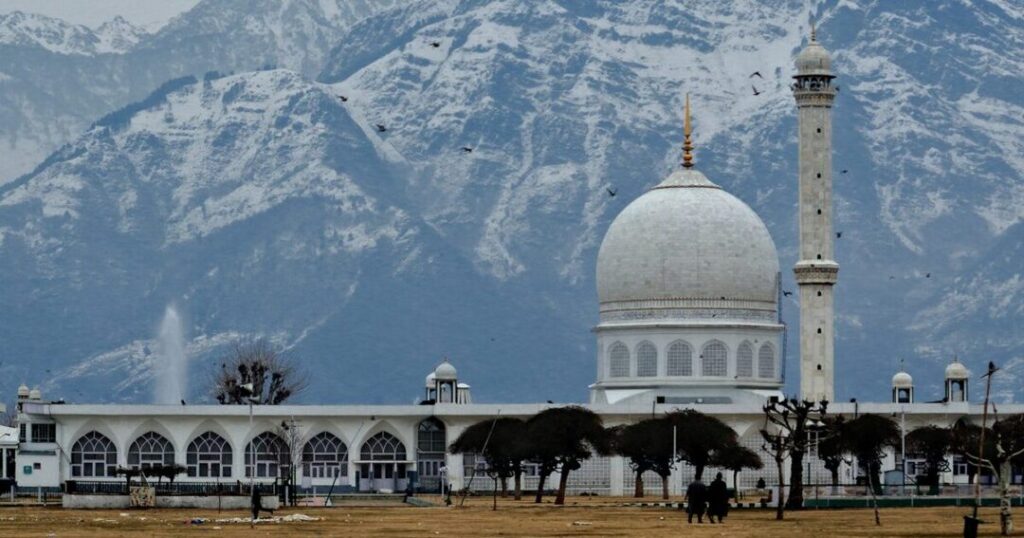
Hazratbal Shrine on the western shore of Dal Lake is the most significant Muslim shrine in Kashmir—a white marble mosque housing what is believed to be a hair of the Prophet Muhammad (moe-e-muqqadas). The relic was brought to Kashmir in the 17th century and has been housed at Hazratbal since 1700. The shrine draws enormous pilgrimage crowds on Islamic holy days, particularly Eid Milad-un-Nabi and the anniversary of the relic’s return after its disappearance and recovery in 1963—one of the most significant events in 20th-century Kashmiri history.
The setting alone is extraordinary: the white marble dome reflected in Dal Lake, with the Zabarwan hills behind and the Himalayan snowline visible on clear days.
The Floating Market & Shikara Culture — Dal Lake at Dawn
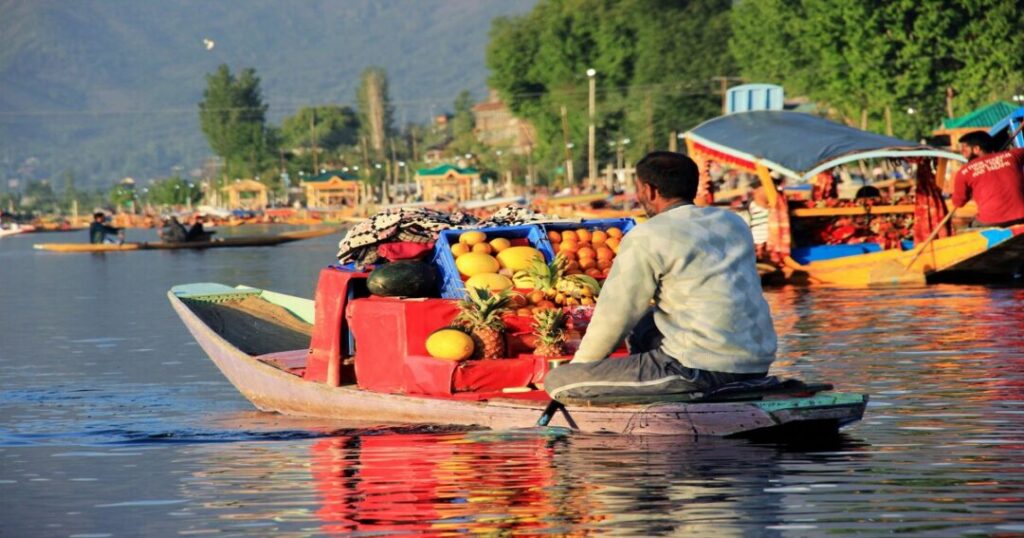
The Dal Lake Floating Market
The most authentic Dal Lake experience is not the sunset shikara ride—it is the floating vegetable market that operates at dawn on the channels between the floating gardens (dems) northwest of the main lake. Farmers who live on the dams bring their produce by boat to the floating market—nadru (lotus stem), turnips, tomatoes, and leafy greens—where traders purchase it by boat-to-boat transaction. The entire transaction takes place on the water: no land, no market building, no stalls.
The market begins at approximately 5:30–6:00 AM and is largely over by 8 AM. Reaching it requires hiring a shikara from the main ghat before dawn — most hotel shikaras will arrange this with enough notice.
Why it matters: The floating market is not a tourist spectacle. It is a functioning agricultural economy that has operated on Dal Lake for centuries—the dems (floating gardens formed from accumulated aquatic vegetation anchored to the lake bed) have been cultivated since the Sultanate period. Witnessing it at dawn, before the tourist shikaras begin their rounds, is one of the most memorable Srinagar attractions available.
The Nagin Lake — Dal’s Quieter Sister
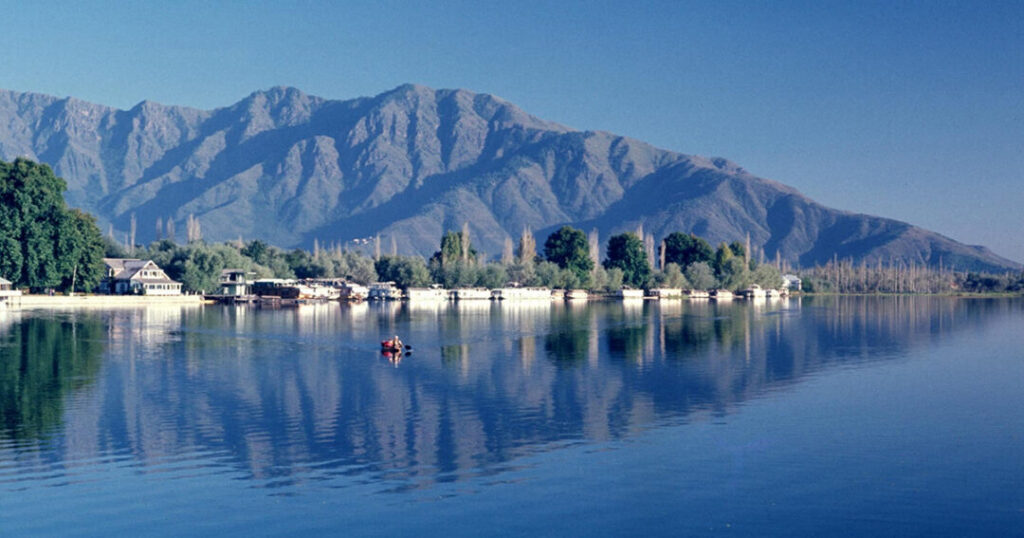
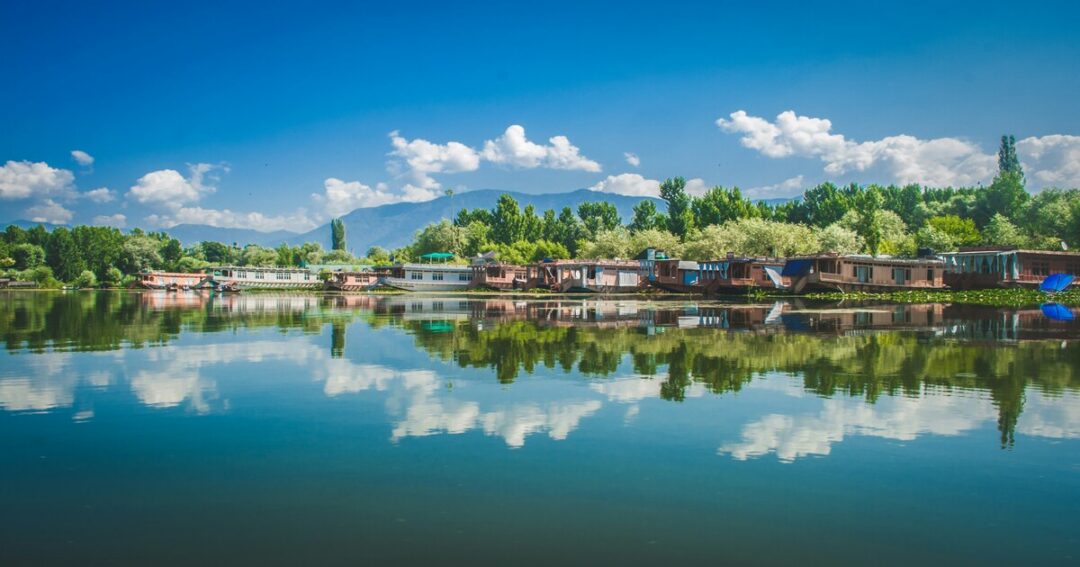
Nagin Lake — connected to Dal Lake by a narrow channel — is smaller, less visited, and in many ways more beautiful. The houseboats on Nagin are fewer; the water is cleaner; the surrounding poplar and chinar trees are reflected in the surface with less disturbance. The shikaras here are hired by locals rather than tourists. Nagin Lake is what Dal Lake was before infrastructure and tourism scale changed the equation.
Char Chinar — The Island of Four Chinars
Char Chinar (Roza Bal or Rupadevi Island)—a small island in Dal Lake named for the four massive chinar trees (Platanus orientalis) planted at its corners—is one of the most photographed objects in Kashmir and yet almost never visited in person. The island is tiny, accessible by shikara from the main lake, and the four chinars frame a small garden that in autumn turns extraordinary shades of gold and red.
The chinar (boein in Kashmiri) is the most beloved tree of the valley—planted by the Mughals, inseparable from the visual identity of Kashmir’s autumn, and specifically associated with Srinagar’s parks and gardens.
Pather Masjid — Shah Jahan’s Stone Mosque
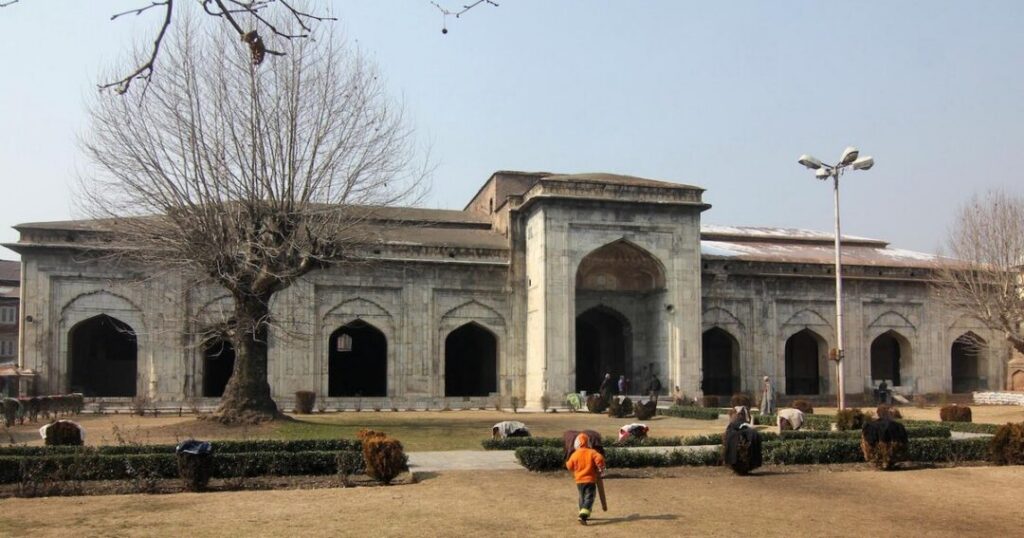
The Pather Masjid (“Stone Mosque”)—built by Shah Jahan’s wife, Noor Jahan, in 1623 on the banks of the Jhelum—is a departure from the wooden architecture that defines most of Srinagar’s historic buildings. Built entirely in grey limestone, it is the only Mughal-era stone mosque in Srinagar and has a severely elegant simplicity that distinguishes it from both the ornate wooden shrines and the Mughal garden pavilions. It is currently not in active use and is largely unvisited—one of the most architecturally significant places of interest in Srinagar that the tourist circuit has not reached.
Rozabal — The Most Debated Tomb in the World
Rozabal in the Khanyar area of the old city is a small, ordinarily appearing Sufi shrine whose occupant has attracted extraordinary international attention. The tomb is officially that of Youza Asaph, a Sufi saint. A parallel tradition — with no mainstream scholarly support but enormous cultural resonance — claims the tomb is that of Isa (Jesus), who supposedly survived the crucifixion and traveled east. The claim is not credible historically, but the site’s significance as a Sufi shrine is genuine, and the surrounding old city lanes are among the finest examples of traditional Kashmiri wooden architecture in the city.
Wazwan — The Food That Defines Kashmir

Wazwan is the ceremonial feast of Kashmir—a multi-course meal traditionally prepared by a specialist cook (waza) for weddings and significant gatherings, comprising 36 courses, of which the most important are seven meat preparations. The waza tradition traces back to the Kashmiri cooking techniques brought to the valley by Central Asian merchants and refined over centuries into a cuisine of extraordinary complexity.
The essential Wazwan preparations:
Rogan Josh — the most internationally famous Kashmiri dish; slow-cooked lamb in a sauce colored and flavored with Kashmiri red chilies (mild and extraordinarily fragrant rather than hot), dried ginger (sonth), fennel (saunf), and a small amount of curd. The color comes from the chili, not from tomato—no tomato is used in authentic Rogan Josh. The dish’s name is believed to derive from the Persian roghan (oil) and josh (heat/passion).
Yakhni is lamb cooked in a yogurt-based sauce with fennel and cardamom; it’s white, delicately spiced, and the precise opposite of Rogan Josh’s intensity. Both are essential to understanding Wazwan’s range.
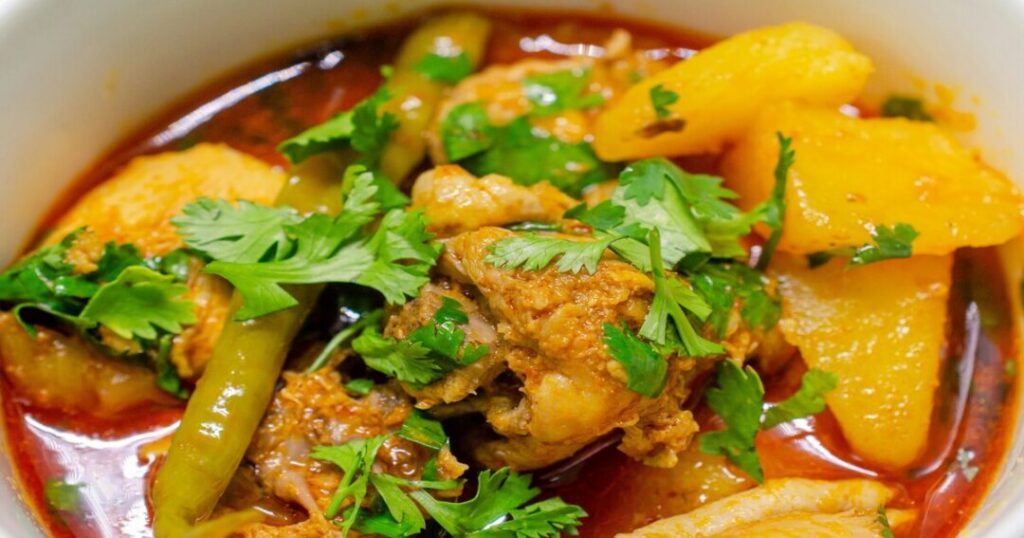
Gushtaba—minced lamb pounded smooth and formed into large meatballs, cooked in a yogurt gravy; traditionally the concluding dish of the Wazwan—its arrival signals that the feast is ending.
Nadru yakhni—lotus stem cooked in the same yogurt-fennel sauce as the meat yakhni; the lotus stem (nadru) of Dal Lake is one of the most distinctively Kashmiri ingredients in existence, available only here and in the connected wetland systems.

Shab deg—turnips and lamb slow-cooked overnight—is traditionally a winter preparation; the turnip absorbs the lamb’s fat, and the night-long cooking produces a depth of flavor that no quick preparation replicates.
Day Trips — Places to Visit in Kashmir and Srinagar’s Surroundings
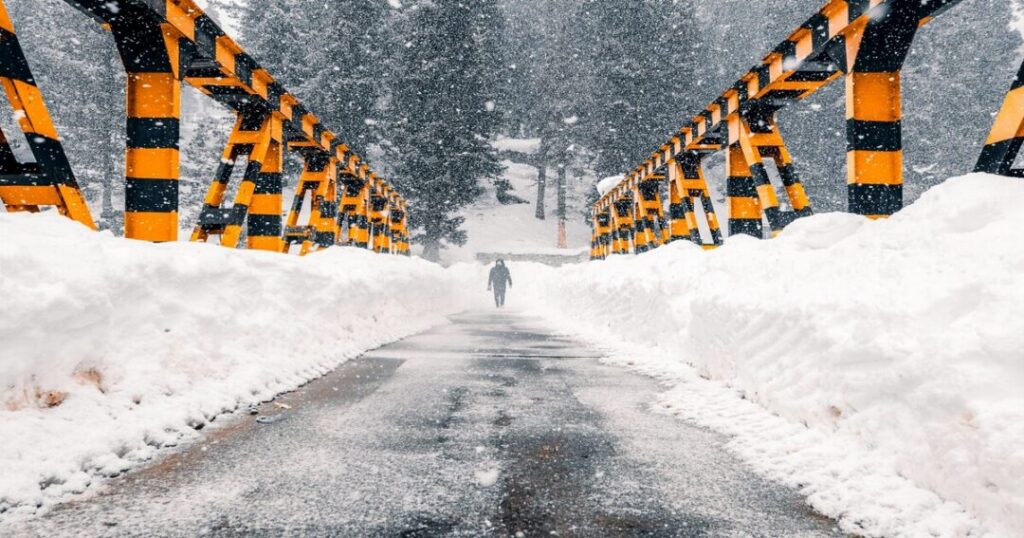
Gulmarg (~56 km | 1.5 hours)
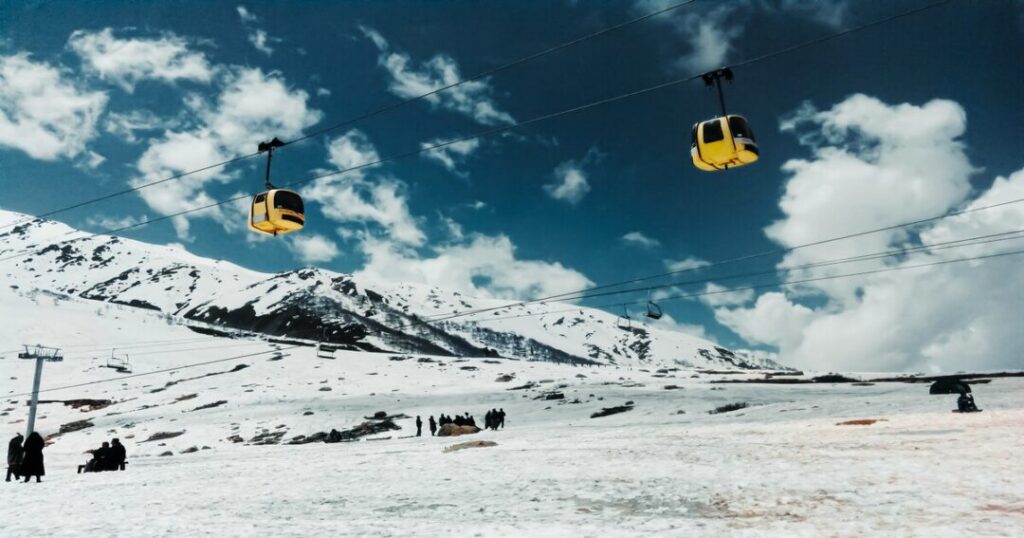
Gulmarg—at approximately 2,650 meters in the Pir Panjal range—is the summer meadow that gives Kashmir its most famous single image: a circular green plateau surrounded by snowcapped peaks. In winter it becomes Asia’s highest ropeway destination (Gulmarg Gondola Phase 2 reaches approximately 3,979–4,390 m) and one of the continent’s finest ski destinations. In summer the meadow is covered in wildflowers, and the walks through the surrounding forest are extraordinary.
Pahalgam (~96 km | 2.5 hours)
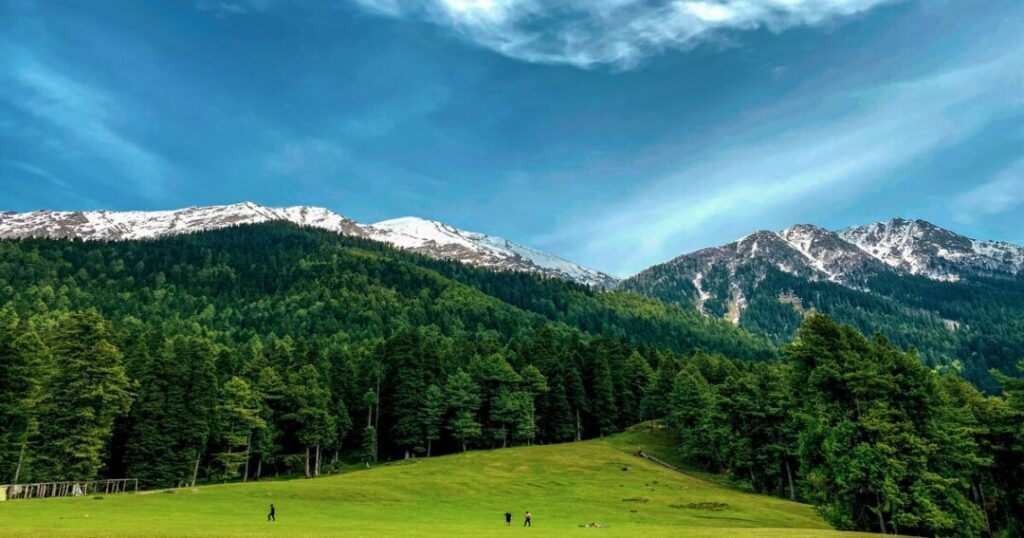
Pahalgam (“Village of Shepherds”) sits at 2,130 meters at the confluence of the Lidder River and the Sheshnag River—a traditional shepherd settlement that now serves as the base for the Amarnath Yatra pilgrimage (to the sacred ice Shivalingam cave). The Baisaran meadow (accessible by pony or on foot from the town) and the Aru Valley (12 km from Pahalgam) are two of the finest alpine meadow experiences in Kashmir.
Sonamarg (~87 km | 2 hours)
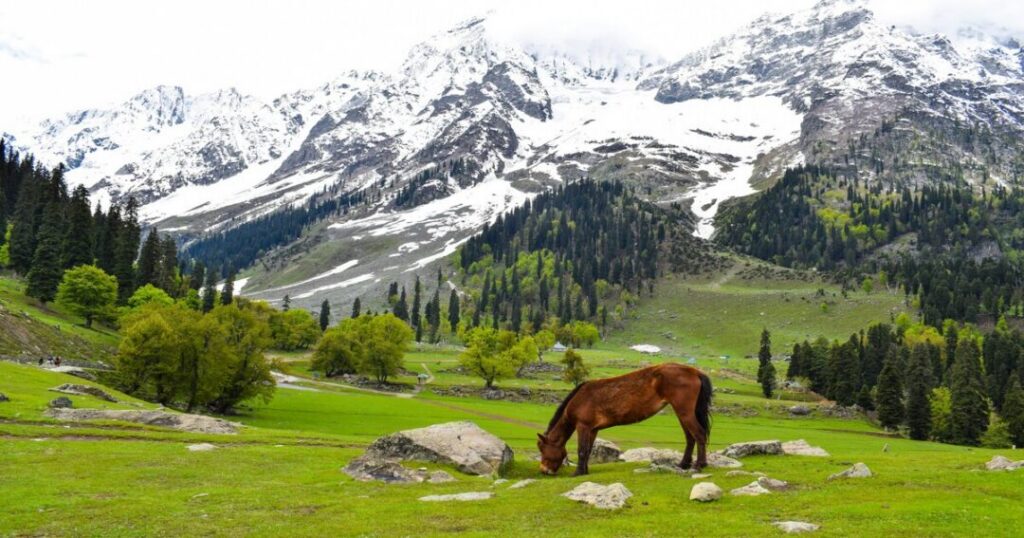
Sonamarg (“Meadow of Gold”)—at approximately 2,740 meters—is the gateway to the Ladakh region and the Zoji La pass. The meadow’s name comes from the yellow wildflowers that cover it in summer; the Thajiwas Glacier is accessible by pony or on foot from the town; and the Krishnasar and Vishansar lakes (a day’s trek from Sonamarg) are two of the finest alpine lakes in the Western Himalayas.
Also Read: Kashmir Great Lakes Trek: The Most Beautiful Trek in India
What is the best time to visit Srinagar?
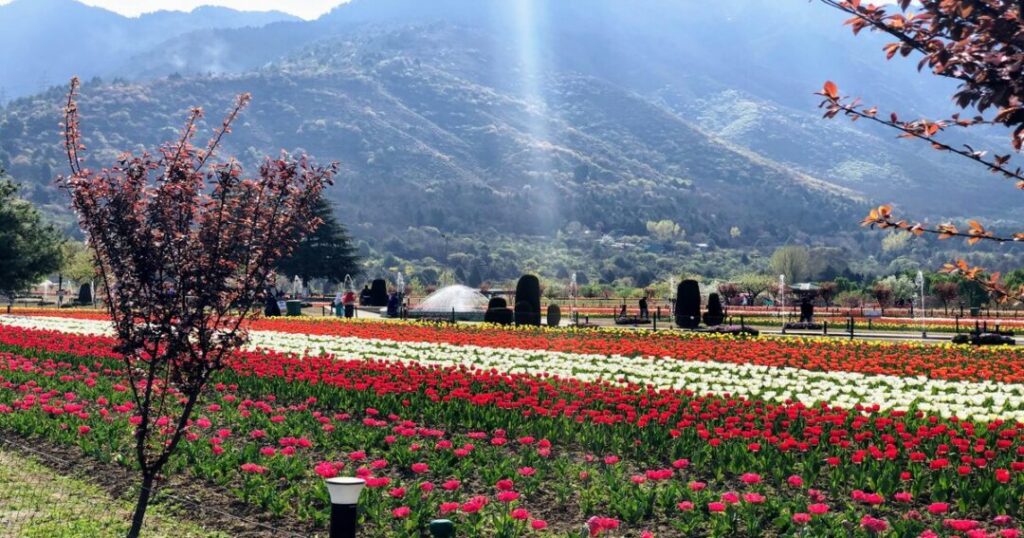
April to June — spring; tulip season (March–April at the Indira Gandhi Memorial Tulip Garden, the largest in Asia with over 1.5 million tulips across 30+ varieties), apple and cherry blossom, the Mughal gardens at their most vivid green.
September to November—the finest season overall; the chinar trees turn gold and red from mid-October, the air is crisp and clear, the lake reflects the autumn colors, and the light on the mountains is extraordinary. This is when Srinagar is at its most photographically beautiful.
December to February — snow; the houseboats are cold (bring layers), and the Mughal gardens are closed or minimal, but Gulmarg is in full ski season, and Srinagar under snow is a completely different and genuinely beautiful experience.
How to Reach Srinagar?
- By air: Sheikh ul-Alam International Airport, Srinagar (SXR) — the most practical access; connected to Delhi (1.5 hours), Mumbai (2.5 hours), and major Indian cities; domestic airlines operate frequent services
- By road from Jammu: National Highway 44 through the Banihal Tunnel (the Banihal–Qazigund tunnel, opened 2013, makes the drive viable year-round); approximately 260 km, 5–6 hours
- By rail: Banihal is the current railhead on the Udhampur–Srinagar–Baramulla Rail Link (USBRL) project; the extension to Srinagar is under construction—verify current status before planning
Conclusion about Places to Visit in Srinagar
Srinagar is a city where the depth is proportional to your patience. The places to visit in Srinagar city that most reward return visitors are not the ones on the standard itinerary—they are the ones that reveal the city’s specific layers: the Mughal ambition embedded in 400-year-old gardens, the Sufi devotion still alive at riverside shrines, the agricultural economy still operating on boats at dawn, and the food tradition that took Central Asian spice routes and made them Kashmiri.
Quick guide to places to see in Kashmir Srinagar:
- Mughal gardens: Shalimar (1619, Jahangir), Nishat (1633, Asif Khan, 12 terraces), Pari Mahal (1650, Dara Shikoh, ridge viewpoint—undervisited)
- Sufi shrines: Shah-i-Hamdan (1395, wooden mosque, Jhelum riverside), Makhdoom Sahib (ridge climb, old city view), Hazratbal (Dal Lake, Prophet’s hair relic)
- Hidden gems: Pather Masjid (1623, Noor Jahan’s stone mosque), Char Chinar island, floating vegetable market at dawn, Nagin Lake
- Food: Wazwan — Rogan Josh, Yakhni, Gushtaba, Nadru Yakhni, Shab Deg
- Day trips: Gulmarg (56 km, gondola, skiing), Pahalgam (96 km, Lidder Valley), Sonamarg (87 km, meadow of gold)
Download the Explurger app to discover what Kashmir and Srinagar travelers actually recommend, find the hidden shrines and dawn markets beyond the tourist circuit, and log every chinar, shikara ride, and bowl of Rogan Josh on your Kashmir journey.
The shikaras are already on the water. The chinar leaves are already turning. Srinagar’s layers are waiting to be read.
FAQs about Places to Visit in Srinagar
2. What are the Mughal gardens in Srinagar?
Srinagar's principal Mughal gardens: Shalimar Bagh (1619, Jahangir for Noor Jahan, 12.4 hectares, three terraces, linked to Dal Lake by 1.6 km canal — considered the high point of Mughal horticulture), Nishat Bagh (1633, Asif Khan — Nur Jahan's brother, 19 hectares, 12 terraces representing zodiac signs, second largest in valley), Pari Mahal (1650, Shah Jahan's son Dara Shikoh's observatory and garden, 5,200 ft on Zabarwan ridge — most dramatic setting, least visited), and Chashme Shahi (1632, the smallest but spring-fed — the name means "Royal Spring"). All are on the eastern shore of Dal Lake.
3. What is the best time to visit Srinagar?
Two peak windows: April to June for the tulip garden (largest in Asia, 1.5 million+ tulips in March–April), cherry and apple blossom, and the Mughal gardens at full green. September to November for the chinar trees turning gold and red from mid-October — the most visually extraordinary season in Kashmir. The Srinagar places to see in Kashmir Srinagar are at their most atmospheric in October when the chinar leaves fall on the Dal Lake surface and the air is crisp and clear.
4. What is the Wazwan feast?
Wazwan is Kashmir's ceremonial feast — a multi-course meal prepared by a specialist waza cook for weddings and significant gatherings, comprising up to 36 courses of predominantly meat preparations. The essential dishes are: Rogan Josh (slow-cooked lamb in Kashmiri red chilli sauce — no tomato — named from Persian roghan oil and josh heat), Yakhni (lamb in yogurt-fennel sauce), Gushtaba (pounded lamb meatballs in yogurt — the concluding dish), Nadru Yakhni (lotus stem in yogurt sauce), and Shab Deg (turnip and lamb slow-cooked overnight). The Wazwan tradition traces to Central Asian culinary influences refined in Kashmir over centuries.
5. How far is Gulmarg from Srinagar?
Gulmarg is approximately 56 km from Srinagar — about 1.5 hours by road. It is the most popular day trip from Srinagar, offering Asia's highest ropeway (Gulmarg Gondola Phase 2 reaches approximately 3,979–4,390 m), winter skiing, and summer alpine meadows. It can be done as a day trip from Srinagar or as an overnight stay. The road from Srinagar to Gulmarg passes through Tangmarg and climbs into the Pir Panjal range — the drive itself is scenic.