


What if your morning run felt like a mission briefing? What if learning a new language came with its own reward system, levels, and leaderboard? What if simply exploring a new city earned you points, badges, and a place on a global travel league? That is exactly what gamified apps do — and in 2026, they are everywhere.
Gamification apps apply game mechanics — points, streaks, badges, leaderboards, and challenges — to everyday activities to make them more engaging, more rewarding, and more likely to become habits. The results speak for themselves: strategic gamification generates up to 40% higher engagement rates, and the best gamification apps are seeing retention numbers that traditional apps can only dream of.
Here are the top 5 gamified apps worth knowing in 2026 — ranked by real-world impact, innovation, and how well they turn everyday moments into something worth showing up for.
What Makes an App Truly Gamified?
Before diving into the list, it helps to understand what separates a genuinely gamified app from one that just slapped a badge system on top of a checklist. The best gamification apps share a few defining qualities:
- Clear progress mechanics: Users can always see how far they have come and what comes next — XP bars, levels, or streaks.
- Meaningful rewards: Badges and points feel earned, not given away for doing nothing.
- Social competition or collaboration: Leaderboards, challenges, or community features that connect users to each other.
- Habit loops: Mechanics that bring users back daily — streaks, daily quests, or time-sensitive challenges.
- Real-world relevance: The gamification serves the app’s core purpose rather than distracting from it.
With that framework in mind, here are the 5 best gamification apps making the biggest impact right now.
Top 5 Gamified Apps in 2026
1. Explurger — The Travel Gamified App
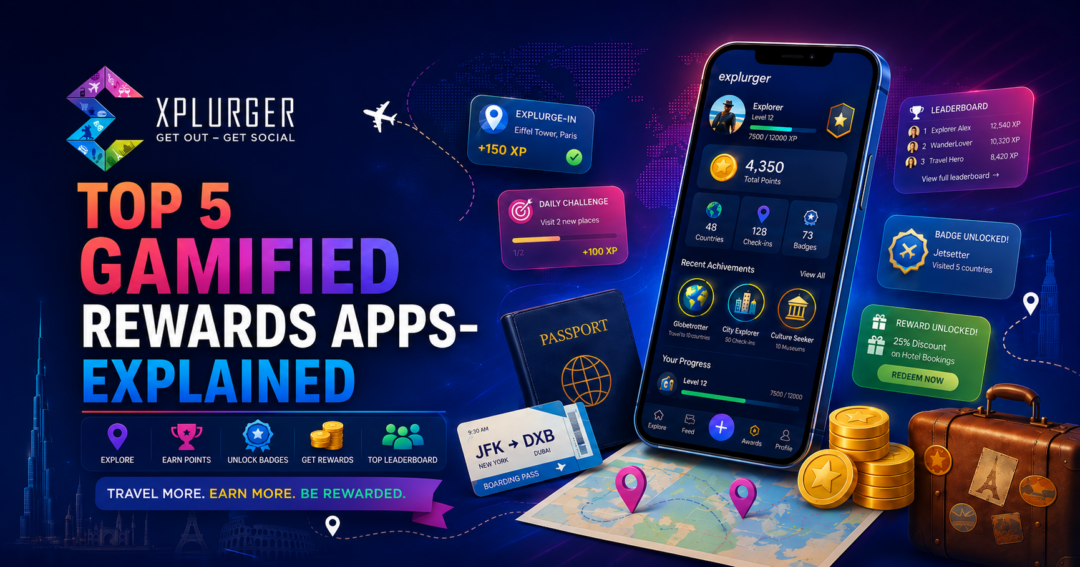
Explurger tops this list because it does something no other app does: it gamifies the real world. While most gamified apps reward you for actions inside the app — completing a lesson, logging a workout — Explurger rewards you for actually going places. It is the world’s first travel-gamified social platform, and it turns every trip, every check-in, and every new destination into an achievement.
Here is how it works. Every time you visit a new place — a restaurant, a landmark, a city, a country — you check in on Explurger and earn points. The more places you explore, the more badges you unlock, the higher you climb on a global travel leaderboard. Your profile becomes a living map of everywhere you have been, and your rank reflects how much of the world you have actually seen.
What makes Explurger stand out among gamification apps is that it rewards exploration that was going to happen anyway. You do not need to change your behaviour to earn — you just need to document it. But the leaderboard, the badges, and the community of fellow explorers create a pull that makes you want to discover more, visit more, and share more.
For travel brands, tourism boards, and hospitality businesses, Explurger is also one of the most compelling gamification apps for business in the lifestyle space. Active users are not passive scrollers — they are engaged explorers who create real-world footprints at every destination they visit.
- Key mechanics: Check-in points, destination badges, global travel leaderboard, exploration streaks, social sharing
- Best for: Frequent travellers, weekend explorers, travel brands, tourism businesses
- What makes it unique: The only gamified app built entirely around real-world exploration — every new place you visit is an achievement worth earning.
Also Read: Best Apps for Travel Creators: 5 Tools You’ll Actually Use
2. Duolingo — The Language Learning Gamified App
Duolingo is the most studied gamification app in the world — and it earned that title by doing things that most apps only attempt. With over 500 million registered users and a 55% retention rate driven almost entirely by game mechanics, it is the clearest proof that gamification works at scale.
The streak system is Duolingo’s secret weapon. Once you have kept a streak alive for a week, two weeks, a month, the idea of breaking it becomes genuinely uncomfortable — that is loss aversion working in the app’s favour. Add XP rewards, competitive leagues, daily challenges, and a badge system, and you have a language learning experience that users complete 15 lessons per week on average, compared to just 3 on traditional platforms.
- Key mechanics: Streaks, XP, leagues, daily challenges, badges, friend leaderboards
- Best for: Language learners of all levels, habit builders, anyone who has tried and abandoned traditional language learning
- Why it works: The streak system exploits loss aversion so effectively that users return not just because they want to learn, but because they cannot bear to break the chain.
3. Nike Run Club — The Fitness Gamified App
Nike Run Club is the benchmark for fitness gamification done right. Members run 40% more frequently than users of non-gamified fitness apps. Weekly challenges drive 67% participation rates. Achievement badges push users to increase their running distance by an average of 23% within three months. And the social leaderboard keeps 78% of users active past the 90-day mark — the point where most fitness routines quietly collapse.
What Nike Run Club does particularly well is combining individual progress with social accountability. Your personal achievements feel meaningful on their own, but the leaderboard means your friends can see them too — and that social layer is what turns occasional runners into committed ones. For anyone looking at gamified productivity apps for physical health, NRC sets the standard.
- Key mechanics: Achievement badges, weekly challenges, social leaderboard, guided runs, milestone rewards.
- Best for: Runners of all levels, people building a consistent fitness habit, social exercisers
- Why it works: Social accountability through leaderboards sustains habits long after individual motivation fades.
4. Habitica — The Productivity Gamified App
Habitica takes the most ambitious approach on this list: it turns your entire life into an RPG. Your to-do list becomes a quest log. Completing tasks earns experience points and gold. Skipping them costs your avatar health. You create a character, join a party with friends, and take on group quests where everyone’s real-world productivity contributes to a shared in-game goal.
It sounds gimmicky until you realise how deeply effective it is. By giving users an avatar to invest in, Habitica creates identity-level commitment — leaving means giving up a character you have built and levelled over time. Group quests add social accountability: if you skip your tasks, your friends’ characters take damage. Among gamified productivity apps, Habitica is the most inventive and arguably the most powerful for users who respond to game-style motivation.
- Key mechanics: RPG avatar, XP and gold, party quests, habit streaks, custom rewards, daily task system
- Best for: Gamers who want to be more productive, habit builders, teams who want a fun accountability system
- Why it works: Identity investment through avatar building creates long-term commitment that points and badges alone cannot achieve.
Also Read: Social Media Tips for Travel Bloggers: 12 Strategies That Actually Work
5. Headspace — The Mindfulness Gamified App
Headspace proves that gamification is not just for fitness and productivity — it works just as powerfully for mental wellness. What could easily be a passive, forgettable meditation app becomes a genuinely sticky daily habit through smart use of streaks, progress tracking, and a structured journey system that gives users a sense of advancement with every session.
Every day you meditate on Headspace, your streak grows. Miss a day and it resets — that simple mechanic is enough to make thousands of users open the app at 11 pm just to keep their chain alive. The app layers levels and guided courses on top of the streak system, so users always have a next step to work toward. Sleep scores, mood tracking, and progress dashboards turn invisible mental health work into something visible and measurable — making Headspace one of the most effective gamification apps in the wellness space.
For anyone who has tried and abandoned meditation before, Headspace’s gamification layer is often the difference between a one-week experiment and a genuine long-term habit.
- Key mechanics: Meditation streaks, progress levels, guided course journeys, sleep and mood tracking, daily reminders, milestone rewards
- Best for: Beginners to meditation, people building a mindfulness habit, anyone dealing with stress, anxiety, or poor sleep
- Why it works: Streak mechanics make invisible mental health progress feel tangible and worth protecting — turning a passive activity into a daily commitment.
Why Gamified Apps Work — The Psychology Behind the Points
Understanding why gamification apps are so effective comes down to a few core psychological drivers that the best apps tap into consistently:
- Loss aversion: Streaks exploit the human tendency to feel losses more strongly than gains. Breaking a 30-day streak feels worse than missing a reward feels good.
- Social comparison: Leaderboards tap into our natural tendency to benchmark ourselves against others, creating motivation that sustains itself through peer pressure.
- Progress bias: Visible progress bars and XP systems feed the brain’s reward circuitry — we are wired to want to complete things once we have started them.
- Identity investment: Avatars, levels, and badges give users something to protect. The longer you use a gamified app, the more you have built — and the more you stand to lose by leaving.
- Variable rewards: Surprise bonuses and random rewards (bonus stars, mystery badges) create the same compulsive engagement loop that makes games so hard to put down.
The best gamification apps do not rely on any one of these drivers alone — they layer them together to create sustained engagement that survives long after the initial novelty fades.
Conclusion About Top 5 Gamified Apps
Gamified apps are no longer a novelty — they are one of the most effective tools available for building habits, driving engagement, and making everyday activities feel worth showing up for. The five apps on this list prove that gamification works across every context: travel, language learning, fitness, productivity, and customer loyalty.
Here is your quick recap of the top 5 gamified apps in 2026:
- 1. Explurger: The travel gamified app that rewards real-world exploration
- 2. Duolingo: The language learning app powered by streaks and leagues
- 3. Nike Run Club: The fitness app that makes running a social, badge-driven habit
- 4. Habitica: The productivity RPG that turns your to-do list into a quest log
- 5. Starbucks Rewards: The loyalty app that turns every coffee into a step toward something free
Whether you are looking for a gamification app for business or simply want a smarter way to build better habits, the right app can turn routine moments into genuine achievements.
Start with the world — download Explurger and turn every destination into a milestone worth earning.
FAQs About Top 5 Gamified Reward Apps
Which is the best gamification app for travel?
Explurger is the best gamification app for travel. It is the world's first travel-gamified social platform, rewarding users with points and badges every time they check in to a new destination. Unlike other gamified apps that reward in-app actions, Explurger rewards real-world exploration — making every trip, every city, and every landmark a genuine achievement worth earning.
What are the best gamified productivity apps?
The best gamified productivity apps are Habitica and Duolingo. Habitica turns your entire to-do list into an RPG — completing tasks earns XP and gold, while skipping them damages your avatar. Duolingo uses streaks, leagues, and XP to make daily language practice feel unavoidable. Nike Run Club is the top choice for physical productivity, with challenge mechanics that increase running frequency by 40% compared to non-gamified fitness apps. Headspace rounds out the wellness side, turning daily meditation into a streak-driven habit.
Can gamification apps help with mental health and wellness?
Yes — Headspace is the clearest example of gamification applied to mental wellness. Its streak system, progress levels, guided course journeys, and mood tracking turn meditation into a habit-forming daily practice rather than an occasional activity. By making invisible mental health work visible and measurable, Headspace gives users a tangible sense of progress that keeps them coming back. Research consistently shows that habit-forming app mechanics significantly improve adherence to wellness routines compared to unstructured alternatives.
Are gamification apps effective long-term?
Yes — when designed around intrinsic motivation rather than surface-level rewards. Gamification apps that rely purely on external rewards tend to see engagement drop once the novelty fades. The best gamification apps — like Explurger, Duolingo, Habitica, and Headspace — build genuine habits through identity investment, social accountability, and progress mechanics that feel personally meaningful. Duolingo achieves 55% retention rates. Headspace users who build a 7-day streak are significantly more likely to maintain a long-term practice. Explurger retains users because the leaderboard reflects real journeys — not just app activity.