
1,110 Total Views
If there is one trek in the Indian Himalayas that makes it genuinely accessible to everyone — the office worker who has never trekked before, the college group on a weekend budget, the solo traveller who arrived in McLeod Ganj without a plan — it is the Triund trek. At 2,850 metres (9,350 feet), the Triund hill summit sits just above the Tibetan-flavoured lanes of McLeodganj, reachable in 4–5 hours of steady walking through rhododendron and oak forest. The reward: a wide, flat alpine meadow with the Dhauladhar range filling the sky on one side and the entire Kangra Valley spread below on the other. And if you stay the night — which you should — the Triund trek’s night-sky view of stars above the Dhauladhars is one of the finest night-sky experiences accessible from any Indian hill station.
This guide covers everything: the key facts, the complete day-by-day itinerary, the overnight camping experience, the night sky, the best time, and the practical details.
About Triund Trek — Key Facts
| Detail | Info |
| Triund height | 2,850 m (9,350 ft) — Wikipedia confirmed |
| Triund location | Dhauladhar range, Kangra district, Himachal Pradesh |
| Trek starting point | McLeod Ganj (~1,457 m) or Galu Devi Temple (~1,770 m) |
| Trek distance | ~9 km one way from McLeod Ganj; ~7 km from Galu Devi Temple |
| Altitude gain | ~1,393 m (McLeod Ganj to Triund top) |
| Trek time | 4–5 hours (ascent); 3–4 hours (descent) |
| Difficulty | Easy to Moderate — India’s most beginner-friendly Himalayan trek |
| Best season | March to June; September to November |
| From Delhi | ~500 km (~10–12 hours by overnight bus) |
| From Chandigarh | ~240 km (~5–6 hours by road) |
| Permit | Forest department permit required for overnight camping |
What makes Triund Trek so special?
Three things make the Triund trek genuinely worth doing rather than just easy to do:
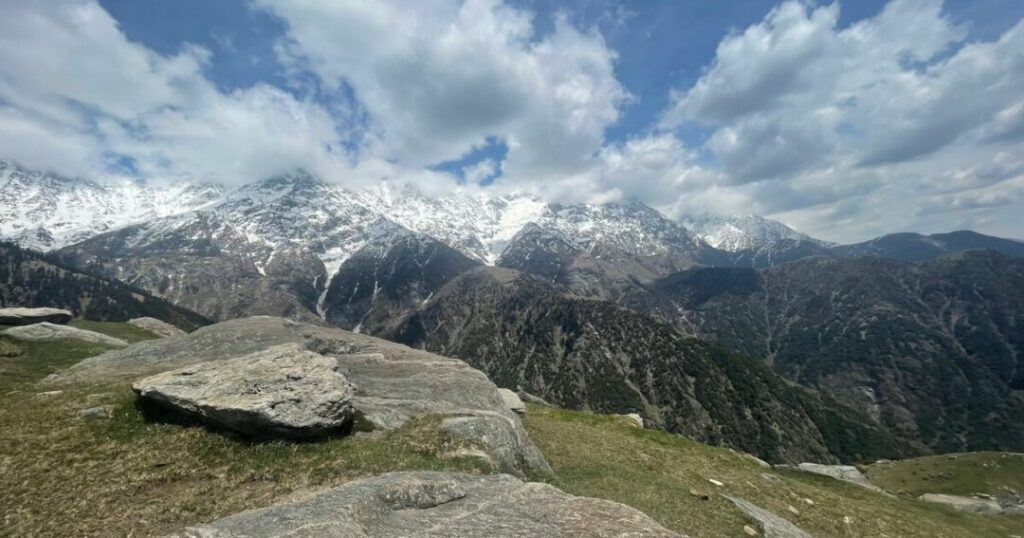
The Dhauladhar wall: The Dhauladhar range — a dramatic sub-Himalayan range that rises abruptly from the plains of Kangra to peaks over 5,000 metres — is best seen from directly below. At Triund top, the range fills the northern horizon like a wall — so close and so steep that it creates the impression of standing at the base of the Himalayas rather than on a hill above a tourist town. This is one of the closest accessible views of a high Himalayan range from any beginner trek in India.
The McLeod Ganj context: The Triund location is not just geographical — it is cultural. McLeod Ganj, where the trek begins, has been home to the Tibetan government-in-exile since 1960 and to His Holiness the 14th Dalai Lama. Walking the lanes of McLeodganj before the trek — through monasteries, past prayer flags, with the smell of butter lamps drifting from doorways — and then climbing above it all into the mountains creates a specific kind of emotional texture that no other accessible Indian trek offers.
The night sky: At 2,850 metres, away from the town lights below, the Triund trek night view is extraordinary. With no light pollution at the summit meadow and the Dhauladhar snowfields reflecting starlight, the sky above Triund on a clear night is one of the most photogenic in Himachal Pradesh.
What is the Best Time for the Triund Trek?
| Season | Conditions | Recommended? |
| March to April | Rhododendron in full bloom on the lower trail; some snow possible at the top; clear mornings | ✅ Excellent — flowering trail, possibility of snow at summit |
| May to June | Warm days, clear skies, green meadow at the top; most comfortable temperatures | ✅ Best for first-timers |
| July to August | Monsoon — trail slippery, leeches, cloud cover reduces views; summit often in mist | ❌ Not recommended |
| September to October | Post-monsoon clarity; crisp air; excellent night sky; Dhauladhar snowline fresh | ✅ Best for night sky and views |
| November to February | Snow from November onward; the top is snow-covered; requires layers and micro-spikes; extraordinary winter landscape | ⚠️ Experienced winter trekkers; snow adds beauty but demands preparation |
The single best window: October — post-monsoon clarity, the Dhauladhar freshly dusted with early snow, the nights long enough to fully experience the star sky, and the crowds significantly thinner than the summer peak.
How to Reach McLeod Ganj (Trek Base)?
McLeod Ganj (McLeodganj) is the starting point for the Triund trek — a suburb of Dharamshala, approximately 5 km uphill from Dharamshala town, in Kangra district, Himachal Pradesh.
From Delhi (~500 km | 10–12 hours):
- Overnight buses from Delhi ISBT Kashmere Gate to McLeod Ganj — several operators run direct services, departing 5 PM–9 PM, arriving 6–8 AM
- By train: Pathankot (~85 km from Dharamshala) or Chakki Bank are the nearest railway stations; then bus/taxi to McLeod Ganj
From Chandigarh (~240 km | 5–6 hours):
- Direct buses from Chandigarh ISBT to McLeod Ganj; shared taxis also available
- Via road: NH20 to Pathankot, then into the Kangra valley toward Dharamshala
By air: Gaggal Airport (Kangra Airport) is approximately 15 km from McLeod Ganj — connected to Delhi; check current flight availability
At McLeod Ganj:
- Guesthouses, cafés, and shops available for all budgets; the town is well-supplied for trekkers
- The trek can begin directly from McLeod Ganj market (longer route) or from Galu Devi Temple (approximately 2 km by taxi from McLeod Ganj — the most common starting point, reduces trek distance by ~2 km)
Also Read: 20 Offbeat Places to Visit in Himachal Pradesh’s Underrated & Unseen Destinations
What’s the Best Route for Triund Trek?
Option A: Day Trek (Single Day)
For those doing the Triund trek as a day hike — arriving, reaching the summit, and returning the same day.
Day 1: McLeod Ganj / Galu Devi Temple → Triund Top → Return
- Trek distance: ~9 km one way (7 km from Galu Devi)
- Altitude gain: ~1,080–1,393 m depending on start point
- Total time: 8–10 hours including summit time and descent
- Start time: 6–7 AM strongly recommended — summit by late morning, descent before afternoon clouds
The day trek is entirely feasible but requires a reasonably early start. The trail from Galu Devi climbs through dense forest, passing the Forest Guest House at approximately 2,200 m, before the famous “22 curves” — a series of steep switchbacks in the upper section that represent the most demanding part of the climb. Above the curves, the trail flattens onto the meadow approach to Triund.
Option B: Overnight Trek (The Recommended Format)
Day 1: McLeod Ganj → Triund Top Camping
Most trekkers begin from Galu Devi Temple (~1,770 m), reachable by taxi from McLeod Ganj in 10 minutes.
Stage 1: Galu Devi Temple to Magic View Café
- Distance: ~4 km | Time: 2–2.5 hours
- Starting altitude: ~1,770 m | Ending altitude: ~2,450 m
The trail begins on a wide, clear path through mixed forest — deodar, oak, and rhododendron. The rhododendron flowers brilliantly in March–April; the forest shade keeps the trail cool even in summer. At approximately 4 km from Galu Devi, the trail reaches the Magic View Café — a seasonal tea stall perched on a ridge with the first open views of the Kangra Valley below. This is the standard rest point; small snacks and tea available seasonally.
Stage 2: Magic View Café to Triund Top
- Distance: ~3 km | Time: 1.5–2 hours
- Starting altitude: ~2,450 m | Ending altitude: Triund top ~2,850 m (9,350 ft)
The trail above Magic View Café becomes steeper and more open. The forest thins; the views expand dramatically on both sides. The famous “22 curves” section — a series of steep switchbacks across a nearly open hillside — is the most demanding part of the climb. Each curve is painted with a number by the forest department; knowing you are on curve 15 of 22 is either encouraging or demoralising depending on your disposition. Above curve 22, the gradient eases, and the Triund meadow opens before you.
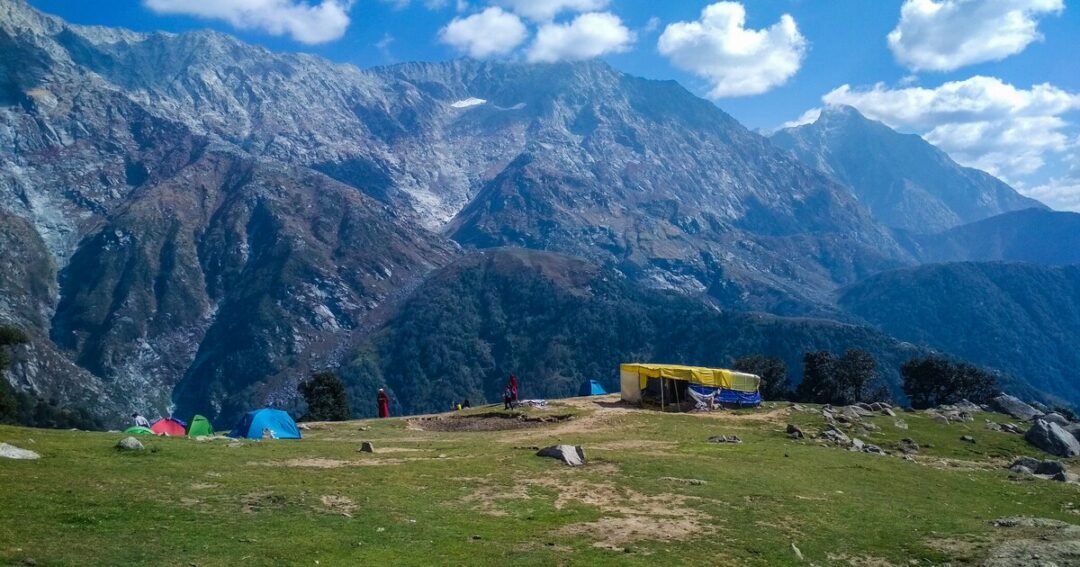
At Triund Top (~2,850 m): The meadow is flat, wide, and surrounded by the most dramatic view combination in the Western Himalayas: the Dhauladhar snowfields filling the north and the Kangra Valley spreading south all the way to the plains. The forest department runs a basic shelter and chai stall at the top; camping takes place across the meadow in designated areas.
- The meadow is open and exposed — set up camp before sunset to avoid struggling with tent pegs in the cold and dark
- Water is available from a stream near the camp area; purify before drinking
- Camp: Triund top (~2,850 m)
Day 2: Triund Top → Descent to McLeod Ganj
- Trek distance: ~9 km descent | Time: 3–4 hours
- Return to McLeod Ganj by early afternoon
Triund Top Camping — The Overnight Experience
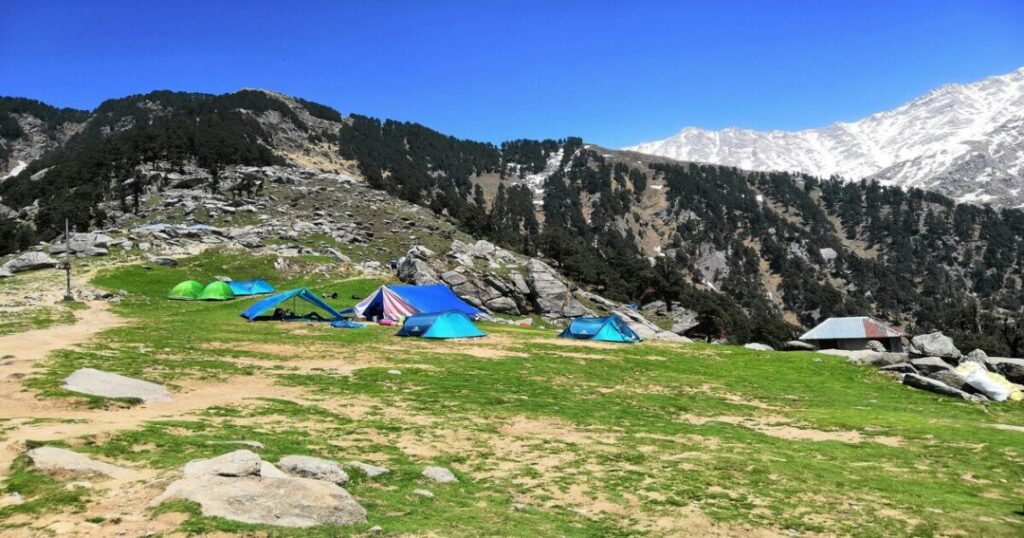
Camping at Triund top is the main reason most trekkers stay rather than return the same day — and the overnight experience is significantly more rewarding than the day trek for three reasons: the sunset, the night sky, and the dawn.
The sunset: The Kangra Valley below Triund faces west — as the sun drops toward the plains, the entire valley turns golden and then deep orange, the Dhauladhar snowfields behind you catching the last light from the east. It is one of the finest sunset panoramas in Himachal Pradesh and the specific reward of arriving at the summit in the afternoon rather than morning.
The Triund trek night view: After dark, Triund at 2,850 metres sits well above the light dome of Dharamshala and McLeod Ganj. The Milky Way is visible from approximately March through October on clear nights; the Dhauladhar snowfields reflect the moonlight, creating a cold blue glow on the northern horizon. The Triund trek night view is the photograph most people come back with, and the experience most people say they did not expect.
The dawn: The Dhauladhar peaks catch the first light before the valley below comes alive — an orange-to-pink gradation on the snowfields that is best seen from the campsite on the northern edge of the meadow.
Camping logistics at Triund Heights:
- Tent rental is available at McLeod Ganj and at some forest department counters — negotiate rental the evening before
- Sleeping bag: Essential; temperatures at Triund top drop to 5°C–10°C in summer, well below 0°C in winter
- Forest department permit: Required for overnight camping; available at the forest department checkpost before the summit; nominal fee
- The Triund Heights area — the section of the meadow nearest the northern edge — offers the closest view of the Dhauladhar wall and is the preferred camping zone for the best overnight experience
- Basic food is available at the summit tea stall (Maggi, chai, eggs) from April to October; carry adequate supplies in other months or if visiting on a weekday when the stall may be closed
Toilet and waste: The forest department has established basic toilet facilities near the camping area; use them. Triund has suffered from littering and human waste in recent years — carry all waste down, carry a small trowel for human waste away from water sources, and leave the meadow exactly as you found it.
Triund Trek Package — What to Expect?
The Triund trekking package offered by McLeod Ganj-based operators typically includes:
- Guide (optional — the trail is well-marked and most trekkers do it independently)
- Tent rental for the overnight
- Sleeping bag rental
- Meals at the summit (dinner and breakfast)
- Forest department permit fee
Self-organised: The Triund trek is one of the most independently accessible treks in India. The trail is clearly marked, entirely on a single path, and well-frequented — losing the trail is nearly impossible in clear weather. First-time trekkers can easily manage it without a guide.
Note: All package prices are approximate and subject to seasonal variation — verify current rates with McLeod Ganj operators before booking.
Practical Tips — Gear, Fitness & Permits
Gear List
- Footwear: Good trekking shoes or trail runners with grip — the 22 curves section is steep and the surface can be loose; sandals or sneakers are not adequate
- Layers: Fleece, windproof jacket — temperatures at the summit drop sharply after sunset even in summer
- Sleeping bag: Essential for the overnight; -5°C rated for October–March
- Headlamp: For the pre-dawn exploration and star photography
- Water: Carry 2 litres from McLeod Ganj; refill at streams (purify before drinking)
- Trekking poles: Recommended for the descent and the 22 curves section
- Sunscreen and UV sunglasses: UV intensity increases significantly above 2,000 m
Fitness
The Triund trek difficulty is easy to moderate — India’s most recommended first Himalayan trek. No prior trekking experience required. The only demanding section is the 22 curves — a sustained steep climb of approximately 45–60 minutes. Anyone who can comfortably walk 6–8 km at a normal pace can complete this trek.
Permits
- Overnight camping permit: Required from the Himachal Pradesh Forest Department; available at the checkpost before the summit; carry valid government-issued photo ID
- The permit system regulates the number of overnight campers to protect the meadow ecosystem — do not camp without a permit
Conclusion about Triund Trek
The Triund trek earns its reputation as the perfect first Himalayan trek because it gives you everything — a proper mountain ascent, a high meadow summit, the Dhauladhar wall at close range, and the night sky — within a weekend format accessible from Delhi on a Thursday or Friday night bus.
Quick recap:
- Triund height: 2,850 m (9,350 ft), Dhauladhar range, Kangra district
- Triund location: Above McLeod Ganj, Dharamshala, Himachal Pradesh
- Trek distance: ~9 km one way; ~7 km from Galu Devi Temple
- The “22 curves”: Steep upper switchback section — the most demanding part
- Best time: March–June; September–November (October for night sky)
- Triund top camping: Tent + sleeping bag essential; forest permit required; best spot is the northern edge for Dhauladhar views
- Triund trek night view: Milky Way + snowfields = one of Himachal’s finest night experiences
Download the Explurger app to log your Triund trek, discover what other trekkers recommend for current trail conditions, and plan your next Himalayan adventure from McLeod Ganj.
The 22 curves are already waiting. The meadow is already there. McLeod Ganj is already lit up below. Time to climb.
FAQs about Triund Trek
2. How far is the Triund trek?
The Triund trek distance is approximately 9 km one way from McLeod Ganj, or approximately 7 km from Galu Devi Temple (the most common starting point, reachable by taxi). The ascent takes 4–5 hours at a steady pace; the descent takes 3–4 hours. The famous "22 curves" — steep switchbacks in the upper section — are the most demanding part of the route.
3. What is Triund top camping like?
Triund top camping is on a wide, flat alpine meadow at 2,850 metres. Tent rental is available in McLeod Ganj and at the summit; sleeping bags are essential as temperatures drop sharply after dark. A forest department permit is required for overnight stays. The camping experience is defined by the sunset over the Kangra Valley, the extraordinary Triund trek night view of the Milky Way above the Dhauladhar snowfields, and the pre-dawn light on the mountain wall. Basic food (Maggi, chai, eggs) is available at the summit tea stall from April to October.
4. What is the Triund trek night view like?
The Triund trek night view is one of the finest night sky experiences accessible from any Indian hill station. At 2,850 metres, above the light dome of Dharamshala and McLeod Ganj, the Milky Way is clearly visible on cloudless nights from March to October. The Dhauladhar snowfields to the north reflect the moonlight creating a cold blue illumination on the mountains. The combination of the snow-capped Dhauladhars against a star-filled sky is what most overnight trekkers cite as the highlight of the entire experience.
5. What is the best time for the Triund trek?
The Triund trek best time is March to June (rhododendron bloom March–April; warm conditions May–June) and September to November (post-monsoon clarity — the best Milky Way visibility and the freshest Dhauladhar snow). Avoid July and August (monsoon — slippery trail, leeches, mist-covered summit). October is arguably the single best month — clear skies, fresh snow, thinner crowds, and long nights for the full night sky experience.
6. Is the Triund trek good for beginners?
Yes — the Triund trek is consistently rated as India's most beginner-friendly Himalayan trek. The trail is 9 km one way, well-marked, takes 4–5 hours, and requires no technical skills or prior trekking experience. The only demanding section is the 22 curves — a steep upper switchback section of approximately 45–60 minutes. The overnight camping format makes it feel like a complete Himalayan adventure while keeping the physical demand within reach of almost any reasonably fit adult.