
466 Total Views
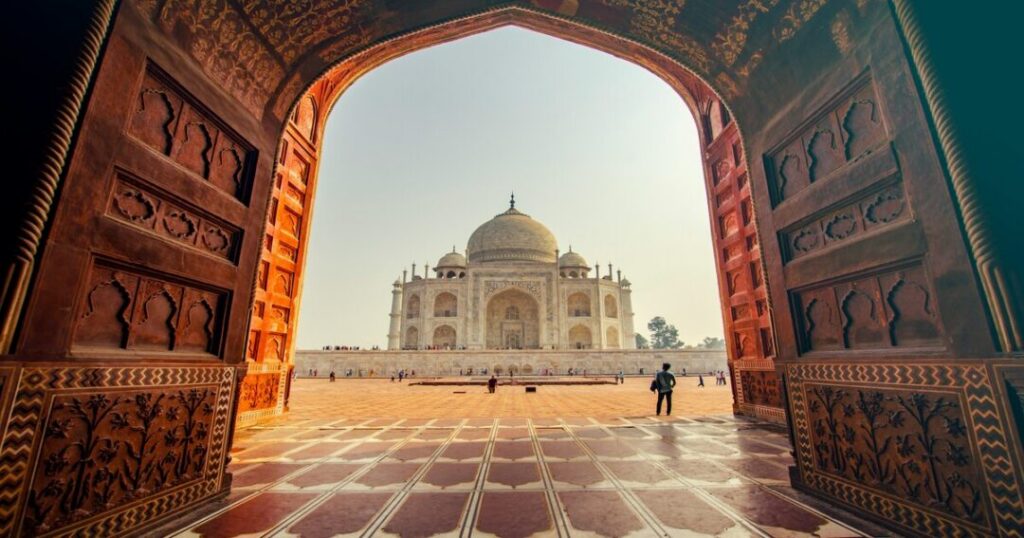
Everyone comes to Agra for the Taj Mahal. That is correct. In fact, it sits at the top of almost every list of things to do in Agra. The Taj Mahal is genuinely one of the most extraordinary things ever built by human beings and no photograph or description fully prepares you for the first time you walk through the main gate and see it across the reflecting pool. Go. See it. Come back early the next morning and see it again.
But Agra is not only the Taj Mahal. The same Mughal civilisation that built it also built a red sandstone fort complex two kilometres away. It built a ghost city 40 km to the west that was abandoned after only 14 years. It built tombs, mosques, and gardens that would be the centrepiece of any other city’s tourism but get barely a glance here. And the street food — petha, bedai, Mughal-inspired biryanis and kebabs that have been cooked in the same style for centuries — is as much a reason to come as any monument. This guide covers all of it.
Essential Travel Tips Before Exploring the Top Things to Do in Agra
What is the Best Time to Visit Agra?
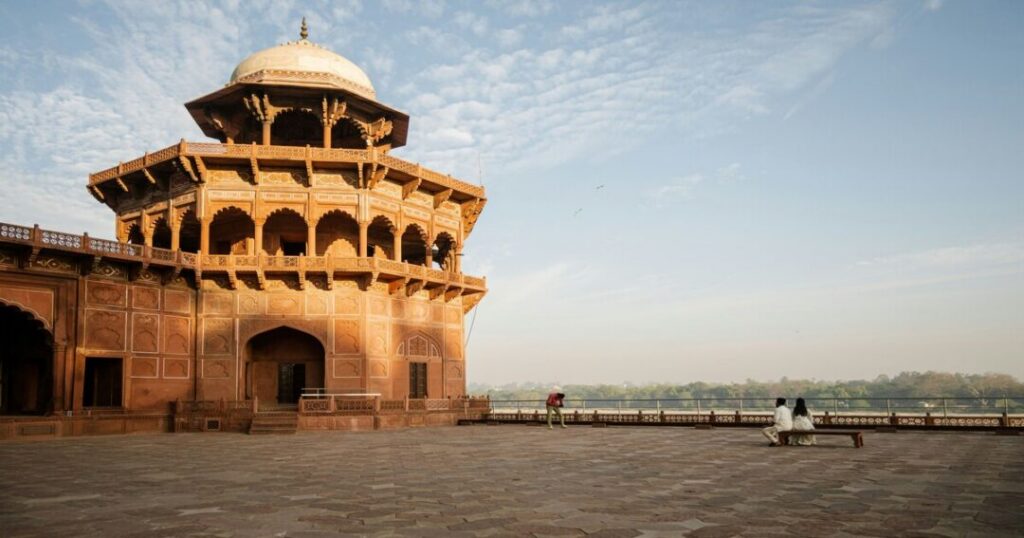
October to March is the best window — temperatures between 5°C and 28°C, clear skies, and comfortable conditions for walking between monuments. November to February is peak season and the most pleasant; the Taj Mahal in winter morning mist is one of the most photographed scenes in India. April to June is brutally hot (up to 45°C) — manageable only with very early morning visits. Monsoon (July–September) brings humidity and occasional smog but the gardens around the Taj Mahal and Agra Fort are vivid green.
For the Taj Mahal specifically: Sunrise is non-negotiable. The marble turns from grey to pink to white to gold in the first hour of daylight — and the crowds are at their thinnest. The monument opens approximately 30 minutes before sunrise; be at the gate.
How to Reach Agra?
- From Delhi (~200–230 km): By train — the Gatimaan Express (approximately 1h 40m, India’s fastest train between the two cities) and the Shatabdi Express are the most popular; Agra Cantonment station is the main railhead. By road — approximately 3–4 hours via the Yamuna Expressway. By the Agra Metro, now operational with connections to the main monuments
- From Jaipur (~230 km | 4–5 hours): By road via NH21; frequent bus and cab services
- By air: Agra’s Pandit Deen Dayal Upadhyay Airport (AGR) has limited connectivity; most visitors fly into Delhi or Jaipur and travel by road or train
The Unmissables — Brief, Because You Already Know
Taj Mahal — The Wonder
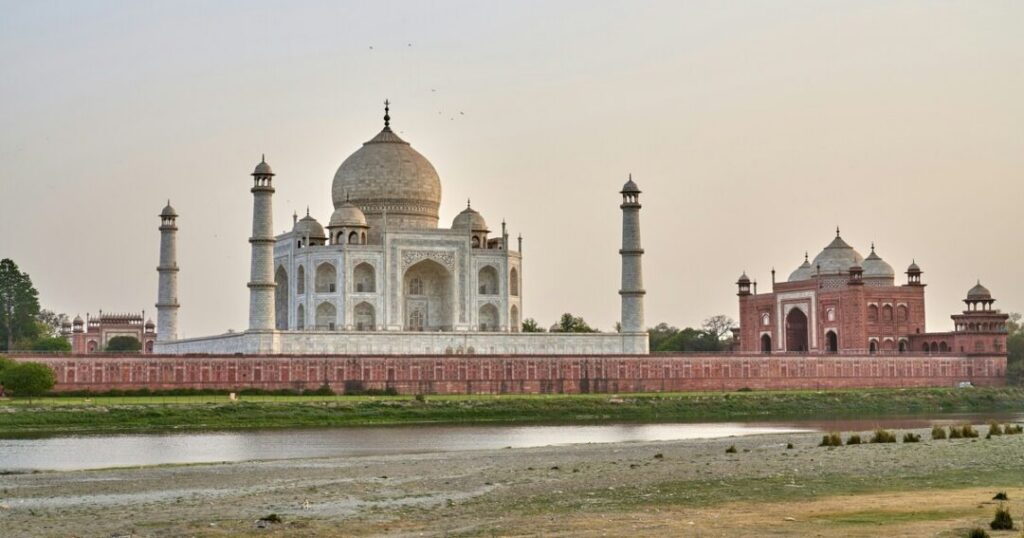
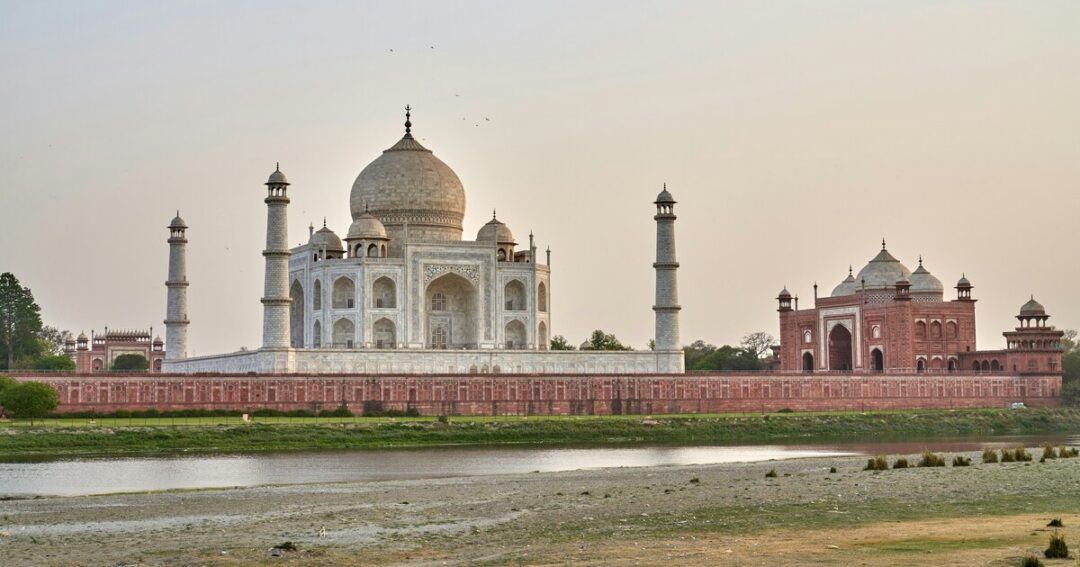
What it is: An ivory-white marble mausoleum commissioned in 1632 by Mughal Emperor Shah Jahan for his wife Mumtaz Mahal, who died in childbirth in 1631. Construction was completed by approximately 1653 — over 20,000 artisans worked on it for 21 years. The chief architect was Ustad Ahmad Lahori. The complex sits on the southern bank of the Yamuna River, covering approximately 17 hectares including gardens, mosque, and guest house. It was designated a UNESCO World Heritage Site in 1983 and named one of the New Seven Wonders of the World in 2007.
What to know:
- The marble changes colour throughout the day — pinkish at dawn, white at midday, golden at sunset
- The four minarets tilt slightly outward — an earthquake-protection design
- Shah Jahan was later imprisoned in Agra Fort by his son Aurangzeb; his view from captivity was across the river to the Taj Mahal. When he died in 1666, he was buried beside Mumtaz Mahal — the only asymmetrical element in the otherwise perfectly symmetrical complex
- Entry for Indian nationals is nominal; foreign nationals pay a significantly higher entry fee — verify current rates before visiting; closed on Fridays
- Shoes must be covered or removed before entering the main mausoleum platform; booties are provided
Agra Fort — The Red Sandstone Fortress
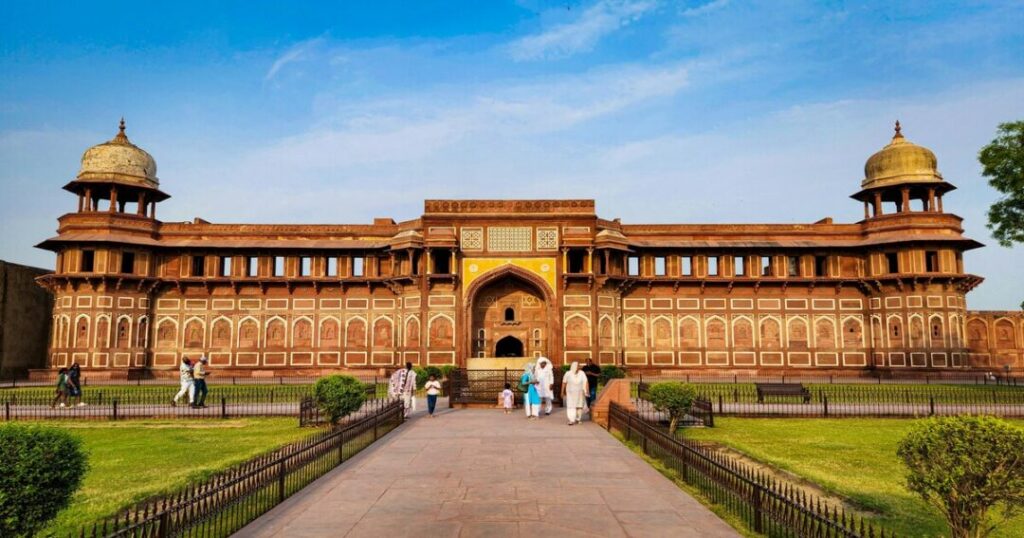
Two kilometres northwest of the Taj Mahal, Agra Fort is a UNESCO World Heritage Site in its own right — a massive red sandstone and marble fort complex on the Yamuna River that served as the main residence of the Mughal emperors from Akbar’s time until Shah Jahan’s. Construction began under Emperor Akbar in 1565 and was extended by Jahangir and Shah Jahan, who added the marble palaces inside. The fort covers approximately 94 acres with double ramparts and four gates.
- Musamman Burj — the octagonal marble tower where Shah Jahan spent his final years in captivity, with its direct sightline to the Taj Mahal across the river
- Diwan-i-Am (Hall of Public Audience) and Diwan-i-Khas (Hall of Private Audience) — the emperor’s audience chambers
- Jahangiri Mahal — the largest residential palace in the fort, built by Akbar for his son Jahangir
- UNESCO World Heritage Site since 1983 (same year as the Taj Mahal)
Also Read: Places to Visit in Alleppey: A Complete Travel Guide to Kerala’s Backwater Paradise
Itimad-ud-Daulah — The Baby Taj
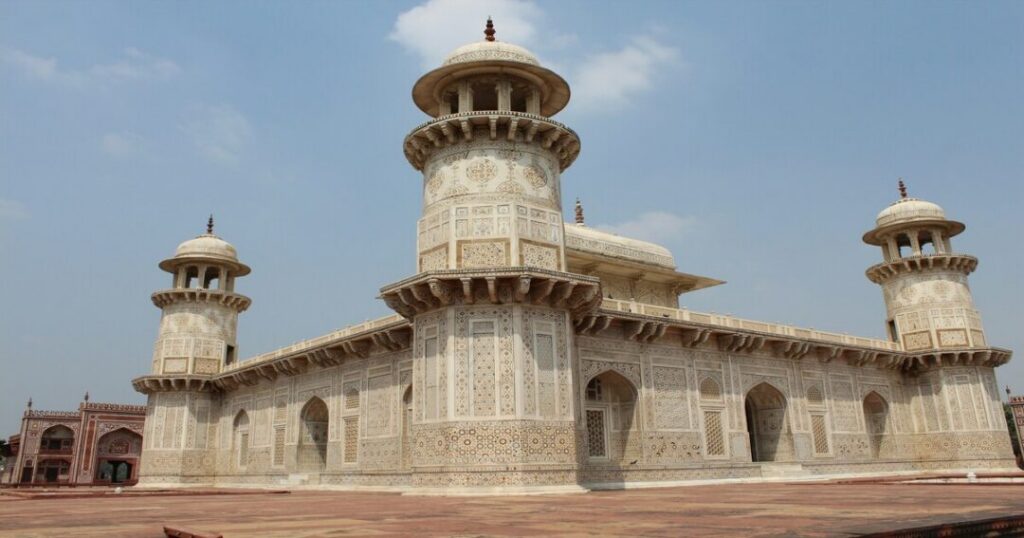
The tomb of Itimad-ud-Daulah — often called the Baby Taj — is one of the most overlooked Agra tourist attractions, despite being genuinely extraordinary. Built between 1622 and 1628 by Nur Jahan (the powerful wife of Emperor Jahangir) for her parents — her father Mirza Ghiyas Beg and her mother Asmat Begum — Itimad-ud-Daulah was the first Mughal tomb built in white marble and the first to use pietra dura — the inlay technique of setting semi-precious stones into marble — that would later define the Taj Mahal. The Taj Mahal is the perfected version of what Itimad-ud-Daulah began.
The tomb sits in a walled garden on the east bank of the Yamuna, approximately 3 km from the Taj Mahal. It is smaller, more intimate, and far less crowded — and its delicate stone inlay work is, if anything, more finely detailed than the Taj’s.
- Often called the “jewellery box” or “Baby Taj” for its miniature proportions and intricate detail
- Best time to visit: early morning or late afternoon when the marble picks up the warmest light
- Entry fee is nominal; rarely crowded even in peak season
Mehtab Bagh — The Moonlight Garden
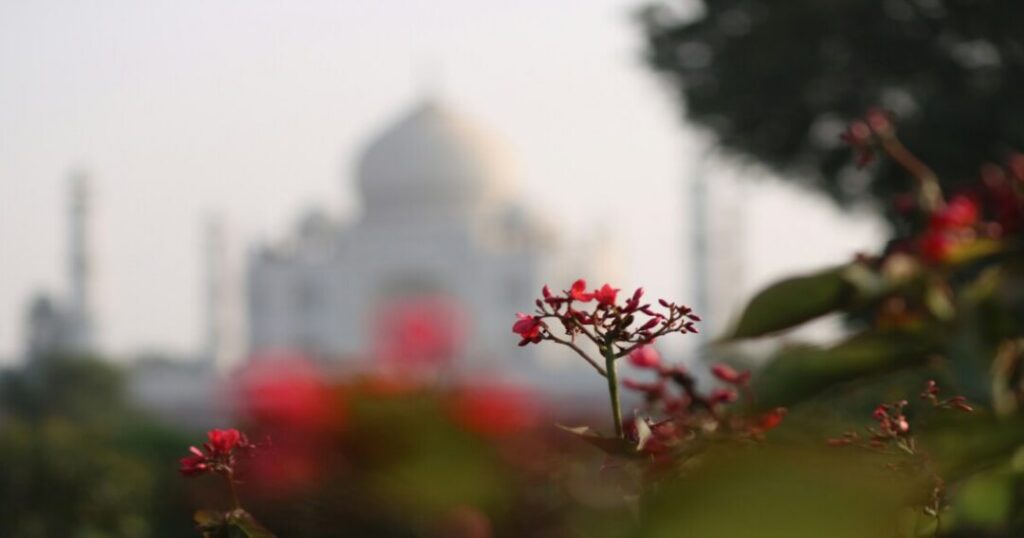
Directly across the Yamuna River from the Taj Mahal, Mehtab Bagh (Moonlight Garden) is a large Mughal garden complex on the northern bank — aligned precisely with the Taj Mahal’s axis. Built during Emperor Babur’s reign and later restored by Shah Jahan, the garden was designed to provide the evening viewing point for the Taj Mahal. From Mehtab Bagh, you see the Taj Mahal reflected in the Yamuna at sunset — the image most professional photographers use, with no crowds, no entry restrictions on photography, and an entirely different perspective on the monument.
- The sunset view of the Taj Mahal from Mehtab Bagh is arguably more beautiful than the sunrise view from inside the complex — and far less photographed
- Entry is nominal; the garden is peaceful and largely unvisited by tour groups
- Located approximately 5 km from the Taj Mahal’s main entrance; accessible by auto
Akbar’s Tomb (Sikandra) — The Emperor’s Mausoleum
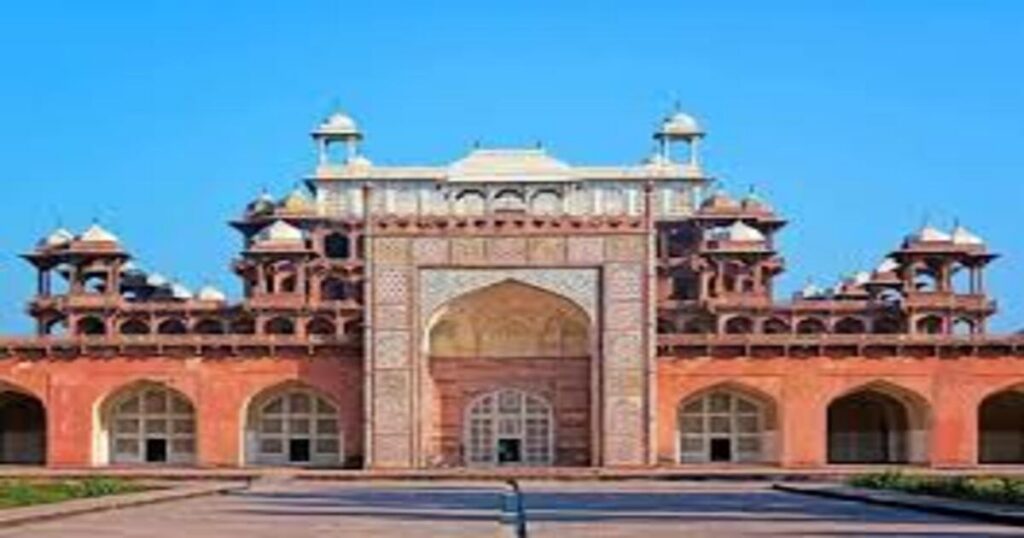
Akbar’s Tomb at Sikandra, approximately 10 km northwest of Agra, is the mausoleum of the greatest of the Mughal emperors — Akbar the Great (1556–1605). Begun by Akbar himself before his death and completed by his son Jahangir, the tomb is an unusual five-storey structure combining Hindu, Christian, Islamic, and Buddhist architectural elements — reflecting Akbar’s deliberately syncretic personal philosophy. The gardens around it are maintained by the Archaeological Survey of India and are home to a significant population of deer.
- The architectural eclecticism of the tomb reflects Akbar’s Din-i-Ilahi (the syncretic religious philosophy he developed) — fascinating for anyone interested in Mughal intellectual history
- The four carved gates to the tomb complex are among the finest examples of Mughal decorative stonework in Agra
- Accessible by road from Agra; combine with the Taj Mahal on a full-day Agra circuit
Chini Ka Rauza — The Persian Tile Mausoleum
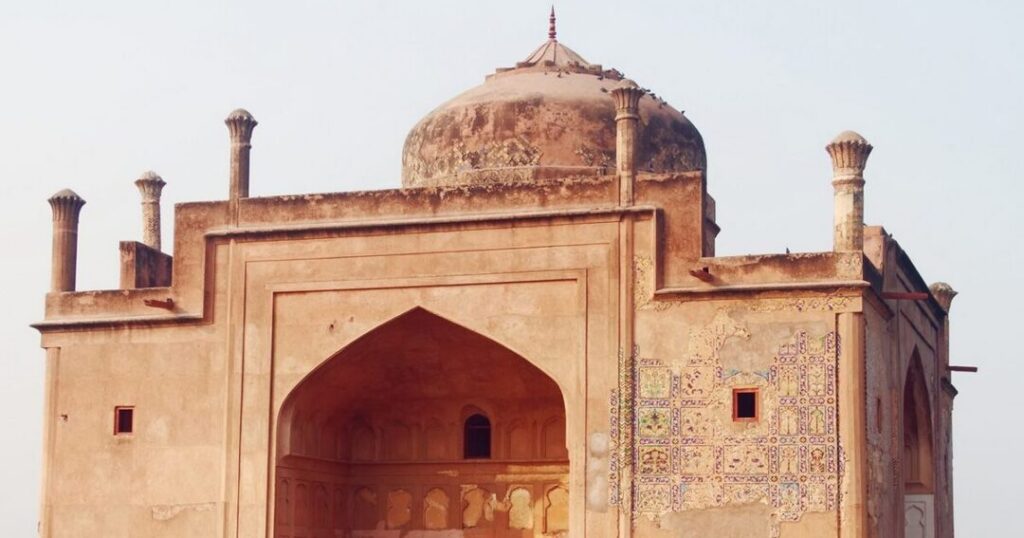
Chini Ka Rauza (literally “China Tomb”) is one of Agra’s most unusual and least-visited places of interest — a 17th-century mausoleum covered in glazed tile mosaic work (chini = China/tile) in brilliant blues, greens, and yellows, quite unlike any other Mughal monument in India. It is the tomb of Allama Afzal Khan Mullah, a poet and minister at Shah Jahan’s court. The tile work has deteriorated significantly but what remains — particularly the interior ceiling — is extraordinary.
- Almost completely unvisited; you may have it entirely to yourself
- Located on the east bank of the Yamuna, about 1 km north of Itimad-ud-Daulah
- No entry fee; accessible by auto or on foot from the Baby Taj
Mughal Food & Street Food — What to Eat in Agra
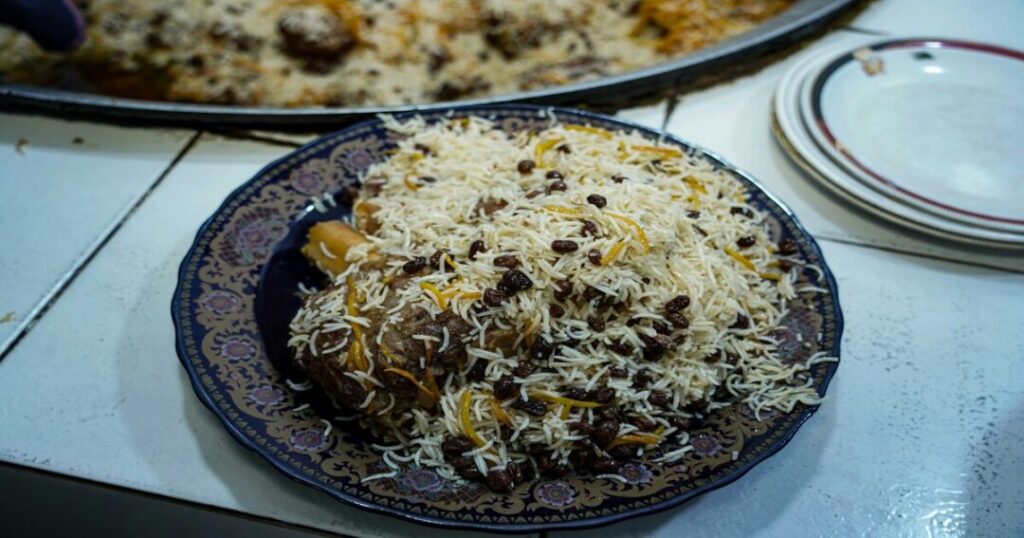
Agra’s food culture is one of the most distinctive of any Indian heritage city — shaped by centuries of Mughal court cooking and a specific set of local specialities that have been made here for generations.
Petha — the defining Agra sweet — is a translucent soft candy made from ash gourd (white pumpkin), cooked with sugar until it sets into a crystalline, melt-in-the-mouth confection. The plain version is the most traditional; modern variants include kesar (saffron), paan (betel), and dozens of other flavours. Petha has been made in Agra for several centuries and is sold at every sweet shop in the city; it is the single most ubiquitous Agra souvenir.
Bedai with aloo sabzi — Agra’s definitive breakfast: deep-fried puris stuffed with lentil paste (urad dal), served with a spiced potato curry. The bedai-aloo combination has been the morning meal of Agra for generations and is found at street stalls from 6 AM onwards in the old city lanes near the Taj Ganj area.
Mughlai cuisine — the court cooking tradition of the Mughal emperors, refined over centuries in Agra’s kitchens, survives in the city’s restaurants as biryani, seekh kebabs, nihari (slow-cooked mutton stew), korma, and the full range of slow-cooked, aromatic preparations that define north Indian non-vegetarian cooking at its richest. The Taj Ganj area near the Taj Mahal has the highest concentration of restaurants serving this tradition.
Jalebi and rabri — the classic Indian street sweet combination, particularly good in Agra’s old city, where the jalebis are fried fresh and the rabri (reduced sweetened milk) is thick and cold.
Dalmoth — a spiced, crunchy lentil-and-nut snack mix that is Agra’s other defining street food; sold at every market and widely available as a packaged souvenir.
Day Trips from Agra
Fatehpur Sikri (~40 km | 1 hour)
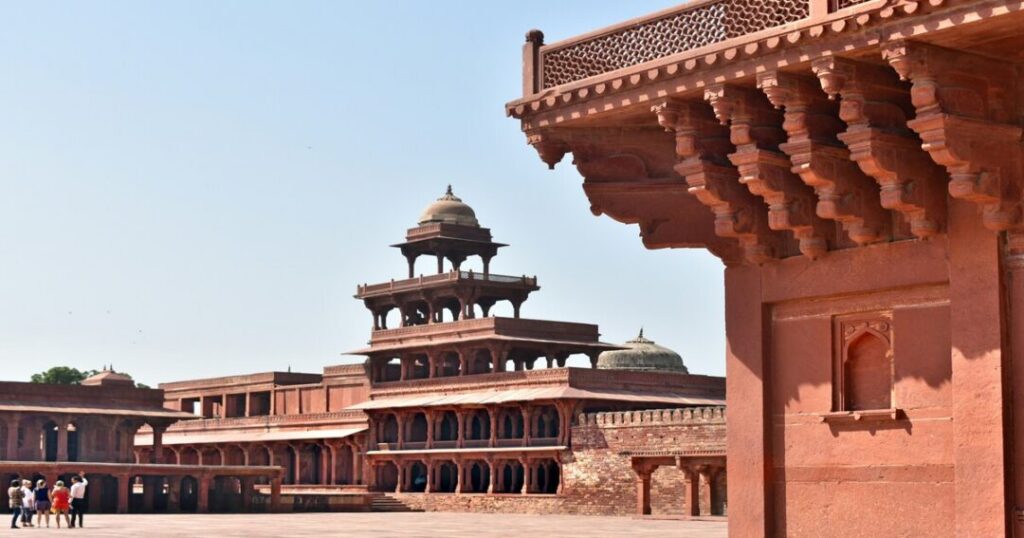
Fatehpur Sikri is one of India’s most extraordinary UNESCO World Heritage Sites — a complete Mughal imperial city built by Emperor Akbar between approximately 1569 and 1585, abandoned after only 14 years (reportedly due to water supply problems), and never reoccupied. The entire city — palace complex, mosques, audience halls, royal courtyards — survives in exceptional condition, made from the same red sandstone as Agra Fort. The scale is staggering: this was the capital of the Mughal Empire, home to tens of thousands of people, simply left.
- The Buland Darwaza (Gate of Magnificence) — built to commemorate Akbar’s conquest of Gujarat — is 54 metres (176 feet) high, making it one of the tallest gateways in the world
- The Jama Masjid at Fatehpur Sikri contains the Dargah of Sheikh Salim Chishti — the Sufi saint whose blessing Akbar credited for the birth of his sons; one of the most visited Sufi shrines in India
- UNESCO World Heritage Site since 1986
- Accessible by road (approximately 1 hour); shared autos and buses run regularly from Agra
Mathura and Vrindavan (~50–60 km | 1–1.5 hours)
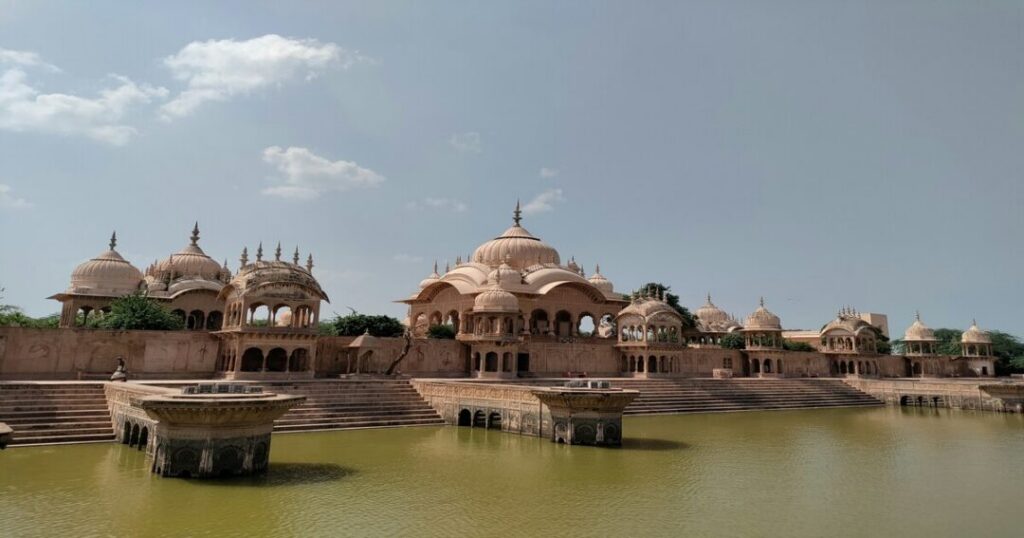
Mathura is the birthplace of Lord Krishna — one of the holiest cities in Hinduism and one of the Sapta Puri (seven sacred cities of India). The Krishna Janmabhoomi temple complex marks the traditional birthplace site and is the spiritual centre of the city. The ghats on the Yamuna at Mathura — particularly at dawn and dusk during aarti — are one of the most atmospheric experiences in Uttar Pradesh.
Vrindavan, 15 km from Mathura, is where Krishna spent his childhood — a town of over 5,000 temples whose density of religious sites is extraordinary. The Banke Bihari Temple, ISKCON temple, and the Prem Mandir (completed 2012, white marble, illuminated at night) are the most visited. Vrindavan’s old lanes — narrow, cow-populated, filled with flower sellers and the sound of bhajans — are one of north India’s most absorbing street-level experiences.
- Best visited in combination as a single day trip from Agra
- Holi in Mathura and Vrindavan (approximately March) is one of the most famous festival celebrations in India — the lathmar Holi at Barsana (near Mathura) is particularly extraordinary
- The Yamuna ghats at Mathura at dawn are the most atmospheric time to visit
Practical Tips for Agra
Taj Mahal — Avoiding the Crowds
- Arrive at gate opening (approximately 30 minutes before sunrise) — the first 90 minutes are dramatically less crowded than mid-morning
- Friday: The Taj Mahal is closed on Fridays — plan around this
- Full moon nights: The Taj Mahal opens for night viewing on the night of the full moon and the two nights before and after; tickets are strictly limited and must be booked in advance through the Archaeological Survey of India
- East Gate vs West Gate: The East Gate (nearest the Baby Taj) typically has shorter queues than the more famous South Gate
Photography
- Tripods are not permitted inside the Taj Mahal complex during daytime visits
- The Mehtab Bagh viewpoint across the river is the best photography location for the Taj Mahal at sunset — no crowds, no restrictions, perfect sightline
- The Agra Fort’s Musamman Burj offers the only elevated view of the Taj Mahal from inside another monument
Transport Within Agra
- Auto-rickshaws are the most practical way to move between monuments
- The Agra Metro (operational) connects some key points in the city
- Cycle rickshaws are common near the Taj Ganj area and genuinely pleasant for the flat stretch between the Taj Mahal and Agra Fort
- Do not accept “the Taj is closed today” from auto drivers — this is a common scam to divert tourists to shops; the Taj is only closed on Fridays
Conclusion about Things to do in Agra
The best things to do in Agra are not limited to the Taj Mahal — though the Taj Mahal alone would be worth the trip. The city that the Mughals built here, and the food culture that grew around it, deserve as much time as you can give them.
Quick guide to Agra sightseeing places:
- The big three: Taj Mahal (sunrise, 1632–1653), Agra Fort (UNESCO, 1565), Fatehpur Sikri (UNESCO, 1569–1585, 40 km)
- Hidden gems: Itimad-ud-Daulah/Baby Taj (1622–1628), Mehtab Bagh (sunset Taj view), Chini Ka Rauza (tile mosaic, unvisited), Akbar’s Tomb Sikandra (10 km)
- Food: Petha, bedai-aloo sabzi breakfast, Mughlai biryani and kebabs, dalmoth
- Day trips: Fatehpur Sikri (1 hour), Mathura/Vrindavan (1–1.5 hours)
- Practical: Arrive at Taj at gate opening; closed Fridays; full moon night viewing by advance booking; Mehtab Bagh for photography
Download the Explurger app to discover what travellers recommend in Agra beyond the standard circuit, find authentic street food spots, and log every monument and bowl of bedai on your trip.
The sun is already rising over the Yamuna. The marble is already turning pink. Get to the gate.
FAQs about Things to do in Agra
2. What are the Agra tourist attractions most visitors miss?
The most overlooked Agra tourist attractions: Mehtab Bagh (the Moonlight Garden directly opposite the Taj Mahal — sunset view of the monument from across the Yamuna, almost no tourists), Itimad-ud-Daulah/Baby Taj (the marble mausoleum that preceded the Taj's technique, far less crowded), Chini Ka Rauza (glazed tile mosaic mausoleum of Shah Jahan's court poet — almost completely unvisited), and Akbar's Tomb at Sikandra (10 km away, eclectic syncretic architecture, deer in the gardens).
3. What is the best time to visit Agra?
October to March is the best window — comfortable temperatures, clear skies, and the Taj Mahal at its most atmospheric in winter morning mist. November to February is peak season. For the Taj Mahal specifically, sunrise is the essential time — the marble changes colour in the first hour of light and crowds are thinnest. Avoid April to June (up to 45°C). The Taj Mahal is closed on Fridays.
4. Is Fatehpur Sikri worth visiting from Agra?
Absolutely — Fatehpur Sikri is one of the most remarkable UNESCO sites in India and only 40 km from Agra (~1 hour by road). Emperor Akbar built a complete imperial capital here between approximately 1569 and 1585, then abandoned it after 14 years — leaving the entire red sandstone city intact. The Buland Darwaza gateway (54 m tall) and the Dargah of Sheikh Salim Chishti are the centrepieces. It is one of the best day trips from Agra and genuinely among the finest Agra tourist sites on the extended circuit.
5. What is the best food to eat in Agra?
The essential Agra food experiences: petha (translucent ash gourd sweet, sold everywhere, the definitive Agra souvenir), bedai with aloo sabzi (the classic Agra breakfast — lentil-stuffed fried bread with spiced potato curry, from street stalls near Taj Ganj from 6 AM), Mughlai biryani and seekh kebabs (court cooking tradition, best in the Taj Ganj area restaurants), and dalmoth (spiced lentil-nut snack mix, widely available packaged as a take-home). Agra's food culture is one of the most distinctive of any Indian heritage city.