
488 Total Views
Every February, something happens to Chiang Mai that even regular visitors find difficult to describe: the city turns into a garden. Not metaphorically — literally. The streets fill with the scent of roses and jasmine. The parade route is lined with petals. Twenty-five floats built entirely from fresh flowers—orchids, chrysanthemums, Damask roses and dozens of other blooms move slowly through the ancient moat roads of the old city. The Miss Chiang Mai beauty pageant crowns its queen. Traditional Lanna dancers perform in costumes as vivid as the flowers themselves. And for three days, the city that is already called the “Rose of the North“ earns that name more fully than at any other point in the year.
The Chiang Mai Flower Festival has been running since 1977—making 2026 the 49th edition—and it is the only event in Thailand that features elaborately decorated floral floats. What began as a celebration of the city’s cool-season blooms has grown into one of the most photographed and most beloved festivals in Southeast Asia. This guide tells you everything you need to know about the Chiang Mai flower festival 2026: the dates, the parade, the flowers, the photo spots, and the city itself.
What Are the Key Facts About the Chiang Mai Flower Festival 2026?
| Detail | Information |
|---|---|
| Festival Name | 49th Chiang Mai Flower Festival |
| Theme 2026 | “Royal Blossoms Glorifying the Skies, Timeless Beauty of Nakhon Ping” |
| Dates | February 13–15, 2026 |
| Main Venue | Suan Buak Haad Park |
| Grand Flower Parade | February 14, 2026 (8:00–9:00 AM) |
| Parade Route | Nawarat Bridge → Thapae Gate → Suan Buak Haad Park |
| Flower Floats | Around 25 floral floats |
| Admission | Free entry |
| Opening Hours | Open until midnight |
| First Held | 1977 |
| Unique Feature | Thailand’s only festival with floral floats |
The Chiang Mai Flower Festival is one of Thailand’s most vibrant cultural celebrations, combining stunning floral artistry, lively parades, and rich local traditions. With free admission, breathtaking flower displays, and the country’s only floral float parade, the 2026 festival promises an unforgettable experience for travelers and flower enthusiasts alike.
The History of Chiang Mai: Why February and Why Flowers?
Chiang Mai’s relationship with flowers is not decorative — it is agricultural and climatic. The city sits in a valley at approximately 300 meters in northern Thailand, surrounded by mountains that rise to over 2,500 meters. The cool season (November to February) brings temperatures that drop to 10–15°C at night, creating the conditions for temperate flowers—roses, cherry blossoms, and chrysanthemums—to bloom alongside the tropical orchids and other highland species that grow in the hills above.
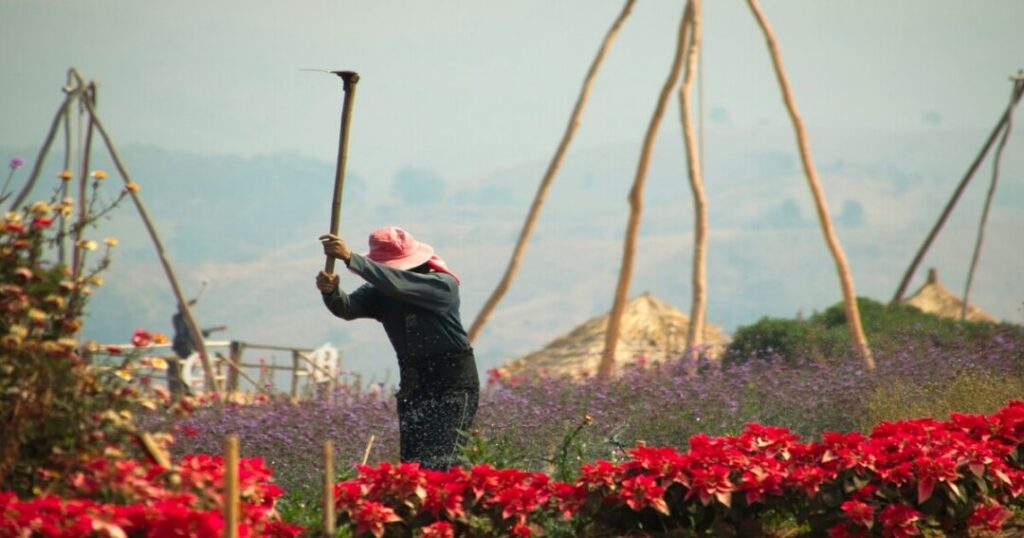
The villages and farms on the slopes of Doi Inthanon (Thailand’s highest peak at 2,565 meters), Doi Suthep, and the surrounding highlands have been cultivating flowers for both domestic use and export for decades. By February, the cool-season blooms reach their peak—and the Chiang Mai Flower Festival exists precisely to celebrate this, to honor the farmers and highland communities whose cultivation makes the spectacle possible, and to draw visitors during what would otherwise be the end of the tourist high season.
The festival was first held in 1977 as a small civic celebration and has grown steadily over nearly five decades into an international event drawing over a million visitors in its most attended years. The 2026 edition carries the theme “Royal Blossoms Glorifying the Skies: Timeless Beauty of Nakhon “Ping”—Nakhon Ping being the ancient name for Chiang Mai, referencing the Ping River that flows through the city.
Also read: Festivals in Mauritius: The Complete Guide to Cavadee, Divali, Chinese New Year & More
The Flowers of Chiang Mai — What’s in Bloom?
The Chiang Mai flower show draws its raw material from the extraordinary floral diversity of northern Thailand. The flowers that fill the festival floats and exhibition gardens include:
Damask roses are the most quintessentially Chiang Mai flower, grown in large quantities in the highland villages above the city. The Damask rose has been cultivated in the north for generations; its petals are used in rose water, cosmetics, and religious offerings as well as for decorating the festival floats.
Orchids—Thailand is one of the world’s largest orchid producers, and Chiang Mai’s highland farms grow Dendrobium, Vanda, and Mokara orchids in enormous quantities. The orchid sections of the festival floats are typically their most photographed element—hundreds of blooms in deep purples, whites, and yellows arranged into faces, animals, and abstract patterns.
Chrysanthemums—the yellow and white chrysanthemum is the backbone of most floats’ structural design; its small, densely petaled flower face tiles into flat surfaces and curved shapes that larger blooms cannot achieve.
Cherry blossoms (Prunus cerasoides)—the Thai wild Himalayan cherry, which blooms on the highlands around Doi Inthanon and Doi Ang Khang from late January to mid-February, is the most photographed cool-season flower in northern Thailand. While not typically used in the parade floats (they are too fragile), the cherry blossom season directly overlaps with the festival period, and Doi Ang Khang is a popular day trip during the festival weekend.
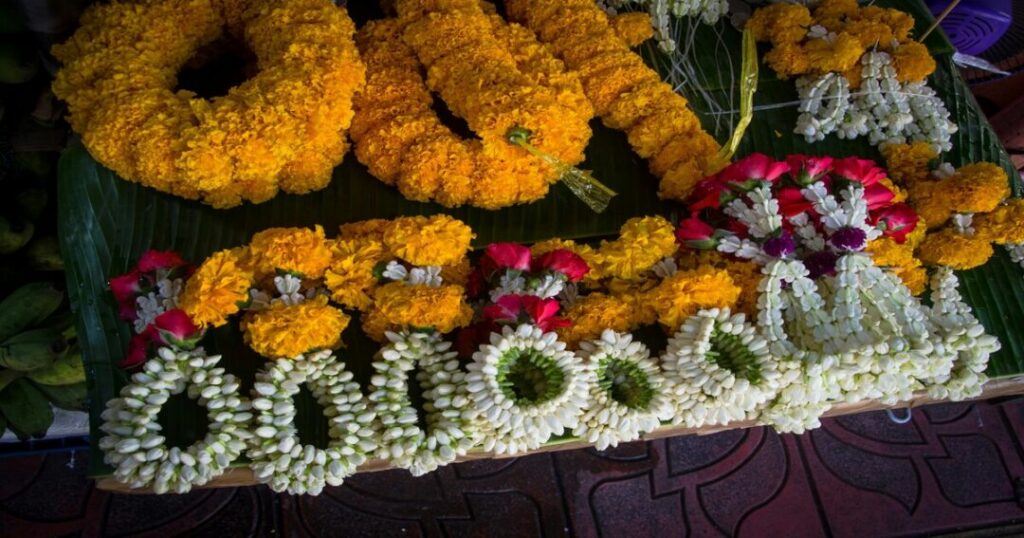
Marigolds, lotus, and jasmine are used in the floral installations and street decorations throughout the old city during the festival; the jasmine garlands (phuang malai) hung at every stall and entrance are a constant olfactory companion to the three festival days.
The Grand Flower Parade — The Heart of the Festival
The Grand Flower Parade is the moment the Chiang Mai Flower Festival builds toward—a slow, spectacular procession on the morning of Saturday, February 14, 2026, beginning at approximately 8:00 AM at Nawarat Bridge on the Ping River, moving through the city streets to Thapae Gate, and continuing to Suan Buak Haad Park.
The Floats
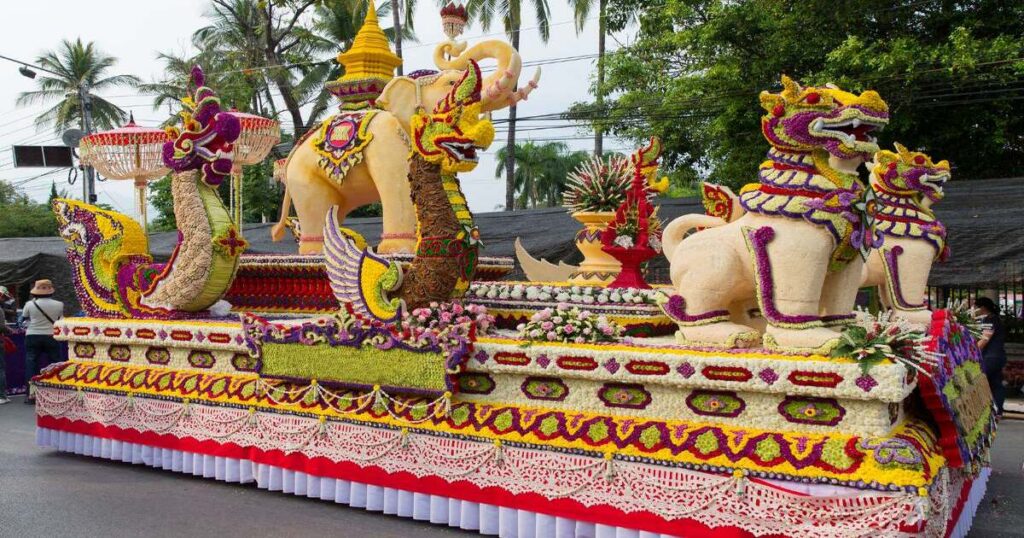
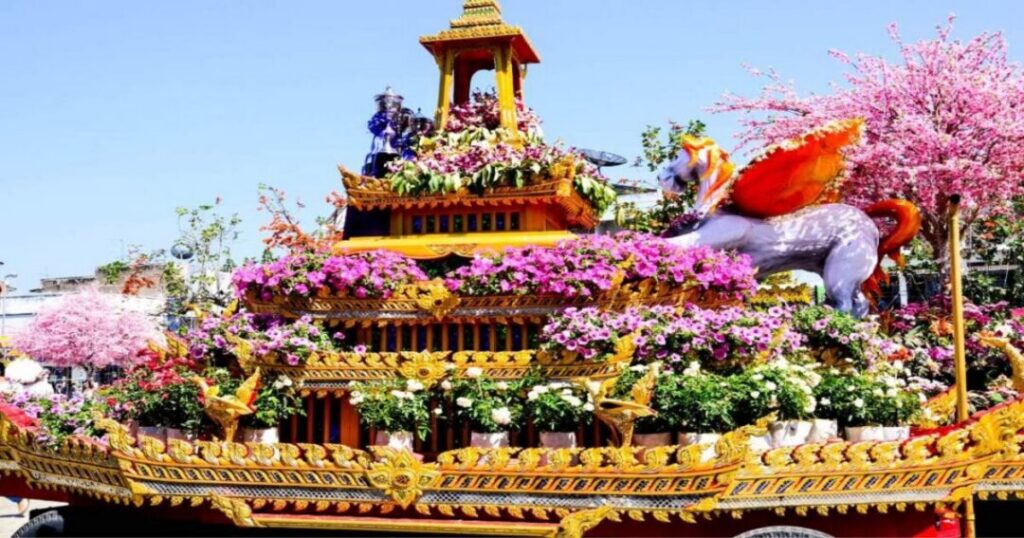
Approximately 25 floats move through the parade route, each built entirely from fresh flowers — thousands of blooms arranged by community groups, local schools, businesses, and artisans over weeks of preparation. The floats compete in their own annual competition, with prizes for the most creative, most technically accomplished, and most culturally significant designs.
Recurring themes include:
- Lanna cultural elements—the distinctive art and architecture of the ancient Lanna Kingdom (which ruled Chiang Mai from the 13th to 18th centuries), represented in carved gable designs, temple spires, and ceremonial objects rendered in flowers
- Buddhist iconography — lotus flowers, Dharma wheels, elephant figures, and scenes from Buddhist mythology built from fresh blooms
- Elephant floats—the elephant (chang) is northern Thailand’s most culturally significant animal; the elephant floats are typically the most elaborately decorated of the entire procession
- Royal tributes—flowers arranged in honour of the Thai royal family, a recurring element of the festival’s civic dimension
The Performers
Between the floats, the parade includes:
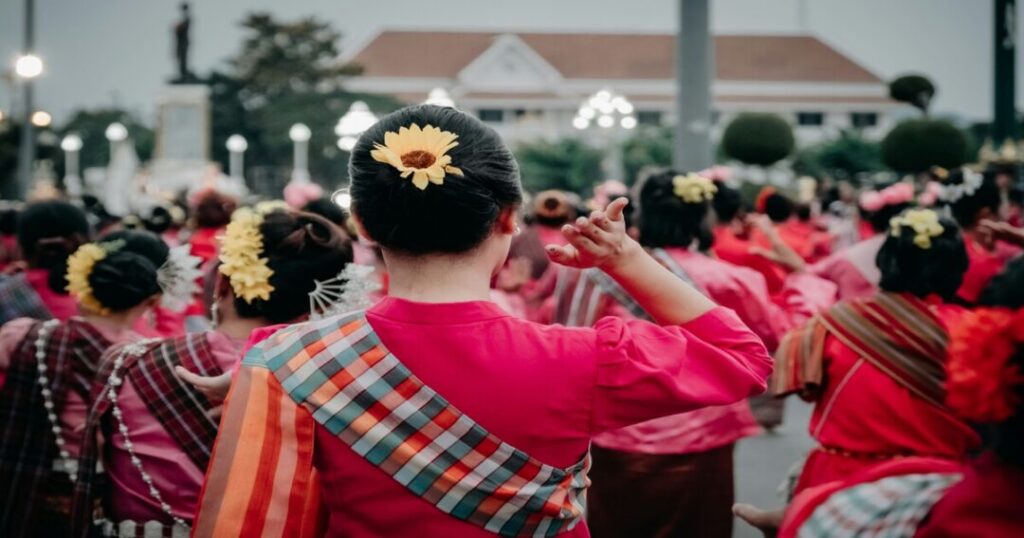
- Traditional Lanna dancers in full ceremonial costume—the fon lep (fingernail dance) and fon tian (candle dance) are the most recognisable forms, with dancers moving in slow, intricate patterns to live music
- Marching bands from Chiang Mai schools and universities
- Miss Chiang Mai Flower Festival and Miss International Flower Bloom—the beauty queens ride on dedicated floats, crowned the previous evening at the festival opening ceremony
- Highland community representatives — groups from the hill tribe communities of northern Thailand in traditional dress, representing the agricultural heritage that provides the festival’s flowers
Watching the Parade
The parade moves slowly—it regularly pauses—and takes approximately 3–4 hours to complete the route. Key viewing positions:
- Nawarat Bridge — the starting point; the floats are freshest and most intact here; best for close-up photography
- Thapae Gate area — the most iconic backdrop (the ancient gate of the old city), the most crowded, and the most photographed point on the route
- Suan Buak Haad Park entrance—the finishing section; the floats arrive here in sequence and the park area has the most space for viewing
Practical tips for the parade:
- Arrive at your chosen viewing spot by at least 7:00–7:30 AM—prime positions fill up quickly
- The road around the park (Arak Road/Bumrung Buri Road) is closed or severely congested; walk or cycle to the festival rather than taking a tuk-tuk or taxi
- The parade moves at the pace of a slow walk; you can watch from multiple positions along the route if you move between floats
Also read: Cayman Islands Festivals: A Complete Guide to the Best Annual Events
The Festival Grounds — Suan Buak Haad Park
Suan Buak Haad Park (also written Nong Buak Haad) is the festival’s permanent home—a public park at the southwest corner of the old city moat, transformed during the three festival days into an elaborate Chiang Mai flower show with:
Floral exhibitions and garden displays:
- Competition gardens entered by schools, community groups, and highland farms—judged for design, horticultural variety, and artistic merit
- Large-scale landscape installations using tens of thousands of blooms
- Individual flower species displays — orchid gardens, rose collections, chrysanthemum arrangements
Cultural performances:
- Lanna traditional music and dance on the main stage
- Traditional crafts demonstrations — northern Thai weaving, silverwork, and lacquerware
Miss Flower Bloom pageant:
- Held on the opening evening (Friday, February 13) — one of Thailand’s most regionally significant beauty contests, with contestants representing different districts of Chiang Mai province
Food and market stalls:
- Northern Thai street food, local produce from the highland farms, flower-derived products (rose water, jasmine oil, dried flower arrangements)
- The park grounds are open until midnight on all three festival days—the illuminated displays after dark are extraordinary and less crowded than daytime hours
The Royal Park Rajapruek — The Extended Floral Season
Running parallel to but distinct from the Chiang Mai flower festival, the Flora Festival at Royal Park Rajapruek extends the floral season from November 2025 through February 2026—a larger-scale botanical event at the royal park on the western edge of the city, themed “Bloom for the Future: Blossoms, Biodiversity & Breaths.” The Royal Park Rajapruek was developed for the 2006 International Horticultural Exposition and contains permanent gardens alongside seasonal exhibition areas.
- Open daily 8:00 AM – 6:00 PM; entry fee applies
- Separate from the annual Chiang Mai flower Festival—a different venue, different scale, and longer duration
- Worth combining with the festival for the full Chiang Mai floral season experience
Also read: Caribbean Festivals: The Complete Guide to Carnival, Caribana & the Best Celebrations
When is the Best Time to Visit?
When to Arrive
For the Chiang Mai Flower Festival 2026, the ideal arrival is Thursday, February 12—the day before the festival opens—when stalls are being set up, flowers are arriving from the farms, and the city is beginning its transformation. This gives you:
- The opening ceremony and Miss Chiang Mai pageant on Friday evening (February 13)
- The Grand Flower Parade on Saturday morning (February 14) — the centrepiece of the festival
- The full Saturday and Sunday festival grounds experience
Photography
The Chiang Mai flower displays offer exceptional photography opportunities:
- Best morning light for floats: The parade on Saturday morning from approximately 8:30–10:00 AM—the light is soft and the floats are fresh
- Best evening photography: The illuminated park displays from 8:00 PM onwards — the flower installations are lit from within and the crowds thin slightly
- Best location away from crowds: Nawarat Bridge at parade start, and the park’s inner garden areas in the early morning before 9 AM
Accommodation
Hotel prices in Chiang Mai spike significantly during festival weekend. Book accommodation at least 6–8 weeks in advance—the old city area (inside the moat), the Nimman Road neighborhood, and the Riverside area fill first. Airbnb-style accommodations in the Santitham and Nimmanhaemin districts are generally more available and within walking/cycling distance of the festival grounds.
Also read: Budapest Festivals: The Complete Guide to the Best Events in Hungary’s Capital
Getting Around During the Festival
- The parade route roads are closed on Saturday morning—plan your movement the night before
- Songthaew (shared red pickup trucks) and cycling are the most practical transport during festival days
- Walking is the most rewarding option within the old city area—the decorated streets, flower stalls, and neighbourhood atmosphere are best experienced on foot
Conclusion about the Chiang Mai Flower Festival
The Chiang Mai Flower Festival is the moment when northern Thailand’s cool season reaches its most vivid expression—and when Chiang Mai earns the name “Rose of the North” in the most literal and most beautiful way possible.
Quick guide to Chiang Mai flower festival 2026:
- Dates: February 13–15, 2026 (49th edition)
- Theme: “Royal Blossoms Glorifying the Skies, Timeless Beauty of Nakhon Ping”
- Venue: Suan Buak Haad Park (Nong Buak Haad), southwest corner of old city moat
- Grand Parade: Saturday February 14, ~8:00 AM, Nawarat Bridge → Thapae Gate → Park
- Floats: ~25, built from orchids, Damask roses, chrysanthemums
- Admission: Free; grounds open until midnight
- Arrive: Thursday February 12, for best hotel availability and setup atmosphere
- Best photo time: Parade morning (8:30–10:00 AM) or illuminated evening displays
Download the Explurger app to discover what other festival-goers recommend in Chiang Mai, find the best photo spots and street food beyond the main parade, and log every flower float and Lanna dance on your trip.
The floats are already being built. The roses are already being cut in the highland fields. Chiang Mai is getting ready.
FAQs about Chiang Mai Flower Festival
2. What is the Chiang Mai flower festival?
The Chiang Mai flower festival is an annual three-day celebration of northern Thailand's cool-season blooms, held each February in Chiang Mai. First held in 1977, it is now in its 49th year (2026) and is the only festival in Thailand featuring elaborate floral floats. The festival features approximately 25 floats built entirely from fresh flowers (orchids, chrysanthemums, and Damask roses); traditional Lanna dancers; the Miss Chiang Mai Flower Festival beauty pageant; flower exhibitions and competitions at Suan Buak Haad Park; and cultural performances. Chiang Mai is known as the "Rose of the North"—the festival celebrates the agricultural heritage of the highland flower-growing communities surrounding the city.
3. What flowers are at the Chiang Mai flower festival?
The Chiang Mai flower show features flowers grown in the highland farms of northern Thailand: Damask roses (grown extensively in highland villages above the city), orchids (Dendrobium, Vanda, and Mokara varieties—Thailand is one of the world's largest orchid producers), chrysanthemums (the structural backbone of most floats), marigolds, lotus, and jasmine. The Thai wild Himalayan cherry blossom (Prunus cerasoides) blooms on the highlands around Doi Ang Khang and Doi Inthanon at the same time—making the festival period the finest flowering season in all of northern Thailand.
4. Is the Chiang Mai flower festival free?
Yes, the Chiang Mai Flower Festival is entirely free to attend. There is no entry charge to the festival grounds at Suan Buak Haad Park, no charge to watch the Grand Flower Parade from the streets, and no ticket required for the cultural performances. The festival grounds remain open until midnight on all three days. The only costs are accommodation (book early — prices spike significantly), food and market stalls, and optional entry to the separate Royal Park Rajapruek (which has its own admission fee).
5. Where is the Chiang Mai flower festival held?
The main Chiang Mai flower festival venue is Suan Buak Haad Park (also written Nong Buak Haad Public Park)—located at the southwest corner of the old city moat, easily accessible on foot from the old city area. The Grand Flower Parade route runs from Nawarat Bridge (on the Ping River, east of the old city) through the city streets to Thapae Gate (the main eastern gate of the old city) and on to Suan Buak Haad Park.
6. What is the parade route for the 2026 Chiang Mai flower festival?
The Grand Flower Parade for the Chiang Mai Flower Festival 2026 takes place on Saturday, February 14, starting at approximately 8:00 AM. The route begins at Nawarat Bridge on the Ping River, moves through the city streets to Thapae Gate, and continues to Suan Buak Haad Park at the southwest corner of the old city moat. Approximately 25 flower floats participate, along with traditional Lanna dancers, marching bands, and cultural performers. The road around the park (Arak Road/Bumrung Buri Road) is closed during the parade.