
956 Total Views
There is a reason every serious trekker in Maharashtra has the Alang Madan Kulang trek on their list. The AMK — as it is universally called — is not just the toughest trek in Maharashtra. It is the one that filters out the unprepared and rewards the committed with something genuinely rare in the Western Ghats: three interconnected Maratha forts traversed across two days of rock climbing, rappelling, kilometre-long exposed ledge traverses, and some of the most dramatic fort ruins in the Sahyadri range.
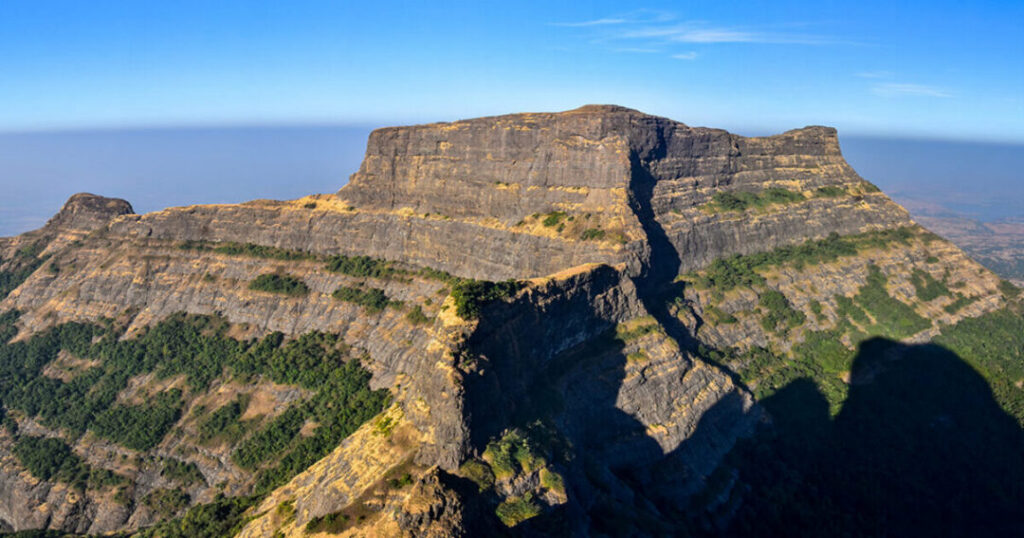
The three peaks — Alang (~4,852 ft / 1,479 m), Madan (~4,841 ft / 1,476 m), and Kulang (~4,850 ft / 1,478 m) — sit in a rough half-moon arrangement in the Kalsubai range of the Western Ghats, Nashik district. Together they form a triangular massif that has blocked countless expeditions and humbled many experienced trekkers. The combination of altitude, technical terrain, remote location, and overnight cave camping makes the AMK trek the benchmark against which every other Sahyadri trek is measured.
This guide covers the complete Alang Madan Kulang trek itinerary, how to reach from both Mumbai and Pune, what gear you need, and everything required for proper preparation.
AMK Trek — Key Facts
| Detail | Info |
| Alang height | ~4,852 ft (1,479 m) |
| Madan height | ~4,841 ft (1,476 m) |
| Kulang height | ~4,850 ft (1,478 m) |
| Location | Kalsubai range, Nashik district, Maharashtra |
| Difficulty | Extremely Difficult — the toughest trek in Maharashtra |
| Skills required | Rock climbing, rappelling, use of mountaineering gear |
| Duration | 2 nights, 2 days (standard) |
| Trek distance | ~18–22 km (total circuit) |
| Base village | Ambewadi / Ghoti area, Nashik district |
| From Mumbai | ~160 km via Kasara / ~3–4 hours by road |
| From Pune | ~150 km via Nashik Phata / ~3–3.5 hours by road |
| Best season | October to February |
| Suitable for | Experienced trekkers only — prior rock climbing experience mandatory |
What are The Three Forts — History and Significance?
The Alang Madan Kulang forts have a history that mirrors the entire arc of Maratha power in the Deccan. All three were significant strongholds in the Kalsubai range — strategically positioned to command the passes and valleys below. The forts changed hands multiple times — from the Marathas to the Mughals, back to the Marathas, and finally fell to the British in 1818.
Alang Fort (also known as Alangad) — located in the Kalsubai range of the Western Ghats, Nashik, regarded as one of the most difficult places to reach in the region. The fort’s walls, water cisterns, and ancient inscriptions are still partially intact. The ascent requires technical rock climbing on near-vertical rock faces.
Madan Fort (Madangad) — the central fort of the three, at approximately 4,841 ft, with steep rock faces on all sides. The traverse between Alang and Madan involves exposed ledge sections where trekkers move along narrow rock shelves with significant drops on one side. The caves of Madan are the standard overnight camp — stone-walled cave shelters used by trekkers for generations.
Kulang Fort (Kulangad) — the third and final fort, at approximately 4,850 ft, accessed on Day 2. The view from Kulang is one of the most rewarding in the entire Sahyadri — visible peaks include Kalsubai, Vikatgad, Vishramgad, Ratangad, Harishchandragad, Sandhan Valley, Ajobagad, Dangya Pinnacle, and Bhandardara.
The combination of dense forests, rocks and boulders, caves, water cisterns, and ancient writings on the walls of the rocks, as well as the views from the peak, make this one of the most spectacular treks in the Western Ghats.
How to Reach — AMK Trek from Mumbai?
Kasara is the primary access point for the AMK trek from Mumbai.
By train (recommended for Friday night departures):
- Board a late-night slow local from CSMT toward Kasara
- Approximate timings: CSMT ~10:50 PM → Dadar ~11:04 PM → Thane ~11:31 PM → Kalyan ~12:03 AM → Kasara ~1:18 AM
- From Kasara station, the base village is approximately 45–60 minutes by private vehicle (shared tempo or pre-arranged pickup)
By road:
- Mumbai → Nashik Highway (NH3/NH160) → Ghoti → base village
- Approximately 160 km, 3–4 hours depending on traffic
- Most organised groups driving from Mumbai depart on Friday evening at 9–10 PM
Key logistics note: Most Mumbai operators follow the overnight train route — departing CSMT Friday night, reaching base village by 3:30–4:30 AM Saturday, beginning the trek at first light. This maximises the weekend window. Check operator timings carefully before booking.
Also Read: Harishchandragad Trek: The Complete Guide to Maharashtra’s Most Dramatic Fort Trek
How to Reach — AMK Trek from Pune?
Pune trekkers typically depart by private vehicle toward Nashik.
By road:
- Pune (Shivajinagar/Swargate) → Nashik Phata → Nashik direction → Ghoti → base village
- Approximately 150 km, 3–3.5 hours
- Standard departure time for Pune groups: 10:00–10:30 PM Friday night, reaching base village by approximately 1:30–2:00 AM Saturday
By bus + connecting vehicle:
- Overnight bus from Pune to Nashik; from Nashik, pre-arranged pickup to the base village
- Less common than the private vehicle option for organised trek groups
Key logistics note: For Pune groups, departure from Shivajinagar area at approximately 10:00 PM allows arrival at the base village in time for a few hours of rest before the Saturday morning trek start. Coordinate pickup logistics carefully with your operator.
AMK Trek Itinerary — Full Day-by-Day
Standard 2-Night, 2-Day Itinerary
Night 0 / Day 1 (Friday Night): Mumbai/Pune → Base Village
- Depart Mumbai (Kasara train) or Pune (private vehicle) Friday night
- Reach base village (Ambewadi area) between 3:30–4:30 AM
- Brief rest; breakfast preparation; gear check and safety briefing
- Trek starts approximately 6:00–6:30 AM after warm-up
Day 1: Base Village → Alang Fort → Madan Fort (Overnight in Cave)
Total distance Day 1: ~10–11 km
Altitude gain: ~1,770 ft from base to Alang top
Total trek time: Approximately 10–12 hours
Stage 1: Base Village to Alang Fort Base (~2 hours)
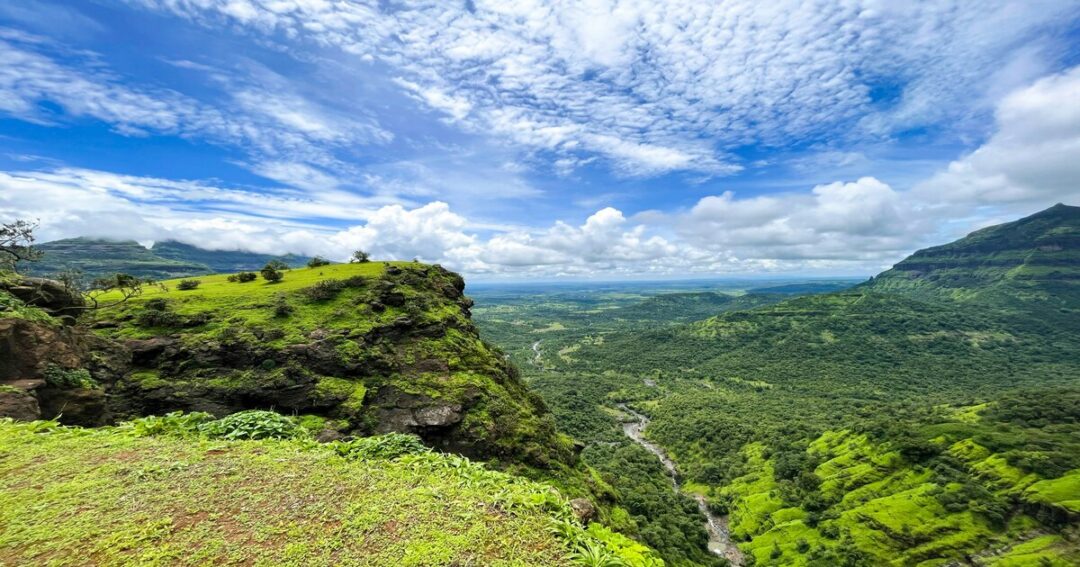
- The trail from the base village enters dense Sahyadri forest — the lower section is a straightforward forest climb through mixed vegetation
- The forest floor changes character as the trail gains altitude — from scrub to dense mixed forest with seasonal streams
- At the base of Alang’s rocky face, the technical section begins
Stage 2: Alang Rock Face Ascent — The First Technical Section (~2–3 hours)
- The AMK trek requires rock climbing, rappelling, and the use of mountaineering gear. The Alang ascent involves near-vertical rock sections where fixed ropes assist the climb
- Handholds and footholds are established but the exposure is significant — a full arm and leg commitment to the rock face is required
- The first ledge traverse appears approximately halfway up Alang — a narrow shelf of rock with the valley visible far below
- Reach Alang Fort top (~10:00–11:00 AM): The plateau at Alang’s top reveals the first fort ruins — cisterns, walls, carved stone. Rest, exploration, and lunch
Stage 3: Alang to Madan — The Ledge Traverse (~3–4 hours) This is the defining section of the entire Alang Madan Kulang trek — the traverse between the two forts.
The long ledge traverses at various points along the trail are a one-of-a-kind experience. When “long traverse” is used, it means parts that are more than a kilometre long. These parts are sure to have your heart pounding, with heavy rocks on one side and a 1,000-foot drop on the other.
The traverse descends partially from Alang, crosses a col, and then climbs toward Madan through another technical rock section. The exposure on the narrow ledges requires deliberate, calm movement — rushing is the most dangerous thing you can do here.
- Rock climbing section on Madan: The final approach to Madan’s top involves another technical rock face, shorter but equally steep as Alang’s
- Reach Madan Fort top (~5:00 PM): Panoramic views of the surrounding Sahyadri peaks; fort ruins and water cisterns to explore
- Overnight in the caves of Madan Fort (~6:30 PM onwards): The caves carved into the fort’s rock face have been used as overnight shelters by trekkers for decades. Cook dinner, rest, and sleep — the night sky from Madan’s exposed plateau is extraordinary
Day 2: Madan Fort → Kulang Fort → Descent to Base Village
Total distance Day 2: ~9–11 km Trek time: Approximately 8–10 hours
Stage 1: Madan to Kulang (~3–4 hours)
- The second day’s traverse from Madan to Kulang involves another exposed ridge section and technical climbing
- The terrain between the forts is the most remote section of the entire AMK — very few trekkers and no facilities
- Water refills from natural sources where available; carry sufficient reserves
At Kulang Fort top: The view from Kulang is spectacular — Kalsubai (highest peak in Maharashtra), Harihar Fort, Ratangad, Harishchandragad, Sandhan Valley, and the Bhandardara reservoir are all visible on a clear day.
The fort ruins at Kulang — cisterns, walls, and carved chambers — are the most intact of the three forts.
Stage 2: Kulang Descent to Base Village (~3–4 hours)
- The descent from Kulang follows a different trail from the ascent — a long, steep descent through forest to the base village
- The descent requires trekking poles and careful footwork — tired legs on steep terrain are the most common cause of slips
- Reach base village by approximately 3:00–5:00 PM
- Drive back to Mumbai (reach by 9:00–10:00 PM) or Pune (reach by 8:00–9:00 PM)
Also Read: Kalavantin Durg Trek: The Complete Guide to Maharashtra’s Most Thrilling Pinnacle
What is the Best Time for the AMK Trek?
| Season | Conditions | Recommended? |
| October to February | Cool temperatures, clear skies, dry rock (better grip), best visibility | ✅ Best overall — dry rock is safer for technical sections |
| March to May | Hot and humid; rock is dry but heat exhaustion risk on exposed sections | ⚠️ Manageable for experienced trekkers; carry extra water |
| June to September (Monsoon) | Wet rock — extremely dangerous for the technical sections; leeches; slippery ledges | ❌ Not recommended — the ledge traverses on wet rock are genuinely life-threatening |
| January to February | The single best window — cool, clear, lowest humidity, excellent views | ✅ Peak season for AMK |
The golden window: January–February — cool temperatures, completely dry rock for the technical sections, clear summit views, and comfortable cave camping temperatures.
Practical Tips — Gear, Fitness & Safety
Mandatory Gear
- Trekking shoes with excellent grip: Not trail runners — proper, stiff-soled trekking boots with aggressive grip; the rock faces and ledges demand sole-to-rock contact
- Harness: A sit harness is required for the rappelling sections — non-negotiable; do not attempt without one
- Gloves: Rock climbing gloves protect hands on the ascent and descent
- Helmet: For the rock climbing sections — mandatory
- Headlamp: For the pre-dawn start and cave movement
- Warm layers: Cave temperatures at night drop significantly, particularly in October–February
- Water: Carry 3–4 litres per person; refill opportunities are limited and unreliable
- Food: All food for the duration must be carried in — no shops, no stalls, nothing at any point on the trail
Fitness and Skills — The Non-Negotiable Requirements
The AMK trek is emphatically not suitable for beginners. The requirements are:
- Prior rock climbing experience — not gym climbing, but actual outdoor rock climbing with rope work
- Comfort with heights and exposure — the ledge traverses involve genuine drop exposure
- High endurance — 10–12 hours of active movement on Day 1, 8–10 on Day 2
- Mental composure under physical stress — the combination of exhaustion and technical sections demands clear thinking
Minimum recommended experience: At least 10–15 moderate Sahyadri treks before attempting AMK, plus at least one technical climb (Harihar, Kalavantin Durg, or equivalent).
Safety
- Never attempt without an experienced leader — a guide who knows the AMK route is not optional
- Fixed ropes: Most sections have fixed ropes installed by previous expeditions; always clip in with your harness before using them
- Weather check: Check the forecast before departure — wet rock or storm risk is a go/no-go decision, not a “we’ll see how it goes” situation
- Emergency: The AMK is remote — the nearest hospital is in Nashik (~70 km); ensure someone knows your itinerary and expected return time
AMK Trek Booking
Booking an organised AMK trek package from a reputable Sahyadri operator is strongly recommended — not primarily for the logistics but for the expert leader, the fixed rope knowledge, the cave camp arrangements, and the safety protocols. The AMK trek requires experienced professional guides; it is recommended only for experienced trekkers or those with professional guidance.
When evaluating operators for Alang Madan Kulang trek booking, look specifically for:
- Operators who require prior trekking experience from registrants
- Explicit mention of harness and helmet provision
- Maximum group size (smaller is safer on ledge traverses — 10–12 people maximum recommended)
- Leader-to-trekker ratio
Note: Costs vary by operator and season — verify current pricing directly with operators; all prices are subject to change.
Conclusion About Alang Madan Kulang Trek
The Alang Madan Kulang trek is Maharashtra’s answer to the question: what does the Sahyadri demand of someone who has done everything else? It demands two full days, technical skill, physical endurance, mental composure on exposed ledges, and the willingness to sleep in a cave at 4,800 feet with the next day’s climbing ahead of you. The reward — the half-moon shape of the three forts, the kilometre-long ledge traverses, the vertical rock sections, the view from Kulang — is proportional to every bit of that effort.
Quick recap:
- Three peaks: Alang (~4,852 ft), Madan (~4,841 ft), Kulang (~4,850 ft) — Kalsubai range, Nashik district
- Difficulty: Extremely difficult — Maharashtra’s toughest trek
- Skills: Rock climbing, rappelling, harness mandatory
- Duration: 2 nights, 2 days
- From Mumbai: Late-night Kasara train (~1:18 AM) + vehicle to base
- From Pune: Private vehicle via Nashik Phata (~10 PM departure, 3.5 hours)
- Best time: October–February; January–February is peak
- Overnight: Caves of Madan Fort — no facilities; carry all food and water
Download the Explurger app to log your AMK trek, discover what experienced Sahyadri trekkers recommend for current conditions, and plan your next Maharashtra adventure.
The rock faces are waiting. The caves are empty. The ledge stretches ahead for a kilometre. The AMK is ready when you are.
FAQs about Alang Madan Kulang Trek
2. How do I reach the Alang Madan Kulang trek from Mumbai?
For the AMK trek from Mumbai, the standard approach is by late-night local train to Kasara station (depart CSMT ~10:50 PM, reach Kasara ~1:18 AM), then private vehicle to the base village (~45–60 minutes). Alternatively, drive from Mumbai via the Nashik Highway (~160 km, 3–4 hours), departing Friday evening around 9–10 PM. Most organised groups use the Kasara train route for its reliability and cost efficiency.
3. How do I reach the Alang Madan Kulang trek from Pune?
How do I reach the Alang Madan Kulang trek from Pune? [PAA] For the AMK trek from Pune, the standard approach is by private vehicle departing Pune (Shivajinagar/Nashik Phata direction) at approximately 10:00 PM on Friday night, reaching the base village in approximately 3–3.5 hours (~150 km). Most Pune operators run organised packages that include this Friday night departure, Saturday and Sunday trekking, and Sunday night return to Pune. Bus to Nashik followed by a connecting vehicle is also possible but requires more coordination.
4. What peaks can you see from the AMK trek?
From the summits — particularly Kulang — the Alang Madan Kulang trek offers views of: Kalsubai (highest peak in Maharashtra), Harihar Fort, Vikatgad, Vishramgad, Ratangad, Harishchandragad, Sandhan Valley, Ajobagad, Dangya Pinnacle, and the Bhandardara reservoir. The panorama spans a significant portion of the northern Sahyadri range, making it one of the finest viewpoints in the entire Western Ghats.
5. When is the best time for the AMK trek?
The best time for the Alang Madan Kulang trek is October to February — cool temperatures, dry rock (critical for the technical sections), clear visibility, and comfortable overnight cave conditions. January–February is the single finest window. Monsoon (June–September) must be avoided entirely — wet rock on the ledge traverses and rock faces is extremely dangerous. The monsoon AMK is not a challenging experience; it is a dangerous one.
6. Is the AMK trek suitable for beginners?
No — the AMK trek is explicitly not suitable for beginners. It requires prior rock climbing experience, comfort with exposure and heights, high physical endurance for 2 full days, and the ability to use a harness and ropes safely. Minimum recommended background is 10–15 moderate Sahyadri treks plus at least one prior technical climb (Harihar Fort, Kalavantin Durg, or equivalent). Attempting AMK without this background or without an experienced guide is genuinely dangerous.