
496 Total Views
You promise yourself this trip will be different — you’ll write every night, sort every photo, remember every detail. Then day three arrives, you’re exhausted, and the journal stays closed. Months later, your camera roll is a blur of five hundred nearly-identical sunset shots with no story attached. Learning how to document your travel journey doesn’t have to mean forcing yourself into a habit that doesn’t fit your trip. It just means picking a system — or a mix of them — that works with how you actually travel.
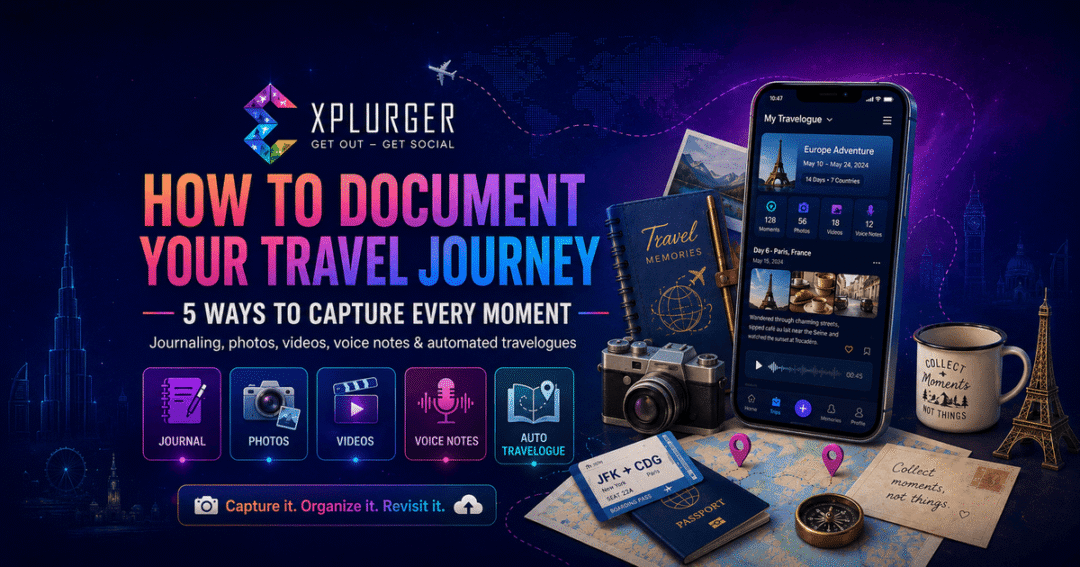
5 Ways to Capture Your Travel Journey in 2026
1. How to Document Your Travel Journey: Choosing Your Method
There’s no single “correct” way to preserve a trip. What matters is picking a method (or combination) you’ll actually keep up with:
- Writing-based: journals, notes apps, voice memos
- Visual: photos, short video clips, sketches
- Audio: voice notes, ambient sound recordings
- Automated: tools that quietly log where you are and what you’re doing, so the story builds itself
Most travelers do best mixing two or three of these rather than committing to just one.
2. Keep a Travel Journal Without Overthinking It
Journaling fails most often because people expect themselves to write like a novelist every night. Lower the bar and it sticks.
- Try a one-line-a-day format. A single sentence about the day’s best or strangest moment beats a blank page.
- Use voice-to-text on your phone. Talk through your day for two minutes while walking back to your hotel instead of sitting down to write.
- Focus on sensory details, not itineraries. What you did matters less than what it smelled like, sounded like, or how a stranger made you laugh — these are the details you’ll forget first.
Also Read: Best Apps for Travel Creators: 5 Tools You’ll Actually Use
3. Capture Better Travel Photos and Videos
You don’t need a professional camera to document a trip well — you need a habit.
- Shoot the in-between moments, not just landmarks: the food stall, the bus ticket, your friend mid-laugh.
- Record 10-second video clips daily. They capture movement and sound that photos can’t, and a week’s worth strung together becomes a mini highlight reel.
- Take one photo of yourself in every place. It’s the first thing most people forget, and the one they wish they had later.
Also Read: Top 5 Gamified Apps That Are Changing the Way We Live in 2026
4. Organize Memories As You Go, Not After
Sorting six thousand photos after a three-week trip is the single biggest reason travel documentation projects die.
- Back up daily to the cloud, even on slow hotel Wi-Fi overnight.
- Create a new folder per city or day instead of one giant dump you’ll never sort later.
- Geo-tag as you shoot so you’re not guessing “was this Lisbon or Porto?” six months from now.
5. Let Automated Tools Do the Heavy Lifting
If manual journaling and photo-sorting never stick no matter how many times you try, the honest fix isn’t more willpower — it’s a system that documents the trip for you in the background.
This is exactly what Explurge-ins are built for. Instead of stopping to write a paragraph, you drop a quick check-in — your location, a mood, a one-line thought — and move on with your day. It takes seconds, but over a two-week trip those small check-ins add up to a surprisingly complete record.
The real payoff comes afterward: Explurger’s automated travelogue feature takes those check-ins, along with your photos and notes, and stitches them into a finished trip story — organized by day and location, without you writing a single recap paragraph. It’s the closest thing to having kept a detailed journal, without ever having felt like you were keeping one.
Traveller Experience: Why First-Timers Stick With Documenting Their Trip
[QUOTE: first-time traveler describing how check-ins plus an automated travelogue helped them keep a “journal” without writing nightly — suggested source: app review or travel blogger testimonial]
Travelers who’ve tried both approaches often say the same thing: manual journaling produces the most personal writing, but automated check-ins are the only method they’ve actually finished a full trip with, start to end.
Turn Your Documentation Into a Keepsake After the Trip
Documenting a trip is only half the process — turning it into something you’ll actually revisit is what makes it worth doing.
- Print a photo book from your favorite shots within a month of returning, while the trip is still fresh enough to choose well.
- Share a private album with travel companions so everyone’s photos end up in one place, not scattered across four phones.
- Export your automated travelogue as a shareable recap — a ready-made way to send friends and family the story of the trip instead of three hundred unsorted photos.
Final Thoughts about 5 Ways to Document Your Travel Journey
There’s no single right way to preserve a trip — only the way you’ll actually keep up with:
- Write light: one line a day beats a blank page
- Shoot with intent: in-between moments over landmark repeats
- Organize daily: don’t leave sorting for “later”
- Automate what you can’t sustain manually: check-ins plus an auto-generated travelogue
However you choose to do it, how you document your travel journey matters less than simply doing it consistently enough that the trip doesn’t fade into a blur of unsorted photos.
Ready to document your next trip without the effort? Try Explurge-ins and let Explurger build your automated travelogue for you.
Pick one method from this list, try it on your next trip, and build from there — the goal is a record you’ll actually revisit, not a perfect system.
FAQs about How to Document Your Travel Journey
How do I keep a travel journal consistently?
Consistency comes from lowering the bar, not raising your discipline. A one-sentence-a-day entry or a two-minute voice memo recorded while walking is far easier to sustain than a full nightly writing session, especially after a long day of travel. Attaching the habit to something you already do daily, like charging your phone before bed, also makes it far more likely to stick for the full trip.
What should I write in a travel journal?
Focus on sensory details and small moments rather than a full itinerary recap, since dates and destinations are easy to reconstruct later but smells, sounds, and passing conversations are not. A useful format is one sentence on the best moment of the day, one on the hardest, and one specific detail you don't want to forget. This structure takes under two minutes but produces far richer entries than trying to summarize the whole day.
Should I use an app or a physical notebook to document travel?
Both work, and the right choice depends on how you personally engage with writing — physical notebooks tend to produce more reflective, personal entries, while apps make it easier to add photos, voice notes, and location data without carrying extra items. Many travelers find a hybrid approach works best: a small notebook for reflective writing and an app or automated tool for the day-to-day logistics and photos.
How do I document a trip without it feeling like a chore?
The chore feeling almost always comes from treating documentation as a separate task instead of building it into moments you're already living, like a quick check-in while waiting for coffee rather than a dedicated journaling session at night. Automated tools that log check-ins in seconds and assemble the story later remove most of the friction, since there's no blank page to face at the end of an exhausting day.
What is an automated travelogue?
An automated travelogue is a trip record generated from quick check-ins, photos, and notes you capture throughout a trip, rather than from paragraphs you sit down and write yourself. Tools like Explurger's automated travelogue feature organize these pieces by day and location into a finished story, giving you the end result of detailed journaling without requiring the daily writing habit that usually causes people to give up.
How do I organize travel photos after a trip?
The easiest approach is to organize by day or city in separate folders rather than dumping everything into one camera roll, and to do a first pass of deleting duplicates and near-identical shots before attempting any deeper sorting. Geo-tagging photos as you shoot, rather than after the fact, also saves significant time later since you won't need to guess which location or day each photo belongs to.